

UHMWPE vs HDPE is a common material comparison for engineers, equipment manufacturers, and industrial buyers. Both materials belong to the polyethylene family, but their molecular structure and performance characteristics make them suitable for very different applications.
In general, UHMWPE sheet is preferred for components exposed to continuous wear, impact, sliding, and friction. HDPE is usually selected for general-purpose structural parts, tanks, containers, fabricated components, and applications where easier welding and conventional processing are important.
This guide explains the seven most important differences between UHMWPE and HDPE, including wear resistance, impact strength, friction, stiffness, processing, cost, and typical industrial applications.
What Is the Difference Between UHMWPE and HDPE?
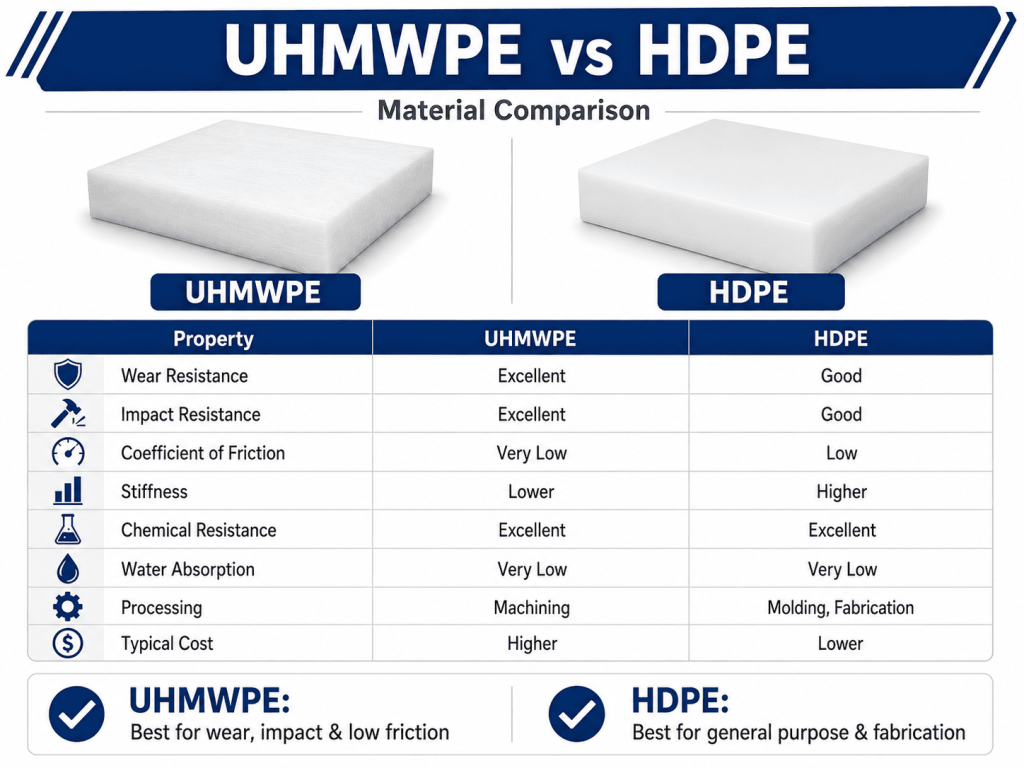
The main difference between UHMWPE and HDPE is the length of their molecular chains.
UHMWPE stands for Ultra High Molecular Weight Polyethylene. Its extremely long polymer chains create strong intermolecular interaction, giving the material excellent toughness, abrasion resistance, impact resistance, and sliding performance.
HDPE stands for High Density Polyethylene. It is also a durable and chemically resistant polyethylene, but it is generally easier to extrude, injection mold, blow mold, fabricate, and weld.
Both materials are lightweight and corrosion resistant, but they should not automatically be treated as interchangeable.
| Property | UHMWPE | HDPE |
|---|---|---|
| Wear Resistance | Excellent | Good |
| Impact Resistance | Excellent | Good |
| Coefficient of Friction | Very Low | Low |
| Stiffness | Lower | Higher |
| Conventional Welding | Limited | Good |
| CNC Machining | Excellent for Wear Parts | Good for General Parts |
| Typical Cost | Higher | Lower |
1. UHMWPE vs HDPE Wear Resistance
Wear resistance is one of the biggest differences in the UHMWPE vs HDPE comparison.
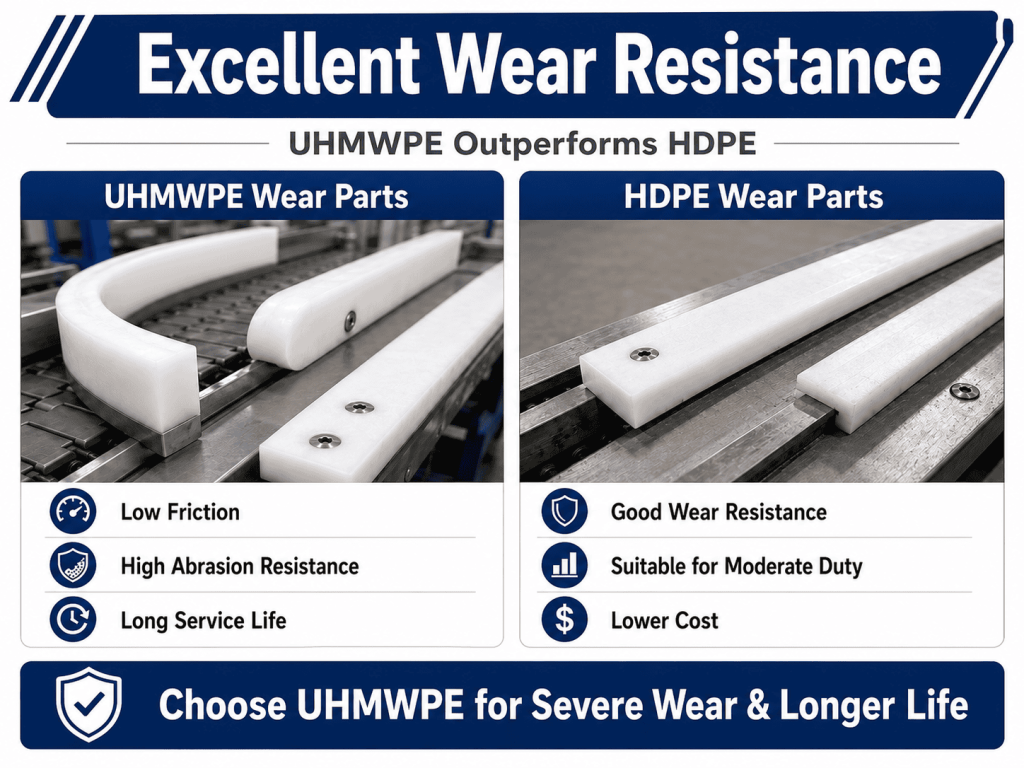
UHMWPE is commonly selected for components that experience repeated sliding, rubbing, material flow, or abrasive contact. Its molecular structure allows it to perform well in applications where ordinary plastics may wear too quickly.
Typical UHMWPE wear components include:
- Conveyor guide rails
- Wear strips
- Chain guides
- Chute liners
- Hopper liners
- Slide plates
- Star wheels
- Scraper components
- Wear blocks
HDPE also has useful wear resistance and can perform well in moderate-duty applications. However, when a component is exposed to continuous movement or abrasive contact, UHMWPE is usually the better material choice.
This is why equipment manufacturers often replace conventional HDPE parts with UHMWPE when longer wear life becomes the main requirement.
2. UHMWPE vs HDPE Impact Resistance
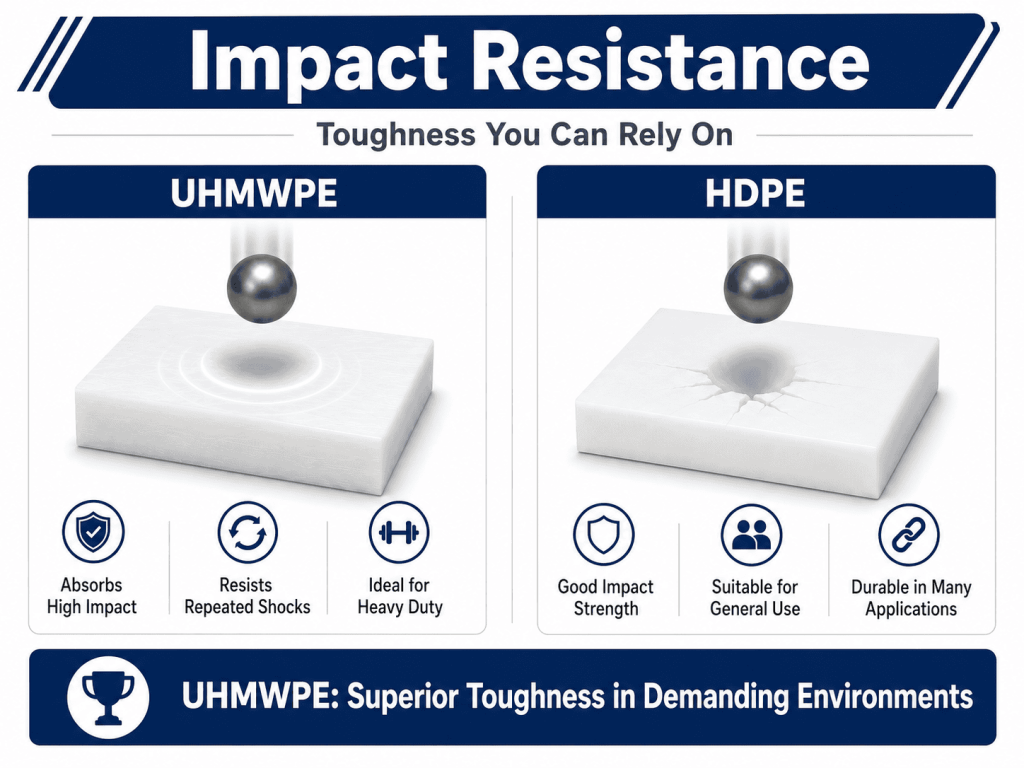
UHMWPE is known for outstanding toughness and impact resistance.
This makes it suitable for components that may experience repeated shocks, collisions, vibration, or sudden loads. Instead of behaving like a rigid and brittle material, UHMWPE can absorb considerable impact energy.
Common impact-related applications include:
- Equipment protection plates
- Impact blocks
- Machine guards
- Marine components
- Mining equipment liners
- Material handling parts
- Heavy-duty industrial pads
HDPE also offers good impact performance and is widely used for durable industrial products. However, for demanding applications where repeated impact and extreme toughness are critical, UHMWPE generally provides better performance.
3. UHMWPE vs HDPE Friction and Sliding Performance
Another important difference between UHMWPE and HDPE is friction.
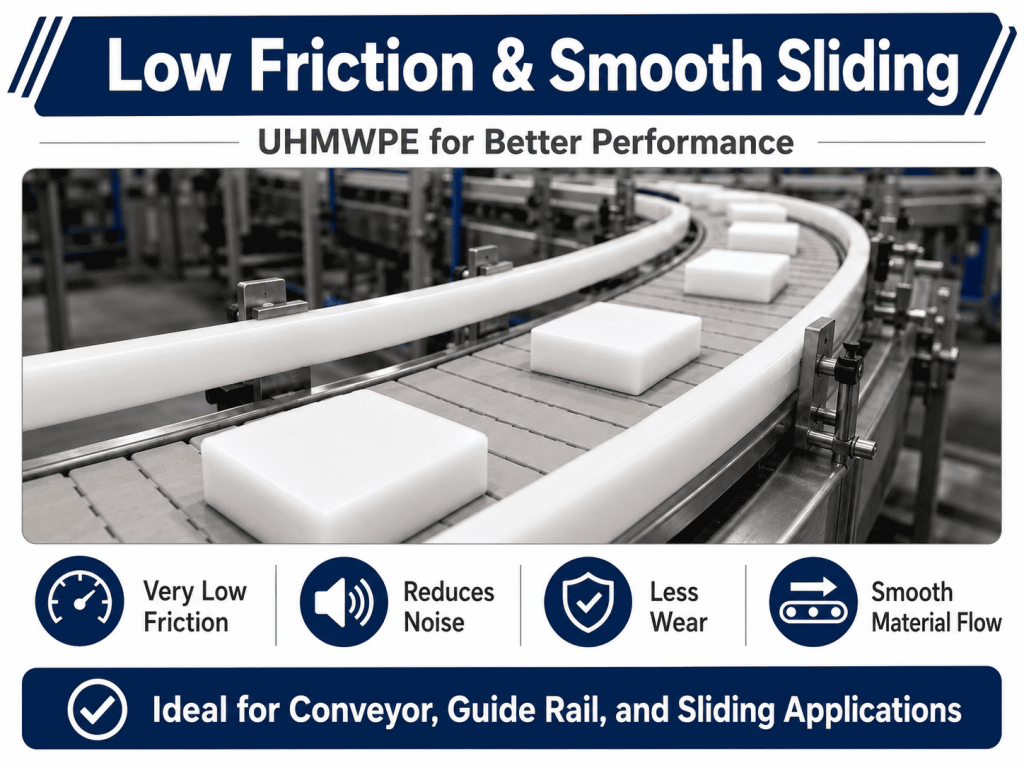
UHMWPE has excellent sliding properties and a very low coefficient of friction. This helps moving products, chains, packages, containers, and machine components slide more smoothly across the material surface.
For this reason, UHMWPE is widely used in:
- Conveyor systems
- Packaging machinery
- Food processing equipment
- Beverage production lines
- Automation equipment
- Industrial guide systems
A lower-friction surface can help reduce sticking, noise, wear, and the need for additional lubrication in suitable applications.
HDPE also provides a relatively smooth surface, but UHMWPE is normally preferred for continuous sliding contact and low-friction wear parts.
4. Which Material Is More Rigid: UHMWPE or HDPE?
UHMWPE is not better than HDPE in every property.
HDPE is generally more rigid than UHMWPE. This can make HDPE a better choice for some tanks, panels, containers, fabricated structures, and general industrial components where shape retention and structural stiffness are more important than extreme wear resistance.
UHMWPE is comparatively softer and more flexible. Its strength lies in toughness, wear resistance, impact performance, and sliding properties rather than high rigidity.
This difference is important when designing CNC machined plastic parts.
For example, a long UHMWPE guide rail may require careful consideration of:
- Mounting hole design
- Fastener spacing
- Thermal expansion
- Working clearance
- Continuous load
- Support structure
The correct material should therefore be selected according to the actual operating conditions rather than choosing UHMWPE simply because it is considered a higher-performance polyethylene.
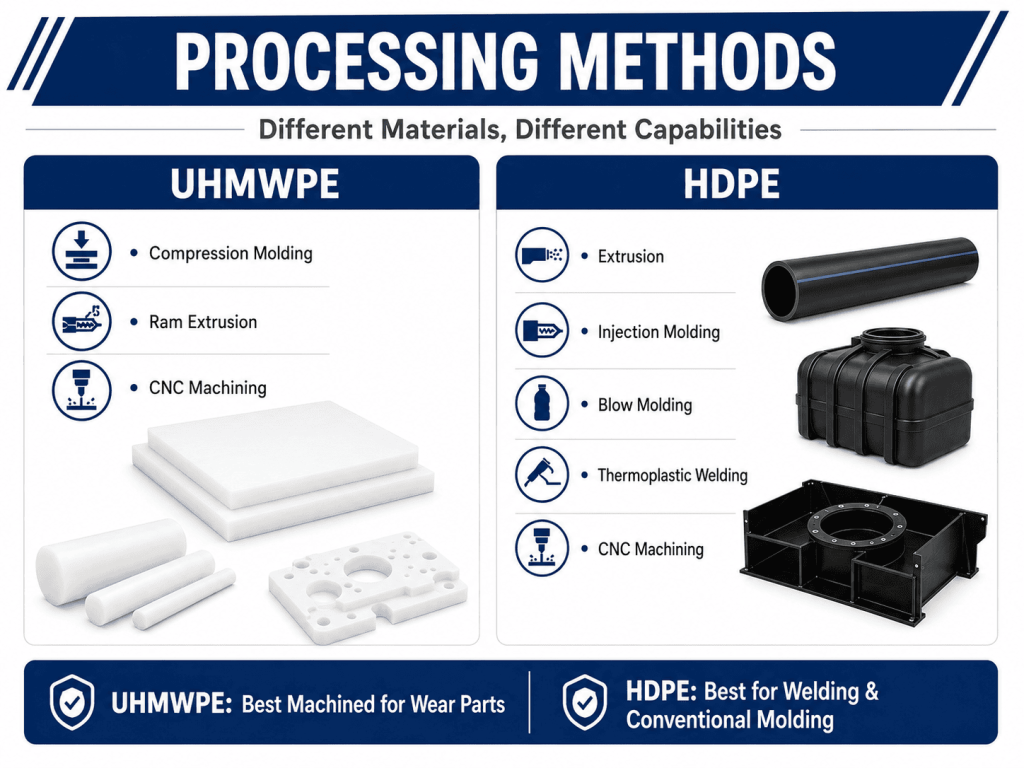
5. UHMWPE vs HDPE Processing Methods
The two materials are also processed differently.
How Is HDPE Processed?
HDPE is widely used in conventional plastic manufacturing processes, including:
- Extrusion
- Injection molding
- Blow molding
- Rotational molding
- Thermoplastic welding
- CNC machining
This processing flexibility makes HDPE suitable for tanks, containers, pipes, panels, fabricated structures, and general-purpose plastic components.
How Is UHMWPE Processed?
Because of its extremely high molecular weight and melt behavior, UHMWPE is commonly produced by compression molding or ram extrusion into sheets, plates, rods, and profiles.
Finished components can then be produced through CNC plastic machining, including:
- CNC milling
- CNC turning
- Drilling
- Slotting
- Boring
- Tapping
- Chamfering
- Contour machining
UHMWPE is particularly suitable for CNC machined wear parts, guide components, liners, sliding blocks, and complex industrial components manufactured according to technical drawings.
6. UHMWPE vs HDPE Cost and Service Life
HDPE is generally the more economical material.
For simple parts, general structural components, containers, and moderate-duty applications, using UHMWPE may add unnecessary material cost.
However, the purchase price of the raw material is only one part of the total cost.
For wear components, buyers should also consider:
- Replacement frequency
- Equipment downtime
- Maintenance labor
- Installation time
- Damage to mating components
- Production interruptions
A UHMWPE component may cost more initially, but its wear resistance and impact performance can provide better value in demanding applications.
On the other hand, HDPE remains the more practical choice when extreme wear resistance is unnecessary.
The correct question is not simply, “Which material is cheaper?”
The better question is, “Which material provides the lowest total operating cost for the actual working conditions?”
7. UHMWPE vs HDPE Applications
The final difference becomes clearer when comparing real industrial applications.
Common UHMWPE Applications
UHMWPE is often used for:
- Wear strips
- Conveyor guide rails
- Chain guides
- Chute and hopper liners
- Star wheels
- Sliding plates
- Wear blocks
- Machine guide components
- Marine fender facing pads
- Outrigger pads
- Custom CNC machined wear parts
Common HDPE Applications
HDPE is often used for:
- Chemical tanks
- Water tanks
- Containers
- Pipes
- Fabricated plastic structures
- General-purpose machine parts
- Cutting boards
- Outdoor plastic products
- Welded plastic assemblies
For smaller machined components and cylindrical parts, polyethylene PE rod can also be used as machining stock depending on the required material grade and operating conditions.
UHMWPE vs HDPE: Which Material Should You Choose?
Choose UHMWPE when the application requires:
- High abrasion resistance
- Repeated impact resistance
- Low-friction sliding
- Reduced sticking
- Wear components with longer service life
- Machined guide rails or wear strips
- Components for demanding material handling systems
Choose HDPE when the application requires:
- Lower material cost
- Greater rigidity
- Conventional thermoplastic welding
- General structural use
- Tanks or fabricated components
- High-volume conventional molding
- Moderate rather than extreme wear resistance
Neither material is universally better. The correct choice depends on friction, load, impact, temperature, chemical exposure, dimensions, mounting conditions, and expected service life.
Can HDPE Replace UHMWPE?
HDPE can replace UHMWPE in some light-duty or moderate-wear applications, especially when material cost and ease of fabrication are more important than maximum wear life.
However, replacement should be considered carefully for components exposed to continuous abrasion, sliding, impact, or high replacement frequency.
Changing from UHMWPE to HDPE without reviewing the operating conditions may result in faster wear and more frequent maintenance.
Can UHMWPE Replace HDPE?
UHMWPE can replace HDPE in some applications, but it is not always necessary or technically appropriate.
For a basic tank, welded assembly, or general structural component, HDPE may be easier to process and more economical.
UHMWPE should normally be selected when its specific advantages—wear resistance, impact toughness, or low friction—solve a real operating problem.
How to Select the Right Polyethylene Material for a Machined Part
Before selecting UHMWPE or HDPE, consider the following questions:
- Is the part exposed to continuous wear?
- Does another component slide against its surface?
- Will the part receive repeated impacts?
- Does the application require high rigidity?
- Will the component be welded?
- What is the operating temperature?
- Are chemicals or moisture present?
- What dimensional tolerances are required?
- How is the component mounted?
- How often is the current part replaced?
For custom machined parts, material selection should be reviewed together with the drawing and real service conditions. Hole positions, wall thickness, mounting method, thermal expansion, tolerance requirements, and batch consistency can all affect the final result.
UHMWPE vs HDPE Final Comparison
The UHMWPE vs HDPE decision depends on what the component needs to do.
UHMWPE is usually the better option for severe wear, repeated impact, low-friction sliding, guide rails, liners, and industrial wear components.
HDPE is generally the better option for economical general-purpose parts, tanks, fabricated structures, welded assemblies, and applications requiring greater rigidity.
For industrial components, the most reliable approach is to evaluate the material together with the actual load, friction, impact, temperature, chemical environment, dimensions, and expected service life.
Shandong Hongxi New Materials supplies engineering plastic materials and manufactures CNC machined plastic parts from drawings or samples. Available processes include cutting, milling, turning, drilling, slotting, boring, tapping, chamfering, and batch machining for industrial components.
For additional technical information, see the UHMWPE overview on Wikipedia.