

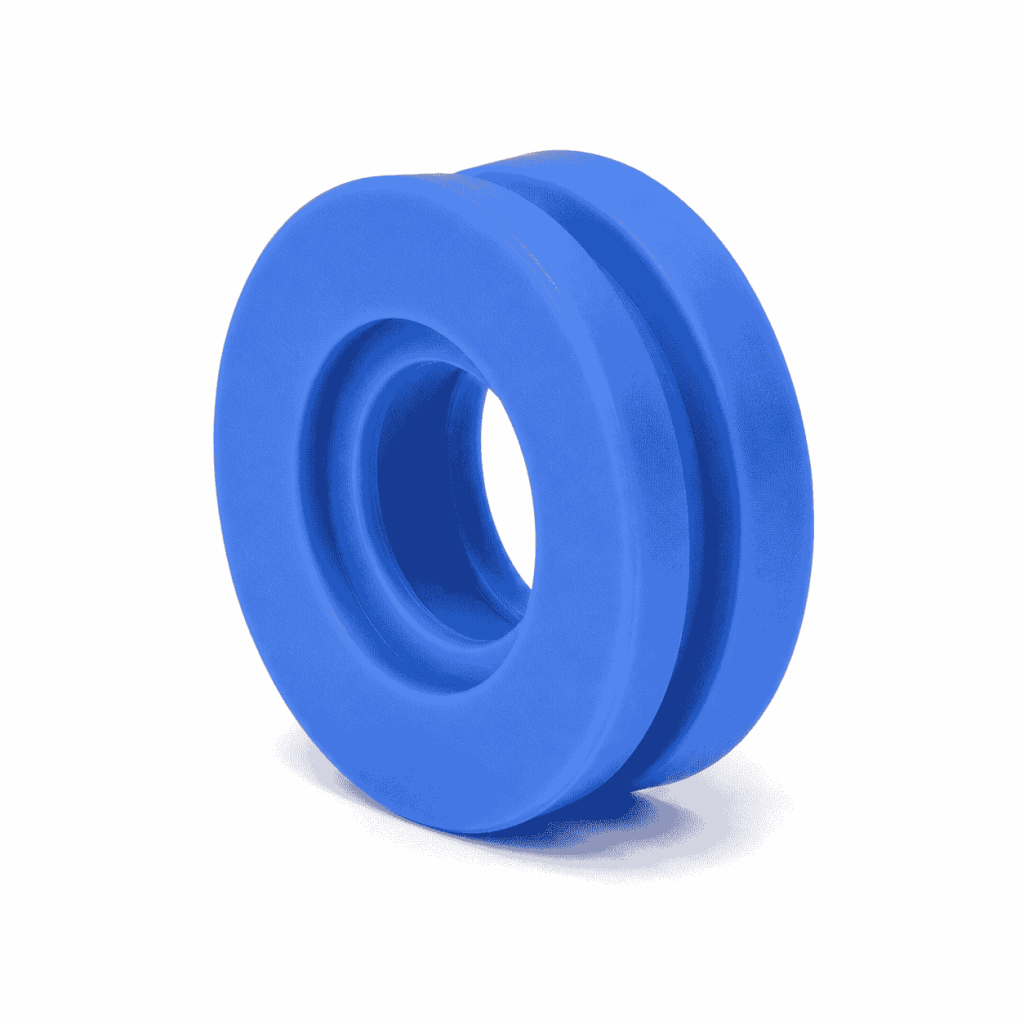
An MC Nylon Guide Pulley is used in mining hoisting equipment, conveyor tensioning systems, wire rope guiding mechanisms, mobile material-handling machinery, and bulk storage discharge equipment. Its main function is to support, redirect, or limit the movement of a wire rope while reducing direct contact between the rope and the steel machine structure.
Mining and bulk material handling equipment frequently operates in dusty, wet, vibrating, and impact-prone environments. When a wire rope repeatedly contacts a steel bracket, frame edge, or unsuitable metal guide, localized abrasion, vibration, operating noise, and irregular rope movement may occur.
MC nylon, also known as cast nylon or cast polyamide 6, combines wear resistance, mechanical damping, low sliding friction, impact resistance, and a lower density than steel. These characteristics make it suitable for many industrial pulleys, sheaves, rollers, bushings, and guiding components. General material information is available from the Ensinger cast nylon material guide.
What Does an MC Nylon Guide Pulley Do?
An MC Nylon Guide Pulley creates a controlled running path for a wire rope. Depending on the equipment structure, it may support the rope, change its direction, restrict lateral movement, or assist a tensioning mechanism.
Its main functions include:
- Guiding a wire rope along a defined operating path
- Changing the direction of wire rope movement
- Reducing lateral rope movement and oscillation
- Supporting auxiliary tensioning mechanisms
- Separating the wire rope from steel brackets and frame edges
- Reducing direct metal-to-metal contact
- Lowering vibration and operating noise in suitable applications
- Protecting shafts, mounting brackets, and adjacent machine parts
- Providing a replaceable pulley component for easier maintenance
An MC nylon pulley should not be selected only according to its outside diameter or appearance. The wire rope diameter, groove geometry, rope speed, wrap angle, radial load, shaft structure, bearing arrangement, operating temperature, and safety classification must all be reviewed before production.
MC Nylon Guide Pulley in Auxiliary Mining Hoisting Equipment
Mining hoisting systems are used to raise and lower ore containers, maintenance platforms, tools, equipment components, and other loads. Wire ropes may pass through several supporting or directional positions before entering a drum, tensioning mechanism, or lifting assembly.
An MC Nylon Guide Pulley can be installed in an auxiliary rope path to prevent the wire rope from rubbing directly against a steel frame or structural edge. The machined groove supports the rope and helps it enter the next mechanism at the required angle.
Typical auxiliary applications include:
- Material lifting devices
- Maintenance platform lifting mechanisms
- Auxiliary mine winches
- Equipment service hoists
- Rope take-up mechanisms
- Anti-swing guiding systems
- Tool and component handling equipment
The pulley groove must match the diameter and construction of the wire rope. A groove that is too narrow can compress the rope and increase localized contact stress. A groove that is too wide may allow excessive movement, uneven loading, or unstable rope tracking.
Detailed guidance concerning nylon sheave geometry, groove dimensions, hub design, bearing installation, and operating conditions is available in the Mitsubishi Chemical Group Rope Sheave Design Manual.
MC Nylon Guide Pulley in Belt Conveyor Tensioning Systems
Belt conveyors used for ore, coal, sand, gravel, limestone, and other bulk materials require a suitable tensioning system to maintain stable belt operation. Gravity take-up units, winch take-up systems, and mobile tensioning carriages may use wire ropes and guide pulleys.
An MC Nylon Guide Pulley can redirect the tensioning rope and help it move between the counterweight, tensioning carriage, winch, or supporting frame.
Common installation positions include:
- Gravity take-up wire rope guides
- Tensioning carriage rope pulleys
- Return-rope guiding positions
- Conveyor adjustment mechanisms
- Auxiliary belt-tracking systems
- Mobile tensioning frame assemblies
The pulley can reduce direct contact between the steel rope and the conveyor frame. The lower weight of the nylon wheel can also reduce the mass of some moving guide assemblies, provided that the selected structure meets the required load and safety conditions.
Dust protection should be considered around the shaft, bearing, and side-clearance positions. Fine mineral powder entering these areas may increase rotational resistance and accelerate wear.
Wire Rope Guidance in Stacker and Reclaimer Equipment
Stackers, reclaimers, ship loaders, and other bulk terminal machines use wire ropes in luffing, extension, positioning, and auxiliary lifting mechanisms. These machines often operate outdoors and may be exposed to rain, mineral dust, coal dust, salt spray, sunlight, and large temperature changes.
MC nylon guide pulleys can be considered for selected auxiliary rope-guiding positions, including:
- Boom luffing rope guidance
- Auxiliary winch systems
- Mobile frame positioning mechanisms
- Telescopic conveyor rope guides
- Anti-swing mechanisms
- Maintenance lifting systems
- Protective cover opening mechanisms
MC nylon does not rust in the same way as carbon steel, which can be useful in wet or outdoor equipment. However, the material grade must still be selected according to ultraviolet exposure, working temperature, moisture, mechanical load, and required service life.
Long-term outdoor installations may require a modified or stabilized nylon grade rather than standard natural cast nylon. The raw material supplier’s technical documentation should be reviewed before the final material is approved.
MC Nylon Guide Pulley in Mobile Crushing and Screening Equipment
Mobile crushers, screening plants, folding conveyors, and telescopic material-handling equipment frequently use wire ropes to adjust frames, fold conveyor sections, move platforms, or control protective structures.
The equipment is exposed to vibration, dust, repeated starting and stopping, and frequent changes in position. An MC Nylon Guide Pulley can support the rope at turning points and prevent it from rubbing against the steel machine frame.
Typical applications include:
- Folding conveyor mechanisms
- Telescopic conveyor adjustment systems
- Mobile crusher frame positioning
- Screening plant maintenance platforms
- Protective cover lifting devices
- Mobile support-frame rope guides
- Service access mechanisms
Because mobile equipment experiences repeated vibration, the pulley assembly should include reliable axial retention and anti-loosening measures. Depending on the structure, these may include shaft shoulders, retaining rings, locknuts, end plates, or secured bearing housings.
MC Nylon Guide Pulley in Hopper Gate Mechanisms
Ore bins, coal hoppers, aggregate silos, and bulk powder storage systems often use slide gates, flap gates, sector gates, or cable-operated discharge mechanisms.
Wire ropes may be used to open, close, balance, or synchronize the gate. MC nylon guide pulleys can redirect the rope around the hopper structure and help maintain a stable pulling direction.
Common applications include:
- Ore hopper discharge gates
- Coal bunker gate mechanisms
- Aggregate bin opening systems
- Wire rope-operated slide gates
- Double-sided synchronized gates
- Bulk material flow-control mechanisms
- Manual and powered winch systems
For installations handling fine powder, the pulley bracket should avoid unnecessary cavities where dust can accumulate. The groove, shaft, fasteners, and bearing positions should also remain accessible for routine inspection and cleaning.
MC Nylon Guide Pulley in Coal Handling Systems
Coal mines, coal preparation plants, power stations, storage yards, and port terminals commonly operate in environments containing coal dust, moisture, vibration, and continuous mechanical movement.
MC nylon guide pulleys may be used in auxiliary rope-guiding and tensioning mechanisms associated with:
- Coal conveyor take-up systems
- Coal bunker discharge gates
- Screening equipment access doors
- Coal-handling maintenance platforms
- Auxiliary lifting mechanisms
- Protective cover opening systems
- Rope take-up and return devices
Standard MC nylon should not automatically be used where antistatic, conductive, flame-retardant, or fire-safety performance is required. Coal-handling applications may have specific site requirements relating to combustible dust and electrical grounding.
Where special performance is required, the selected nylon grade must be supported by appropriate technical documents and approved as part of the complete equipment design.
MC Nylon Guide Pulley in Aggregate Processing Plants
Crushing, screening, washing, conveying, and stockpiling equipment in aggregate plants is exposed to mineral dust, vibration, moisture, and hard particles.
MC nylon guide pulleys are suitable for selected auxiliary mechanisms that do not receive direct high-energy impact from falling rocks.
Possible installation positions include:
- Conveyor tensioning systems
- Maintenance door rope guides
- Adjustable chute mechanisms
- Mobile platform pulling systems
- Telescopic conveyor return-rope systems
- Protective guard lifting devices
- Equipment positioning mechanisms
The pulley should not be installed directly in the material impact zone unless the complete structure has been specifically designed and verified for that load. Large falling rocks may require steel components, rubber impact systems, or reinforced composite structures.
Problems Addressed by an MC Nylon Guide Pulley
Direct Contact Between Wire Rope and Steel Structures
A wire rope sliding over a frame edge or fixed steel plate can experience concentrated contact and irregular wear. A properly positioned pulley provides a defined rolling path and keeps the rope away from unsuitable structural surfaces.
High Operating Noise
Steel wire rope contacting a metal guide can generate vibration and mechanical noise. The damping characteristics of cast nylon may reduce some of the harsh contact noise in suitable auxiliary mechanisms.
Corrosion of Metal Guide Components
Carbon steel guide wheels may corrode in wet, washed, or outdoor environments. MC nylon does not rust, although the shaft, bearing, fasteners, and metal hub still require suitable corrosion protection.
Excessive Weight in Moving Assemblies
Cast nylon has a lower density than steel. A nylon pulley may therefore reduce the weight and inertia of an auxiliary moving mechanism when its load capacity and structural design are suitable for the application.
Uncontrolled Rope Movement
A correctly positioned pulley can restrict lateral movement and guide the rope toward a drum, winch, tensioning unit, or gate mechanism.
Difficult Component Replacement
The pulley can be designed as a replaceable wheel, a wheel with a separate bushing, or an assembly containing bearings and a metal hub. This allows the worn component to be replaced without changing the complete support structure.
Advantages of MC Nylon for Guide Pulleys
Wear and Abrasion Resistance
Wire rope pulleys experience repeated rolling contact and limited sliding. Cast nylon offers useful wear and abrasion resistance for many industrial bearing, roller, pulley, and sheave applications.
Mechanical Damping
MC nylon can absorb part of the vibration produced during starting, stopping, rope tension changes, and direction reversal. This can reduce harsh mechanical contact in auxiliary guide mechanisms.
Lower Sliding Friction
The material has a relatively low coefficient of friction compared with many unlubricated metal-to-metal contact arrangements. This characteristic is useful where the rope may experience limited sliding in the groove.
Corrosion-Free Pulley Body
The nylon wheel body does not rust like carbon steel. This can be beneficial in wash plants, ports, outdoor conveyors, and humid mining environments.
Lower Component Weight
A nylon pulley is lighter than a steel pulley of similar dimensions. This can simplify installation and reduce the moving mass of some auxiliary mechanisms.
Machinability
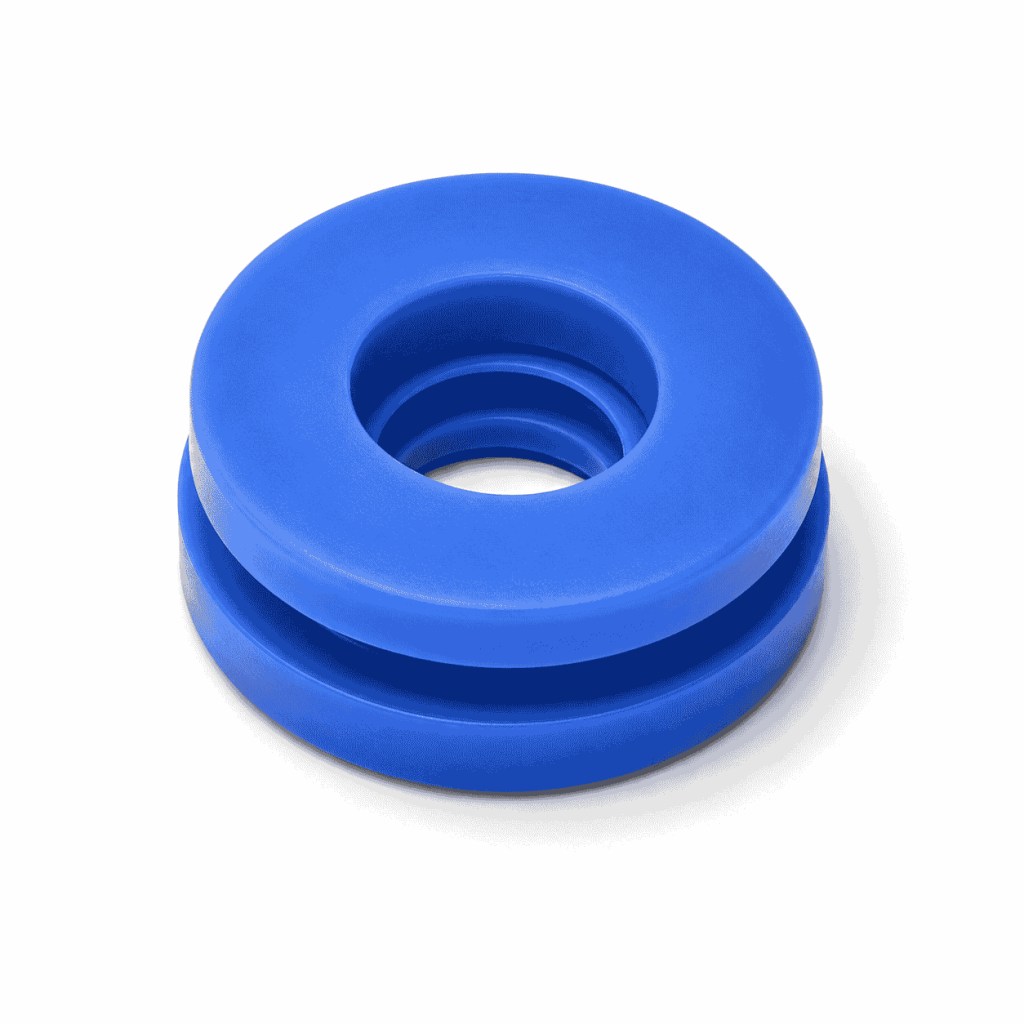
MC nylon can be machined into large-diameter pulleys, U-shaped grooves, V-shaped grooves, double grooves, stepped profiles, bearing seats, shaft holes, and metal-hub assemblies.
Examples of cast nylon materials developed for sheaves, pulleys, bushings, gears, and other wear components are available from Mitsubishi Chemical Group Advanced Materials.
Common MC Nylon Guide Pulley Structures
MC nylon guide pulleys can be manufactured in several configurations:
- Solid MC nylon guide pulley
- U-groove wire rope pulley
- V-groove nylon guide wheel
- Double-groove guide pulley
- Stepped nylon pulley
- Flanged rope guide wheel
- Nylon pulley with rolling bearings
- Nylon pulley with a metal bushing
- Nylon pulley with a steel or aluminum hub
- Split nylon rope sheave
- Custom multi-step guide pulley
- CNC-machined irregular pulley
A solid nylon pulley may be suitable for moderate loads and simple assemblies. Higher-load applications may use a metal bushing, rolling bearing, or metal hub to improve shaft support, dimensional control, and repeated installation performance.
Why Pulley Groove Geometry Matters
The groove is the primary contact area between the guide pulley and the wire rope. Incorrect groove dimensions can cause uneven rope loading, excessive movement, concentrated pressure, or accelerated wear.
A Groove That Is Too Narrow May Cause:
- Compression of the wire rope
- Concentrated contact pressure
- Increased running resistance
- Local damage to the rope surface
- Difficulty entering and leaving the groove
A Groove That Is Too Wide May Cause:
- Excessive lateral rope movement
- Uneven groove loading
- Irregular rope tracking
- Sidewall impact
- Increased risk of the rope leaving the intended path
The bottom of the groove should be smoothly machined without sharp edges, burrs, or deep tool marks. Groove radius, depth, flange thickness, rope wrap angle, and side clearance should be determined according to the rope and operating conditions.
Information Required for Custom Manufacturing
Before manufacturing an MC Nylon Guide Pulley for mining hoisting or bulk material handling equipment, the following information should be confirmed:
- Equipment type and installation position
- Function of the guide pulley
- Wire rope diameter
- Wire rope construction
- Pulley outside diameter
- Overall pulley width
- Groove width, depth, and radius
- Shaft-hole diameter and tolerance
- Required shaft and bearing structure
- Metal bushing or hub requirements
- Radial and axial loads
- Wire rope speed
- Pulley rotational speed
- Rope wrap angle
- Continuous or intermittent operation
- Minimum and maximum working temperature
- Environmental humidity
- Exposure to coal dust, mineral powder, water, oil, or chemicals
- Impact and vibration conditions
- Antistatic, conductive, UV-resistant, or flame-related requirements
- Drawings, old parts, or verified installation dimensions
When a complete drawing is unavailable, an existing pulley, rope specification, shaft diameter, installation width, bracket dimensions, and equipment operating conditions can be provided for dimensional confirmation.
Installation Considerations
Align the Pulley with the Wire Rope
The pulley groove should align with the incoming and outgoing rope direction. Excessive angular misalignment can cause one-sided groove wear and lateral friction on the rope.
Maintain Shaft and Bracket Alignment
The shaft, bearings, bushings, and mounting brackets should remain coaxial. Misalignment may increase rotational resistance and produce uneven loading on the pulley.
Provide Suitable Assembly Clearance
Cast nylon dimensions can be affected by temperature and moisture. Suitable shaft, bushing, bearing, and side clearances should be incorporated into the design.
Use Reliable Axial Retention
Retaining rings, shaft shoulders, locknuts, end plates, or flanges can be used to prevent axial pulley movement under lateral rope forces.
Protect Bearings and Shaft Interfaces
In dusty environments, the pulley assembly may require seals, covers, shields, or other structures to reduce mineral powder entering the rotating interfaces.
Inspect the Groove Regularly
Maintenance inspections should include the groove profile, pulley body, shaft clearance, bearing condition, fasteners, and axial retention components. Uneven wear, cracks, deformation, excessive clearance, or abnormal noise should be investigated.
Safety and Engineering Verification
An MC Nylon Guide Pulley is generally suitable for auxiliary guiding, tensioning, and directional mechanisms when its structure has been correctly designed.
It should not be used as a direct replacement for a primary load-bearing hoist sheave based only on matching external dimensions. Main mine hoists, personnel lifting systems, cranes, and other safety-critical equipment require professional calculations, material verification, appropriate safety factors, and compliance with applicable equipment standards.
Wire rope sheave requirements vary according to equipment type, rope construction, jurisdiction, and safety classification. As one regulatory example, California requirements for load-bearing wire rope sheaves specify groove and minimum diameter considerations for applicable hoisting equipment. The current text is available from the California Department of Industrial Relations.
The applicable national, regional, mining, lifting, and equipment-manufacturer requirements should always take priority over general product information.
Custom MC Nylon Guide Pulley Manufacturing
Mining hoisting and bulk material handling equipment uses many different wire rope diameters, shaft structures, bearing arrangements, and installation spaces. MC nylon guide pulleys are therefore commonly manufactured according to drawings, old parts, equipment dimensions, or verified rope specifications.
Available machining options include:
- CNC turning of the pulley outside diameter
- U-groove and V-groove machining
- Double-groove machining
- Bearing-seat machining
- Precision shaft-hole boring
- Metal bushing installation
- Steel or aluminum hub assembly
- Flange and stepped-profile machining
- Drilling and fastening features
- Small-batch and volume production
Important dimensions include the pulley outside diameter, groove radius, groove depth, flange thickness, shaft-hole tolerance, bearing fit, overall width, concentricity, and end-face parallelism.
In addition to MC nylon guide pulleys, engineering plastic components used in mining and bulk material handling equipment can include:
- MC nylon wire rope sheaves
- Nylon tensioning pulleys
- Nylon conveyor rollers
- Nylon guide wheels
- Nylon bushings
- Flanged nylon bushings
- POM guide rollers
- Conveyor tracking wheels
- Nylon wheels with bearings
- Nylon pulleys with metal hubs
- Custom engineering plastic motion components
Batch components with different outside diameters, groove structures, shaft holes, and installation positions can be manufactured separately according to approved drawings. Finished parts can be packed and labeled by specification, equipment number, or installation position to simplify site assembly and future maintenance.
Conclusion
An MC Nylon Guide Pulley can be used in auxiliary mining hoisting equipment, belt conveyor tensioning systems, stackers and reclaimers, mobile crushing equipment, hopper gates, coal-handling systems, and aggregate processing machinery.
The pulley supports, redirects, and limits wire rope movement while reducing direct contact with steel equipment structures. When correctly selected, it can also reduce component weight, corrosion-related problems, vibration, and operating noise in suitable auxiliary mechanisms.
The final pulley design must be based on wire rope diameter, groove geometry, rope speed, wrap angle, shaft structure, bearing arrangement, load, operating environment, and equipment safety classification. Accurate machining and professional engineering verification are essential for reliable operation.
Industry publications and technical guidance for conveyor and bulk material handling equipment are available from the Conveyor Equipment Manufacturers Association.