
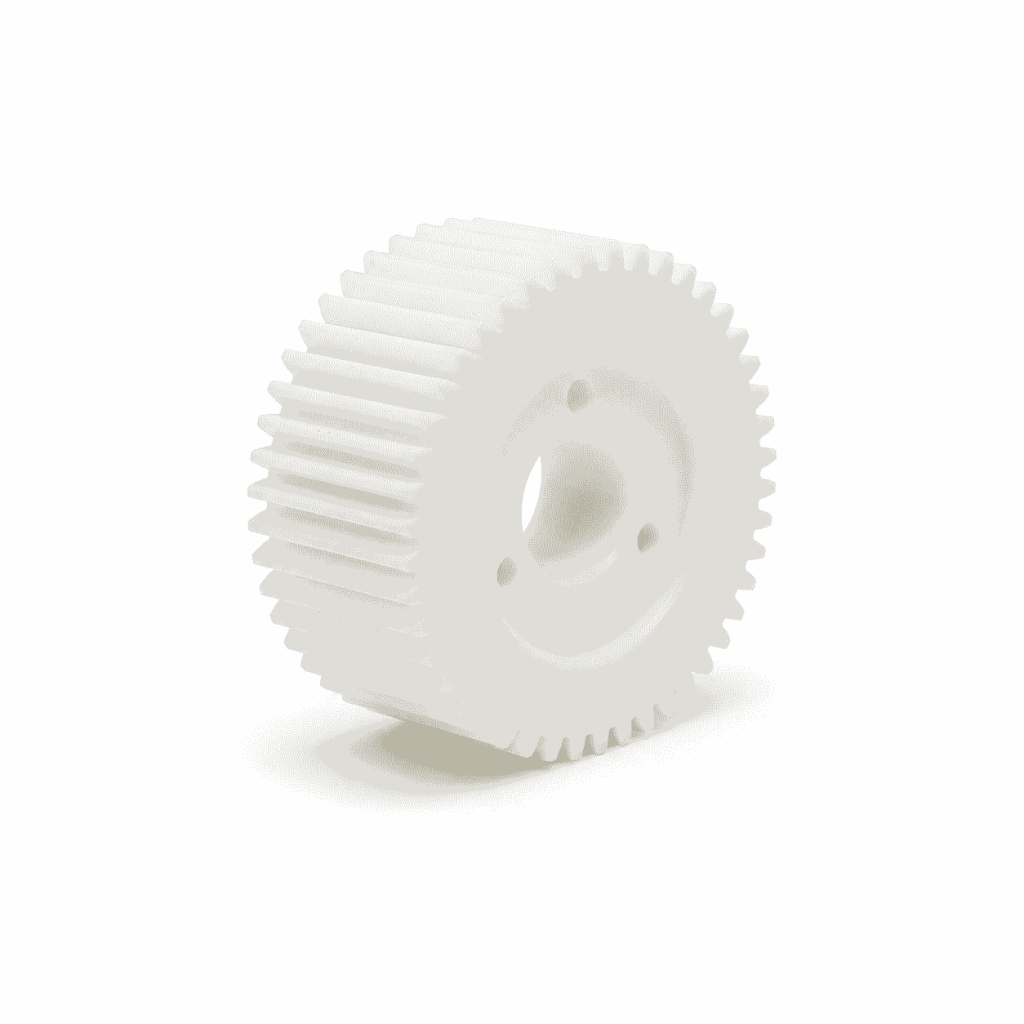
POM Gear components are widely used in pillow packaging machines, sealing machines, labeling machines, cartoning machines, filling systems, bottle-handling equipment, weighing machines, and automatic bagging lines. These gears transmit power, adjust speed, and coordinate feeding, film pulling, sealing, cutting, labeling, pushing, and conveying mechanisms.
Packaging machinery frequently operates for long production shifts and requires repeated starting, stopping, positioning, and speed changes. The dimensional accuracy, tooth profile, material stability, and engagement condition of each gear can directly affect packaging speed, sealing position, label accuracy, and production reliability.
POM, also known as polyoxymethylene, is an engineering thermoplastic with good dimensional stability, wear resistance, mechanical strength, and low-friction characteristics. These properties make a custom POM gear suitable for many medium- and light-load transmission positions in modern packaging equipment.
Common Transmission Problems in Packaging Machinery
Automatic packaging equipment contains multiple transmission mechanisms that must operate according to a precise production cycle. Conventional metal gears may create several problems when they are used in high-frequency auxiliary drives.
- High engagement noise caused by continuous metal-to-metal contact
- Noticeable vibration during frequent machine starts and stops
- High rotating weight that increases the load on motors and shafts
- Regular lubrication requirements around the gear teeth
- Dust, packaging fragments, and contaminants adhering to lubricated components
- Rust or corrosion in humid production environments
- Increasing backlash after long-term tooth wear
- Unstable film feeding, sealing, cutting, labeling, or product positioning
- Frequent maintenance caused by worn or damaged transmission components
These problems can result in film deviation, inconsistent package length, inaccurate sealing positions, label misalignment, unstable conveying cycles, and unexpected equipment downtime.
Why Use a POM Gear in Packaging Equipment?
A POM gear is lighter than a comparable steel gear. Its lower rotating mass helps reduce inertia and decreases the operating load placed on motors, shafts, and bearings. This advantage is useful in packaging mechanisms that repeatedly accelerate, stop, reverse, or perform intermittent movements.
POM also has a relatively low coefficient of friction and good wear resistance. Under suitable load and speed conditions, it can reduce transmission resistance and lower lubrication requirements. This helps keep the internal area of packaging equipment cleaner and simplifies routine maintenance.
Compared with many metal gear systems, POM gears generate less engagement noise. They are therefore suitable for labeling, cartoning, sealing, food packaging, pharmaceutical packaging, and other production environments where machine noise and cleanliness are important.
One of the main advantages of POM over many nylon materials is its relatively low moisture absorption. This helps maintain the bore diameter, tooth dimensions, gear thickness, and engagement clearance in production environments where humidity may vary.
General information about gear tooth engagement and power transmission is available in the Wikipedia gear reference.
POM Gear Applications in Packaging Machines
1. Pillow Packaging Machine Film-Pulling Mechanism
Pillow packaging machines continuously complete product feeding, film forming, longitudinal sealing, transverse sealing, and cutting. The film-pulling mechanism must maintain a consistent speed and accurate synchronization with the sealing and cutting units.
A custom POM gear can be used in film-pulling rollers, feeding rollers, timing mechanisms, and auxiliary drives. Its dimensional stability helps maintain a controlled gear clearance, reducing the risk of inconsistent package length, printed-film misalignment, or cutting-position errors.
The lightweight structure also reduces starting inertia, helping the film-feeding mechanism accelerate and stop more smoothly during intermittent packaging cycles.
2. Automatic Labeling Machine
Labeling machines require precise coordination between product conveying, label feeding, backing-paper movement, label peeling, and pressing mechanisms. Small transmission errors may cause crooked labels, missing labels, double labels, or inconsistent label positions.
POM gears can be machined according to the required module, number of teeth, pressure angle, bore diameter, keyway, hub, and step dimensions. Their stable bore and tooth geometry help maintain a consistent label-feeding speed.
Because POM gears operate with relatively low noise, they are also suitable for high-speed labeling systems containing several compact transmission groups.
3. Continuous Band Sealing Machine
Continuous sealing machines use conveyor belts, pressure wheels, heating blocks, and cooling mechanisms to seal filled packaging bags. Stable transmission speed is necessary to keep the bag inside the heating and pressing areas for a controlled period.
A POM gear can be installed in conveyor drives and auxiliary pressure-wheel mechanisms under suitable medium- or light-load conditions. Smooth gear engagement helps reduce vibration and maintains a consistent conveying speed.
This can reduce problems such as uneven sealing width, incomplete sealing, wrinkled bag openings, and inconsistent pressure.
4. Automatic Cartoning Machine
Cartoning machines contain carton-opening, product-pushing, flap-folding, closing, and discharge mechanisms. Many of these movements are intermittent and must remain synchronized with the main machine cycle.
Lightweight POM gears reduce the inertia of moving components and are suitable for auxiliary drives that frequently start and stop. Accurate tooth profiles and center bores also help maintain the timing between the pushing and carton-folding mechanisms.
POM compound gears, stepped gears, and gear-shaft components can be designed for compact cartoning machines with limited installation space.
5. Filling and Bottling Equipment
Filling lines include bottle feeding, bottle separation, positioning, filling, capping, and discharge processes. POM gears can be used in bottle-handling mechanisms, divider systems, star-wheel drives, and auxiliary conveying devices.
POM does not rust like ordinary carbon steel, making it suitable for equipment that is regularly cleaned or exposed to relatively humid environments. However, the cleaning chemicals, operating temperature, rotational speed, and transmission torque must be evaluated before material selection.
6. Automatic Bagging and Weighing Machines
Automatic bagging machines complete bag feeding, bag opening, clamping, weighing, filling, and sealing. The internal mechanisms operate frequently and are often installed in a compact space.
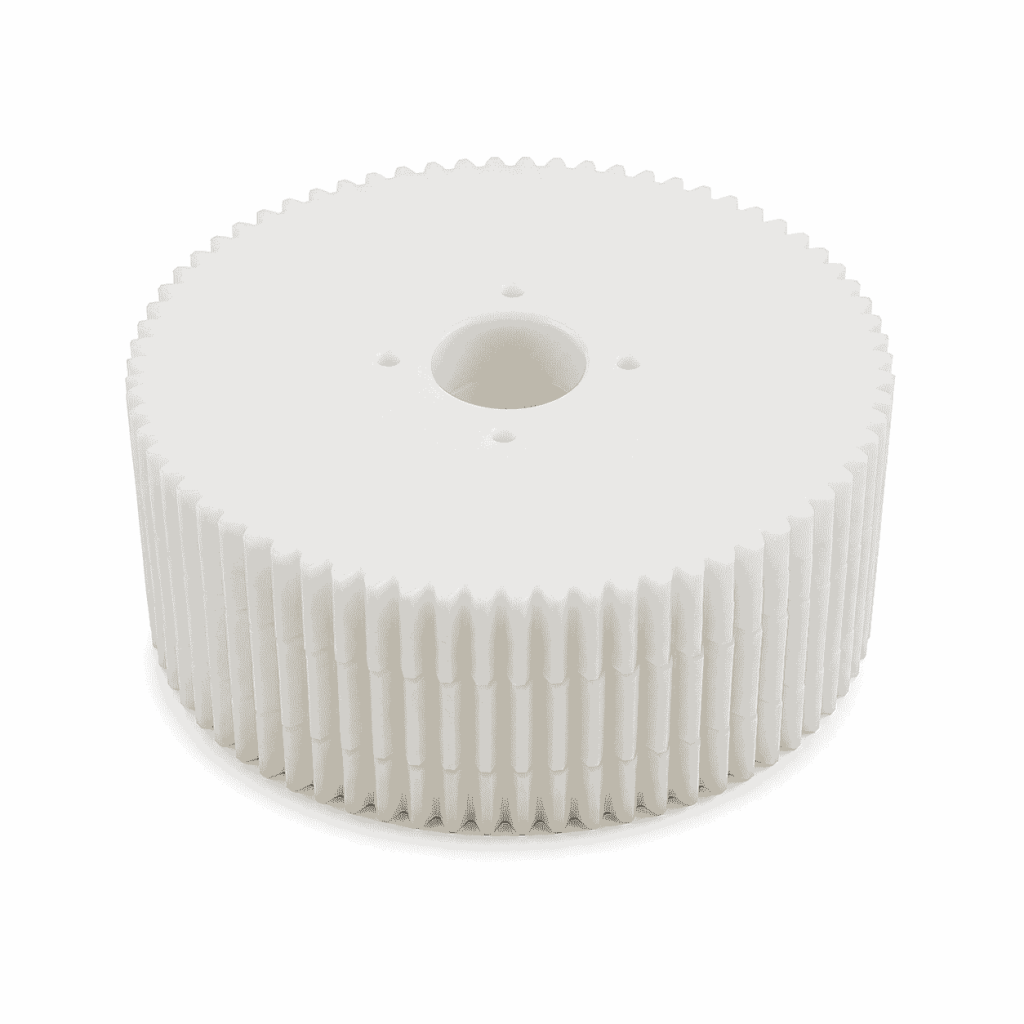
POM gears can be machined into thin gears, double gears, stepped gears, internal gears, or integrated gear-shaft structures. These custom designs help reduce transmission weight while meeting specific installation requirements.
Stable gear movement can improve the synchronization of bag handling and weighing operations, reducing bag-position errors and interruptions during filling.
7. Food Packaging Equipment
Food packaging machines usually require clean transmission systems and regular equipment maintenance. POM gears may be used in auxiliary drives where low noise, corrosion resistance, and reduced lubrication are required.
The exact POM grade must be selected according to the machine structure and applicable hygiene requirements. Components that may directly contact food require suitable food-contact material documentation and appropriate processing controls.
8. Pharmaceutical and Cosmetic Packaging Machines
Pharmaceutical and cosmetic packaging equipment often requires accurate movement, clean machine interiors, and reliable low-load transmission. POM gears can be used in counting machines, bottle-orienting devices, label feeders, carton pushers, and cap-handling mechanisms.
Their low moisture absorption and dimensional stability help maintain gear accuracy in controlled production environments.
Problems Solved by Custom POM Gears
When correctly designed for the operating conditions, POM gears can help packaging machinery manufacturers and maintenance teams address several common problems:
- Reduce noise generated by metal gear engagement
- Decrease vibration during frequent starts and stops
- Reduce transmission weight and rotating inertia
- Lower lubrication requirements in suitable mechanisms
- Prevent rust associated with ordinary metal components
- Maintain stable bore and tooth dimensions in humid environments
- Improve the synchronization of feeding and positioning mechanisms
- Reduce packaging-film, sealing, and labeling position errors
- Replace discontinued or non-standard machine parts
- Produce special bores, hubs, keyways, slots, and stepped structures
Common POM Gear Structures
POM gears used in packaging machinery are often manufactured according to equipment drawings, original components, or physical samples. They are not always available as standard stock parts.
Common structures include:
- POM spur gears
- POM helical gears
- POM compound gears
- POM timing gears
- POM internal gears
- POM gears with keyways
- Stepped POM gears
- Thin POM transmission gears
- Large-diameter POM gears
- POM gear-shaft components
- POM gears with metal bushings
- POM gears with metal hubs
- Special-shaped gears with mounting holes or positioning slots
Before manufacturing, it is necessary to confirm the gear module, number of teeth, pressure angle, outside diameter, root diameter, face width, bore diameter, keyway dimensions, hub structure, installation direction, and mating gear parameters.
For batch production, the tooth profile, bore diameter, thickness, concentricity, keyway position, and overall dimensions should be inspected to maintain consistent installation and engagement.
POM Gear vs. Nylon Gear
Both POM gears and nylon gears are used in packaging machinery, but their material characteristics are different.
POM generally provides lower moisture absorption, good surface hardness, and stable dimensions. It is often selected for gear positions requiring controlled bore dimensions, accurate tooth geometry, and consistent engagement clearance.
Nylon generally provides better toughness, impact absorption, and vibration damping. It may be more suitable for transmission positions exposed to moderate shock or impact loads.
The final material should be selected according to torque, rotational speed, temperature, humidity, gear size, allowable deformation, mating gear material, and required service life. The choice should not be based only on the appearance of the original component.
Technical Advantages of POM Gears
- Good dimensional stability
- Relatively low moisture absorption
- Low-friction operating surface
- Good wear resistance under suitable loads
- Lower operating noise than many metal gears
- Lightweight structure
- Good machining performance
- Resistance to rust
- Suitable for complex bores and stepped structures
- Suitable for small replacement orders and repeat batch production
Friction, wear, lubrication, and interacting surfaces are studied within the field of tribology. These factors should be considered when designing a POM gear for long-term packaging machine operation.
Important Limitations of POM Gears
POM gears are not suitable for every transmission mechanism. High-temperature, high-torque, severe-impact, or continuously overloaded main drives may require steel gears or a combined structure consisting of a POM gear ring and metal hub.
The following operating conditions should be evaluated before production:
- Continuous operating torque
- Maximum starting torque
- Rotational speed
- Start-stop frequency
- Working temperature
- Environmental humidity
- Required dimensional accuracy
- Mating gear material
- Center distance and backlash
- Lubrication conditions
- Expected service life
- Cleaning chemicals and maintenance methods
Even when the correct material is selected, incorrect center distance, excessive backlash, insufficient clearance, poor shaft alignment, or installation runout can cause abnormal noise, uneven wear, tooth damage, or transmission jamming.
Custom POM Gear Manufacturing
POM gears for packaging machinery can be manufactured from complete technical drawings, original parts, or physical samples. When the original gear is severely worn or deformed, its worn dimensions should not be copied directly.
The machine center distance, mating gear, original module, tooth number, pressure angle, and installation structure should be checked before producing a replacement component.
Useful information for manufacturing includes:
- Complete gear drawing or original sample
- Gear module and tooth number
- Pressure angle
- Outside diameter and face width
- Bore diameter and tolerance
- Keyway, slot, and mounting-hole dimensions
- Operating speed and torque
- Working temperature and humidity
- Mating gear material
- Required production quantity
- Equipment installation photographs
Other POM Components Used in Packaging Machinery
In addition to POM gears, packaging machines frequently use other CNC-machined engineering plastic components, including:
- POM rollers
- POM bushings
- POM guide wheels
- POM sliders
- POM positioning blocks
- POM spacer plates
- POM star wheels
- POM sprockets
- POM bearing supports
- POM timing components
- Custom POM transmission parts
Components with different dimensions, bore configurations, tooth structures, and installation requirements can be manufactured according to drawings, samples, and actual equipment operating conditions. Both small replacement orders and repeat batch production can be arranged.
Conclusion
POM gears provide a practical transmission solution for suitable sections of automatic packaging machinery. Their dimensional stability, low moisture absorption, wear resistance, low operating noise, and lightweight structure make them useful in film pulling, labeling, sealing, cartoning, filling, weighing, and auxiliary conveying mechanisms.
Reliable operation depends on correct gear parameters, material selection, load evaluation, dimensional control, and installation accuracy. A properly designed POM gear can reduce maintenance requirements, improve transmission stability, and support continuous packaging production.
Additional background information about packaging equipment is available from the Wikipedia packaging machinery reference.