

A CNC machined PTFE flanged bushing is widely used in chemical equipment where shafts, valve stems, mixing components, and mechanical connections are exposed to corrosive liquids, moisture, or chemically aggressive operating environments.
Conventional steel, bronze, and other metal bushings may corrode, seize, or become difficult to remove after prolonged contact with acids, alkalis, salt solutions, and chemical process fluids. A precisely machined PTFE flanged bushing provides a corrosion-resistant, low-friction, and electrically insulating alternative for many chemical processing applications.
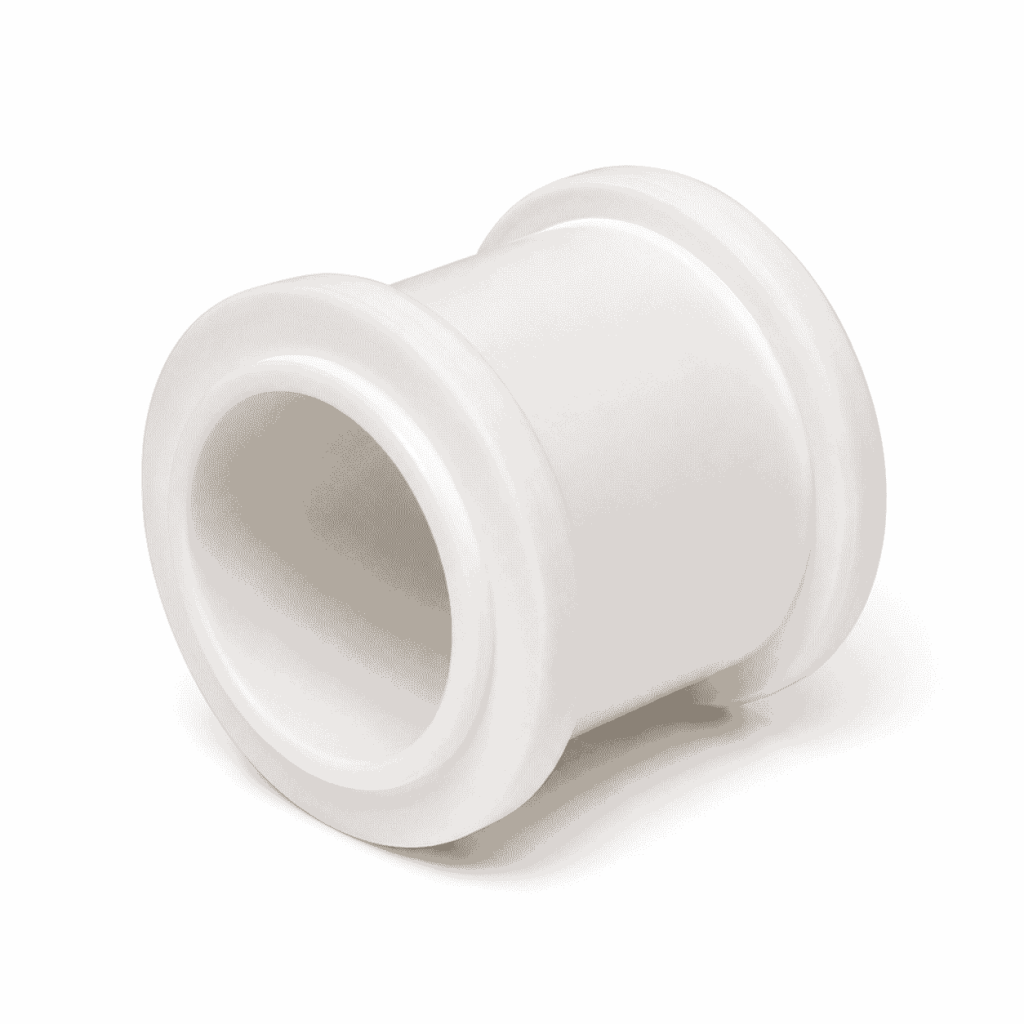
What Is a CNC Machined PTFE Flanged Bushing?
A CNC machined PTFE flanged bushing is manufactured from polytetrafluoroethylene , commonly known as PTFE.
The component normally consists of a cylindrical sleeve combined with an integrated flange. The sleeve supports, guides, or separates a shaft from the surrounding housing, while the flange controls axial movement and provides a larger installation surface.
The flanged structure helps prevent the bushing from moving deeper into the mounting hole or shifting during repeated shaft rotation and reciprocating motion. It can also simplify assembly and improve positioning within chemical processing equipment.
Applications of CNC Machined PTFE Flanged Bushings in Chemical Equipment
CNC machined PTFE flanged bushings can be produced for chemical pumps, reactors, valves, filtration systems, agitators, dosing equipment, and corrosive fluid transfer machinery.
1. Reactor and Agitator Shaft Support
In chemical reactors and mixing tanks, PTFE flanged bushings can be installed between the agitator shaft and the equipment support opening. The bushing guides the shaft while reducing direct metal-to-metal contact.
Its low-friction surface can help reduce running resistance, mechanical noise, and localised wear around the shaft support position. The flange also helps maintain the axial position of the bushing during continuous mixing operations.
2. Chemical Pump Shaft Bushings
Chemical pumps frequently handle corrosive or moisture-rich process fluids. A CNC machined PTFE flanged bushing can be used around pump shafts, guide shafts, or support points where conventional metallic components may be vulnerable to corrosion.
PTFE does not rust and requires little or no external lubrication in many low-load applications. This makes it useful where lubricating oil could contaminate the transported chemical medium.
3. Valve Stem Guide Bushings
PTFE flanged bushings are commonly used to guide valve stems in chemical control valves and corrosion-resistant pipeline systems. They can separate the moving valve stem from the metal valve body and reduce friction during opening and closing.
The material also helps isolate the metal structure from direct exposure to certain corrosive media. Actual material compatibility should always be confirmed according to the chemical concentration, temperature, pressure, and exposure time.
4. Acid and Alkali Transfer Equipment
In equipment used to transfer acids, alkalis, salt solutions, and other process liquids, PTFE flanged bushings can protect shafts and mounting holes from direct chemical contact.
They are often installed in guide mechanisms, rotating assemblies, dosing units, pipeline control devices, and auxiliary transmission components.
5. Chemical Filtration Systems
Filtration equipment may contain guide shafts, movable frames, pressure plates, and valve mechanisms that operate in wet or corrosive environments. CNC machined PTFE bushings provide separation between moving metal parts and the surrounding equipment structure.
Their low moisture absorption also helps maintain more stable performance than some materials that absorb water and change dimension during service.
7 Powerful Benefits of CNC Machined PTFE Flanged Bushings
1. Excellent Chemical Resistance
PTFE is selected for many chemical processing applications because it resists a broad range of corrosive substances. It can help prevent the rusting and chemical attack commonly experienced by unprotected metal bushings.
2. Low Coefficient of Friction
The naturally low-friction surface of PTFE reduces resistance between the bushing and the moving shaft. This characteristic is useful in rotating, sliding, and reciprocating mechanisms.
3. Self-Lubricating Performance
A PTFE flanged bushing can operate without frequent lubrication in many suitable applications. This reduces maintenance requirements and lowers the risk of lubricating oil entering the chemical process.
4. No Rust or Metal Corrosion
Unlike conventional carbon steel or bronze components, PTFE does not rust when exposed to water, humid air, or chemical liquids. This can make equipment disassembly and maintenance more convenient.
5. Electrical Insulation
PTFE provides strong electrical insulation. The bushing can electrically separate a shaft from its housing or prevent direct contact between different metallic components.
6. Low Water Absorption
The material absorbs very little moisture, helping the bushing maintain dimensional stability in wet processing environments.
7. Customisable Flange Structure
CNC machining allows the flange diameter, sleeve length, bore size, wall thickness, mounting holes, steps, grooves, and locating features to be produced according to the equipment design.
Problems Solved by PTFE Flanged Bushings
Using a CNC machined PTFE flanged bushing can help address several common problems found in chemical equipment.
- Corroded and seized metal bushings: PTFE does not rust and can reduce the risk of a bushing becoming difficult to remove after exposure to corrosive media.
- Excessive shaft and housing wear: The bushing separates the moving shaft from the mounting hole, reducing direct contact and protecting more expensive equipment components.
- Lubricant contamination: Low-friction PTFE may reduce or eliminate the need for external lubrication in appropriate low-load operating conditions.
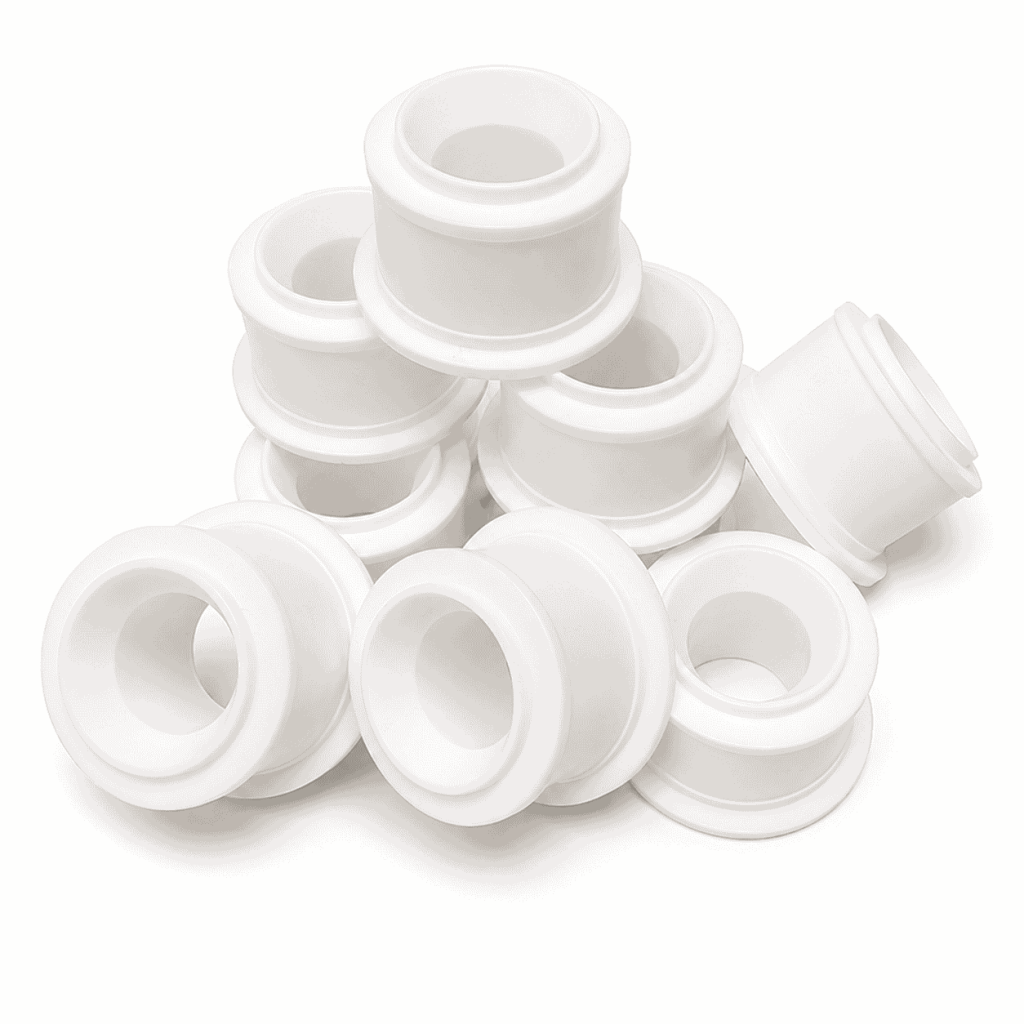
CNC Machining Requirements for PTFE Flanged Bushings
Chemical equipment bushings often need to match a specific shaft diameter, housing bore, installation depth, flange thickness, and axial position. CNC turning and milling allow these dimensions to be controlled according to drawings or physical samples.
Common machining features include:
- Precision inner and outer diameters
- Integrated locating flanges
- Stepped bores and counterbores
- Mounting holes and bolt patterns
- Lubrication grooves where required
- Chamfered installation edges
- Non-standard or asymmetric flange profiles
For batch production, the bore diameter, outside diameter, flange thickness, overall length, hole position, concentricity, and end-face dimensions should be inspected to maintain installation consistency.
Learn more about our PTFE sheet and engineering plastic materials for CNC machined chemical equipment components.
Important PTFE Design Considerations
Although PTFE provides excellent chemical resistance and low friction, it is softer than many engineering plastics and metals. It may experience creep, deformation, or cold flow under continuous mechanical loading.
When designing a CNC machined PTFE flanged bushing, the following operating conditions should be evaluated:
- Continuous and peak operating temperatures
- Chemical type and concentration
- Static and dynamic mechanical loads
- Shaft speed and reciprocating frequency
- Required installation clearance
- Wall thickness and flange dimensions
- Equipment pressure and maintenance cycle
For applications requiring increased wear resistance, compressive strength, or dimensional stability, filled or modified PTFE grades may be considered. The appropriate grade should be selected according to the actual chemical medium and mechanical operating conditions.
Custom CNC Machined PTFE Components
In addition to CNC machined PTFE flanged bushings, PTFE material can be processed into valve stem bushings, pump shaft sleeves, agitator guide sleeves, sealing rings, flange gaskets, wear plates, insulating spacers, scraper blades, and other corrosion-resistant components.
Parts can be manufactured according to complete technical drawings, dimensional data, or existing samples. Different bore sizes, flange diameters, wall thicknesses, hole patterns, and special structures can be produced for chemical processing, fluid handling, filtration, valve, and pump equipment.
Conclusion
A CNC machined PTFE flanged bushing provides corrosion resistance, low friction, electrical insulation, low moisture absorption, and reliable shaft separation in chemical equipment.
When correctly designed for the operating temperature, chemical medium, pressure, and mechanical load, it can reduce corrosion, shaft wear, lubrication requirements, and maintenance difficulties in reactors, pumps, valves, filtration systems, and chemical transfer machinery.