
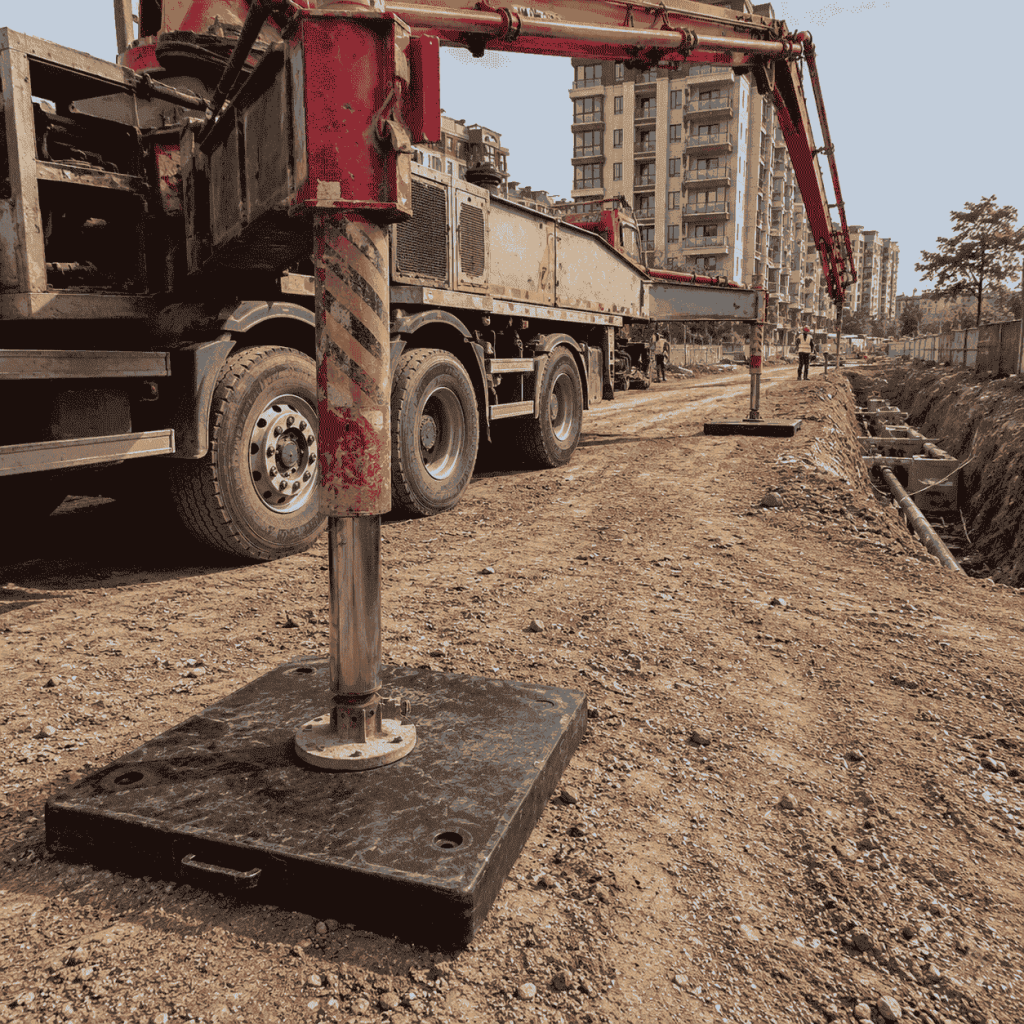
UHMWPE Outrigger Pads were used to support a concrete pump truck during a residential construction project. The working area had recently undergone underground pipeline installation and soil backfilling. Although the surface had been compacted, several sections still had soft soil, uneven bearing capacity and a risk of settlement under heavy equipment.
After entering the work area, the concrete pump truck needed to extend its hydraulic outriggers before pouring concrete for the foundation and main structural sections. During operation, the boom continuously rotated, extended and changed its working angle. These movements caused the equipment’s centre of gravity and the load on each outrigger to change throughout the pumping process.
Ground Support Problems at the Project Site
If the hydraulic outrigger feet were placed directly on the backfilled soil, their relatively small metal bases would create high concentrated ground pressure. As the boom extended and rotated, the soft soil beneath the support points could settle unevenly, causing the truck to tilt, move or become unstable.
Some support positions were located close to underground trenches and utility lines. The internal soil structure in these areas was not completely uniform. Even where the surface appeared level, insufficient compaction beneath the ground could still result in local settlement under heavy loads.
Uneven settlement would not only reduce pumping efficiency but could also increase the risk of equipment movement during concrete placement. The project therefore required a support solution that could spread the outrigger load across a larger surface area.
How UHMWPE Outrigger Pads Supported the Pump Truck
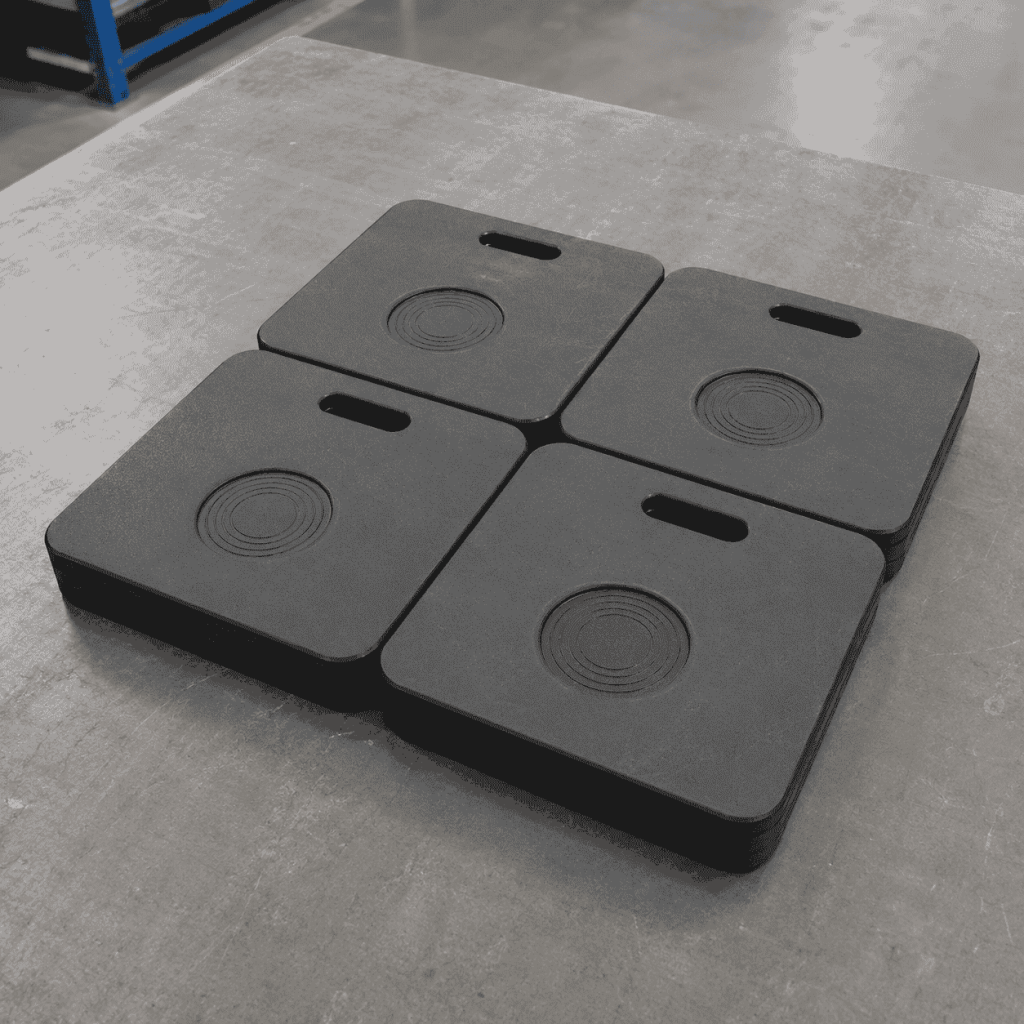
Based on the pump truck weight, outrigger foot dimensions and soil conditions, thick UHMWPE Outrigger Pads were placed beneath all four hydraulic support feet. Each pad was significantly larger than the original metal outrigger base, allowing the concentrated load to be distributed across a wider section of ground.
Before installation, workers removed stones, steel fragments and other sharp objects from the support areas. The soil was then levelled as much as possible. Each pad was placed flat on the ground, and the hydraulic outrigger was slowly lowered onto the centre of the pad.
Positioning the support foot near the centre helped prevent edge loading and uneven pressure. After the boom was fully extended, the site team inspected all four support points again to confirm that the pads had not shifted, tilted or settled excessively.
By increasing the ground contact area, the pads reduced the pressure applied to the backfilled soil. The concrete pump truck remained stable while the boom rotated and concrete was delivered to different sections of the project.
Why UHMWPE Outrigger Pads Were Selected
The project team initially considered using timber boards as temporary support materials. However, timber can absorb moisture, crack, split or deform in wet and muddy environments. Repeated heavy loading can also cause internal damage that may not be immediately visible.
Steel plates provide high strength, but they are heavy and difficult to move manually. Their relatively smooth surfaces may also slide on wet soil or uneven ground. When stored outdoors for long periods, untreated steel plates can also be affected by corrosion.
In comparison, ultra-high-molecular-weight polyethylene provides a practical combination of impact resistance, wear resistance, low moisture absorption and relatively low weight.
The material does not easily absorb water, rot or split when used in rain, mud or humid working conditions. Compared with steel pads of similar dimensions, UHMWPE pads are easier for workers to lift, position and remove without relying on additional lifting equipment.
The pad surfaces can also be machined with anti-slip textures, central positioning areas, recessed markings and integrated carrying handles. These features improve handling efficiency and help workers place the hydraulic support feet correctly.
5 Proven Benefits of UHMWPE Outrigger Pads
1. Larger support area. The pads distribute concentrated outrigger loads over a wider section of ground, reducing pressure beneath each hydraulic support point.
2. Improved equipment stability. On backfilled soil, sand, grass and damp surfaces, the pads help reduce local settlement, movement and uneven support.
3. Easier manual handling. UHMWPE pads are lighter than steel plates of similar dimensions, making frequent transportation and placement more convenient.
4. Reusable construction. Mud, dust and concrete residue can usually be removed with water, allowing the pads to be reused across multiple construction projects.
5. Flexible dimensions. Pad length, width, thickness, surface texture and carrying-handle design can be produced according to the equipment type and operating conditions.
On-Site Performance
During the concrete pouring operation, no obvious outrigger settlement or pad displacement was observed. The pump truck remained stable while the boom rotated and extended, and the backfilled surface did not develop severe local depressions beneath the support points.
After the pumping work was completed, the hydraulic outriggers were retracted and the pads were removed. Workers cleaned the soil from their surfaces with water and stored them for future use.
The pads showed only minor marks from normal site operation. No significant cracking, splitting or permanent deformation was found, allowing them to be used again on subsequent projects.
Project Conclusion
Backfilled soil, trench edges, grass, sand and wet ground do not always provide consistent support for heavy construction equipment. When hydraulic outriggers are placed directly on these surfaces, concentrated loads can cause settlement and instability.
UHMWPE Outrigger Pads increase the contact area beneath each support foot, spread equipment loads and reduce local ground pressure. In this project, they provided a practical and reusable support solution for a concrete pump truck operating on recently backfilled soil.
In addition to concrete pump trucks, these pads can be used beneath mobile cranes, aerial work platforms, fire and rescue vehicles, utility trucks and other machines equipped with hydraulic outriggers.
More engineering plastic components and heavy-equipment support solutions are available on our industrial plastic products page. Pad dimensions and thickness should always be selected according to the total equipment weight, individual outrigger load, support-foot size and ground-bearing capacity.