

An automation equipment manufacturer was experiencing unstable movement in a reciprocating positioning mechanism used on a packaging and conveying line. The moving assembly needed to travel repeatedly along a fixed metal track while maintaining accurate alignment at relatively high operating speeds.
The original metal guide wheels gradually developed wear after extended operation. Direct metal-to-metal contact also caused increased noise, vibration, track scratches, and lateral movement. To improve the operating stability of the equipment without making major structural changes, the customer replaced the original components with machined nylon guide wheels.
Project Background
The guide wheel assembly was installed on an automated packaging line responsible for material transfer, position adjustment, and workstation connection. During operation, the moving mechanism repeatedly traveled along a straight metal guide track.
Because the mechanism operated frequently, the guide wheels needed to provide reliable guiding, positioning, and supporting functions. They also needed to reduce friction and prevent the moving assembly from shifting sideways.
Problems with the Original Guide Wheels
Before the modification, the equipment mainly faced the following problems:
- The moving assembly was prone to lateral deviation during operation.
- Metal guide wheels produced noticeable noise when contacting the metal track.
- Hard contact gradually scratched and damaged the track surface.
- High-speed reciprocating movement caused vibration and mechanical impact.
- The guide wheels required frequent lubrication and maintenance.
- The heavy metal components increased the load on the moving mechanism.
These problems affected positioning accuracy and increased the maintenance requirements of the automated production line.
Application-Specific Solution
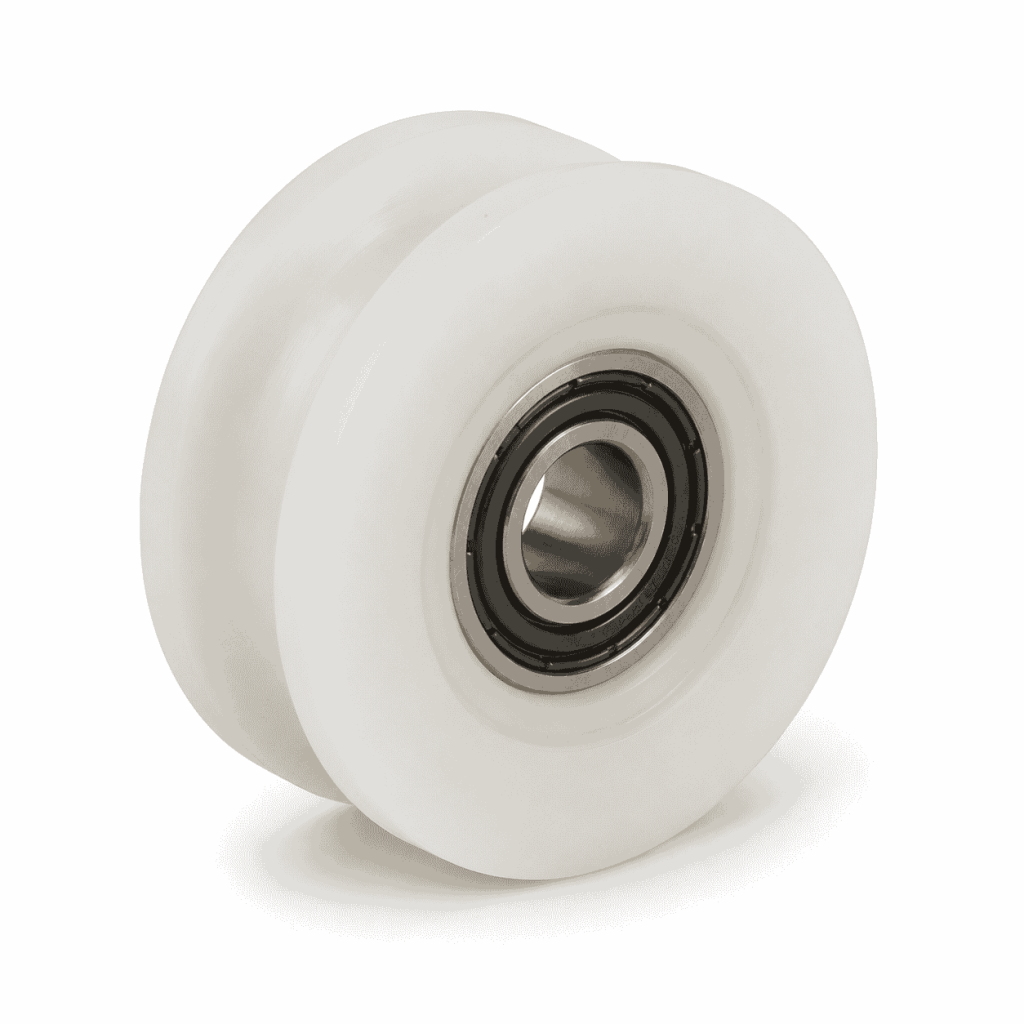
Based on the track width, installation space, operating load, shaft dimensions, and movement path, a grooved nylon guide wheel was machined for the existing guide assembly.
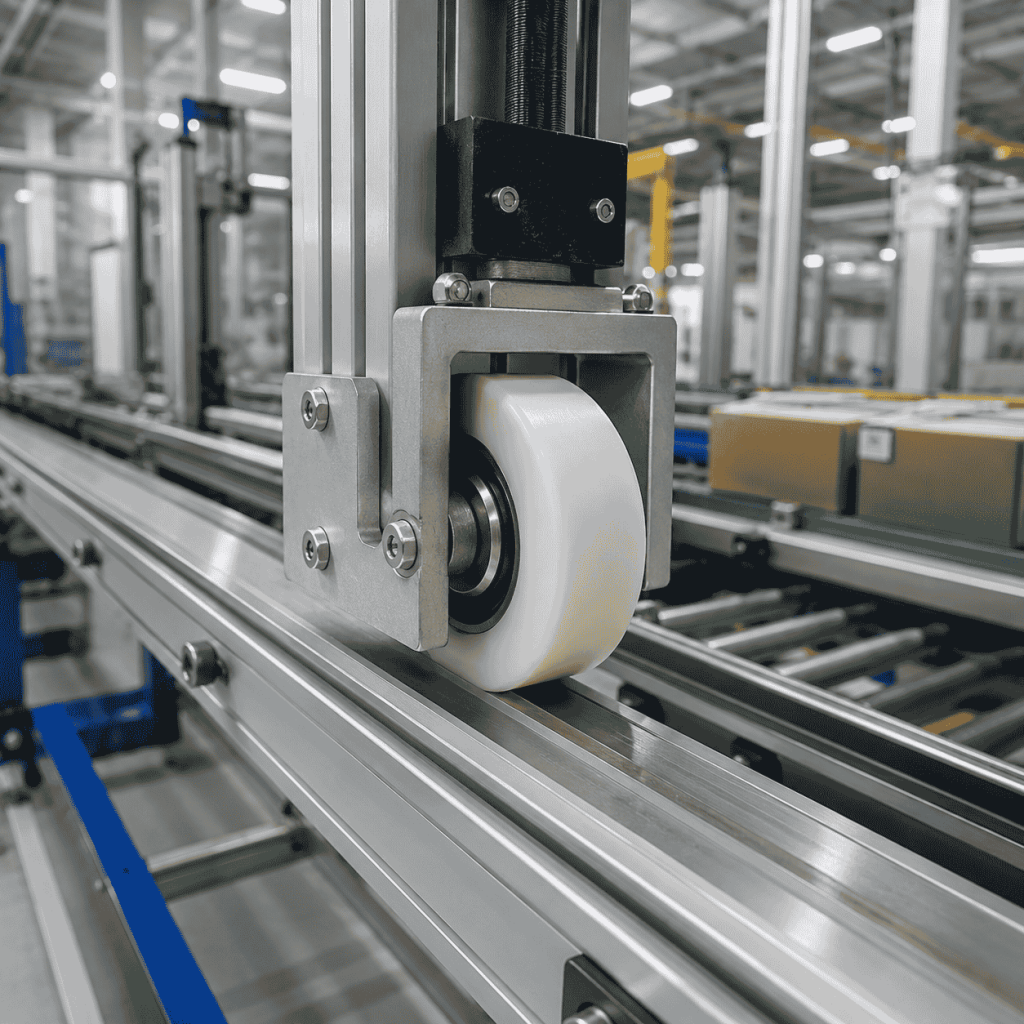
The center of the wheel was designed with a groove matching the shape and width of the metal track. During operation, the groove fits around the track and limits movement on both sides, helping the mechanism follow a fixed path.
The wheel diameter, groove width, groove depth, center bore, bearing seat, and installation position were processed according to the original equipment dimensions. This allowed the new guide wheels to be installed in the existing brackets without extensive modification to the conveying system.
Why Nylon Was Selected
Nylon is commonly used for industrial guide wheels, rollers, bushings, sliders, and other mechanical components because it combines wear resistance with relatively low weight.
Wear Resistance
The guide wheel operates repeatedly against the metal track. Nylon provides suitable wear resistance for continuous rolling and guiding applications, helping extend the service life of the component.
Self-Lubricating Performance
Nylon has relatively good self-lubricating properties. It can reduce friction between the guide wheel and the track, decreasing the need for frequent lubrication under suitable operating conditions.
Reduced Operating Noise
Replacing direct metal-to-metal contact with a nylon-to-metal contact surface helps reduce friction noise and mechanical impact during equipment movement.
Impact and Vibration Absorption
Nylon can absorb part of the vibration and impact generated during starting, stopping, and reversing. This helps the moving mechanism operate more smoothly.
Track Surface Protection
Compared with a hard metal wheel, a nylon guide wheel is less likely to scratch the track surface during normal operation. This helps reduce abnormal track wear.
Lower Component Weight
Nylon guide wheels are lighter than comparable steel components. Reducing the weight of the moving assembly can lower the operating load on the drive and positioning mechanism.
Corrosion-Free Operation
Nylon does not rust, making it suitable for packaging equipment, conveying systems, assembly lines, and general industrial environments where metal corrosion may cause maintenance problems.
Machining Requirements
Before machining, the customer’s drawings and installation measurements were checked to confirm the dimensions of the track and guide wheel assembly.
The main machining requirements included:
- Guide groove width and depth;
- Wheel outside diameter;
- Center bore and shaft fit;
- Bearing installation position;
- Concentricity between the bore and outer surface;
- Parallelism of both wheel sides;
- Clearance between the groove and guide track.
After machining, the guide wheels were inspected and test-fitted. The inspection confirmed that the wheels rotated smoothly, remained stable inside the mounting brackets, and did not interfere with the surrounding equipment structure.
Installation Process
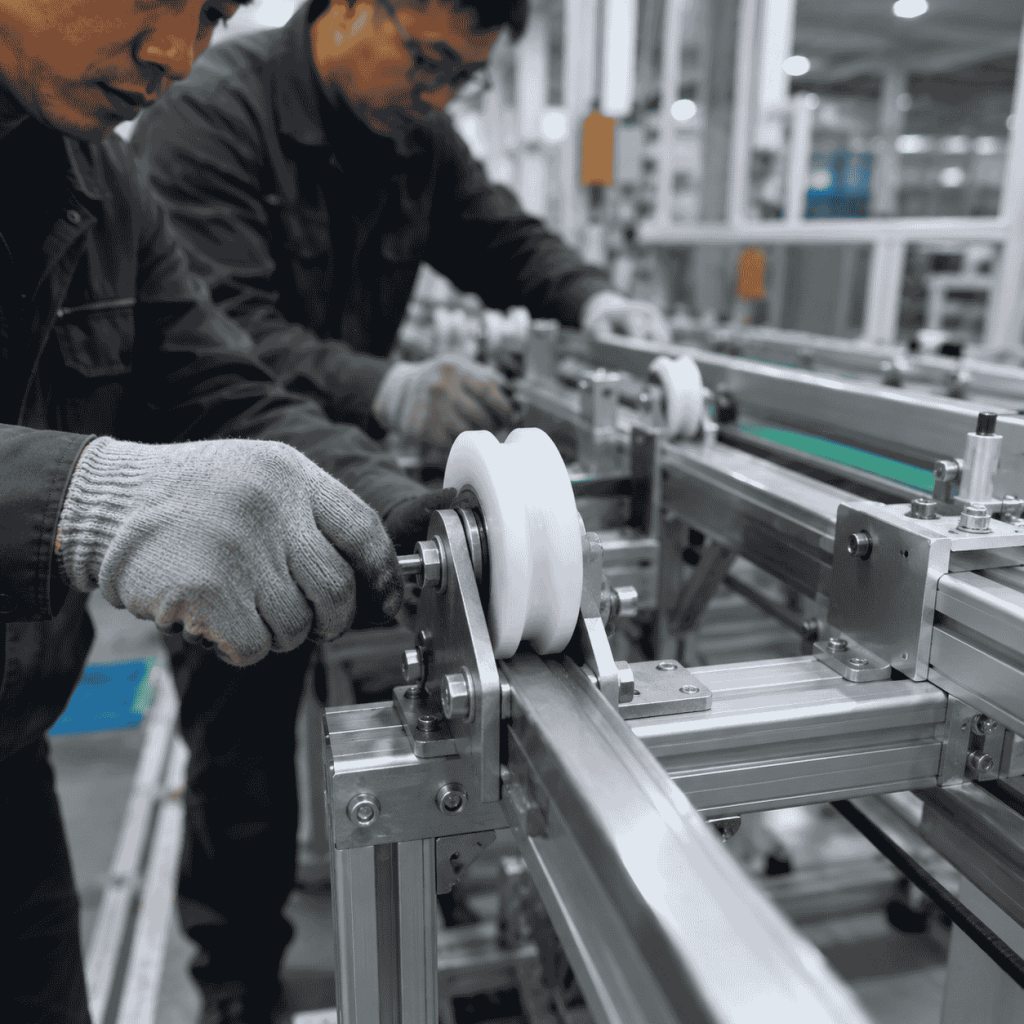
The original metal guide wheels were removed while the existing mounting brackets, shafts, and guide tracks were retained. The new nylon wheels were installed using the original connection structure.
During installation, the wheel position and contact clearance were adjusted to ensure that the guide groove fitted the track correctly. The mechanism was then manually moved along the full travel distance before powered operation.
Conveyor wheels and rollers should be securely positioned, and suitable machine guards should remain in place during operation. Additional conveyor safety information is available from the Occupational Safety and Health Administration .
Project Results
After replacing the metal wheels with grooved nylon guide wheels, the moving assembly followed the designated track more consistently. The groove structure limited lateral movement and reduced the risk of the mechanism shifting away from its intended path.
Direct metal-to-metal contact was also reduced. This lowered operating noise, softened mechanical impact, and helped protect the guide track surface from scratches and abnormal wear.
The nylon wheels were installed in the original equipment structure, so the customer did not need to rebuild the complete conveying system. This simplified installation and reduced equipment modification work.
Typical Application Equipment
Similar nylon guide wheels can be used in:
- Automated assembly lines;
- Packaging machinery;
- Conveyor systems;
- Lifting and positioning equipment;
- Reciprocating movement mechanisms;
- Logistics sorting equipment;
- Auxiliary robotic sliding mechanisms;
- Movable fixtures and tooling platforms.
Depending on the equipment structure, nylon guide wheels can be machined with straight grooves, U-shaped grooves, V-shaped grooves, or application-specific profiles.
Project Summary
This project used a grooved nylon guide wheel to address lateral deviation, operating noise, vibration, track scratches, and excessive metal-to-metal contact in an automated conveying mechanism.
The nylon guide wheel performs guiding, positioning, supporting, and track-protection functions while helping the moving components operate along a fixed path. Its relatively low weight, wear resistance, impact resistance, and self-lubricating performance make it suitable for many automated equipment applications.
Nylon guide wheels can be machined according to the customer’s track dimensions, installation position, shaft structure, operating load, movement speed, and working environment, ensuring that the finished component matches the actual equipment requirements.