

CNC machining is widely used to produce plastic prototypes, low-volume parts, replacement components, jigs, fixtures, gears, bushings, guide rails, and other custom industrial parts. However, a plastic that can be machined is not necessarily easy to machine.
Engineering plastics differ significantly in stiffness, thermal expansion, moisture absorption, internal stress, creep resistance, and chip-forming behavior. Choosing the wrong material may result in burrs, deformation, poor surface finish, dimensional changes, or premature failure during use.
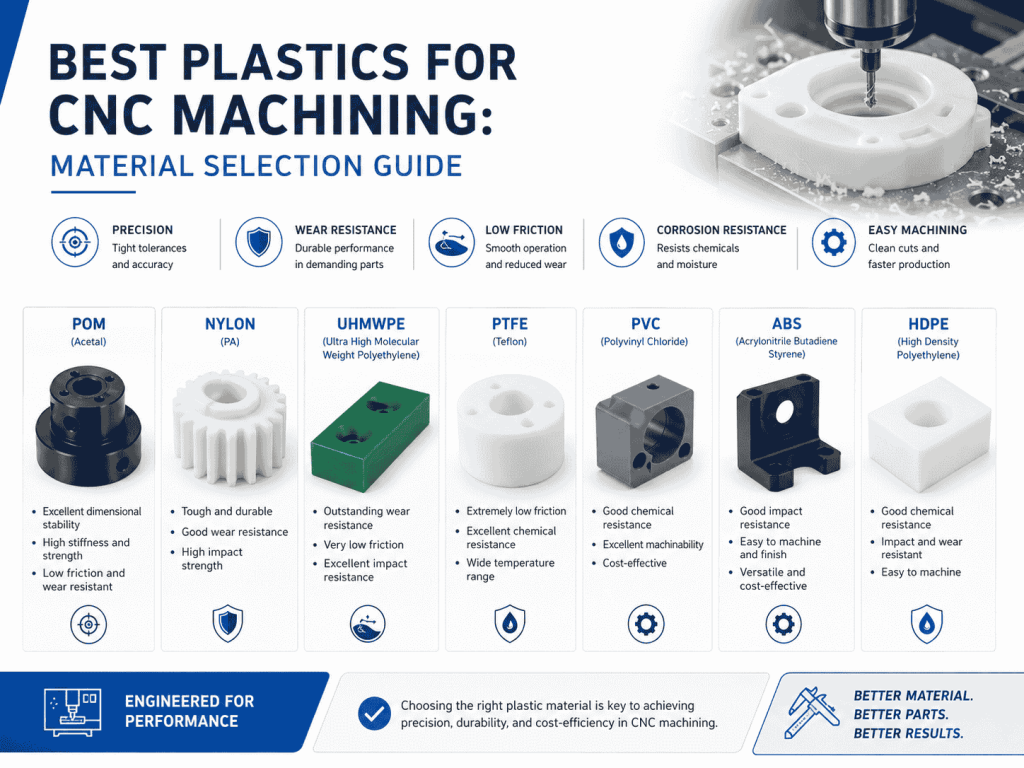
This guide compares POM, nylon, UHMWPE, PTFE, HDPE, ABS, and rigid PVC to help engineers and buyers select the most suitable material for CNC turning and milling.
For additional technical information, refer to the Interstate Plastics Machinable Plastics Guide.
Why Material Selection Matters in Plastic CNC Machining
Compared with metals, most plastics have lower thermal conductivity, lower stiffness, and higher thermal expansion. Heat generated during machining can remain near the cutting area, causing the workpiece to expand, soften, or move out of tolerance.
Plastic parts are also more sensitive to clamping pressure. Excessive force can compress or bend the workpiece during machining. Once the clamps are released, the part may spring back and produce an unexpected dimensional error.
Common CNC machining problems include:
- Dimensional changes after the part cools
- Warping in long, thin, or large components
- Burrs around holes, grooves, and edges
- Long or stringy chips wrapping around the tool
- Material melting or sticking to the cutter
- Poor surface finish caused by tool rubbing
- Moisture-related dimensional changes
- Creep under long-term mechanical loads
Machining parameters used for steel or aluminum should not be copied directly for plastics. Tool geometry, cutting speed, feed rate, workholding, chip evacuation, and temperature control should be adjusted for each polymer.
Quick Comparison of CNC Machining Plastics
| Material | General Machining Behavior | Main Advantages | Key Considerations | Typical Parts |
|---|---|---|---|---|
| POM / Acetal | Predictable machining with clean edges and good surface finish | Dimensional stability, stiffness, low moisture absorption | Internal stress and machining heat still require control | Gears, bushings, sliders, positioning parts |
| Nylon / PA | Machines well but may form stringy chips and burrs | Strength, wear resistance, load-bearing performance | Moisture absorption can affect dimensions | Gears, rollers, pulleys, wheels, bushings |
| UHMWPE | Easy to cut but more difficult to hold to tight tolerances | Low friction, impact resistance, excellent sliding wear performance | Low stiffness, thermal expansion, clamping deformation | Guide rails, wear strips, liners, sliding blocks |
| PTFE | Low cutting resistance but difficult to control dimensionally | Very low friction and excellent chemical resistance | Softness, creep, tool deflection, and thermal expansion | Seals, gaskets, sleeves, insulating parts |
| HDPE | Generally easy to machine with sharp tools and effective chip removal | Impact resistance, chemical resistance, low cost | Lower stiffness can affect thin or unsupported parts | Food-processing parts, spacers, blocks, panels |
| ABS | Easy to mill, turn, drill, and prototype | Cost-effective, impact resistant, easy to finish | Excessive heat may cause melting or chip adhesion | Housings, brackets, prototypes, light-duty fixtures |
| Rigid PVC | Machines cleanly when heat and chip evacuation are controlled | Chemical resistance, rigidity, cost efficiency | Avoid overheating and follow proper dust and ventilation practices | Chemical equipment parts, supports, insulating components |
Which Plastics Are Easier to CNC Machine?
POM: A Reliable Choice for Precision Components
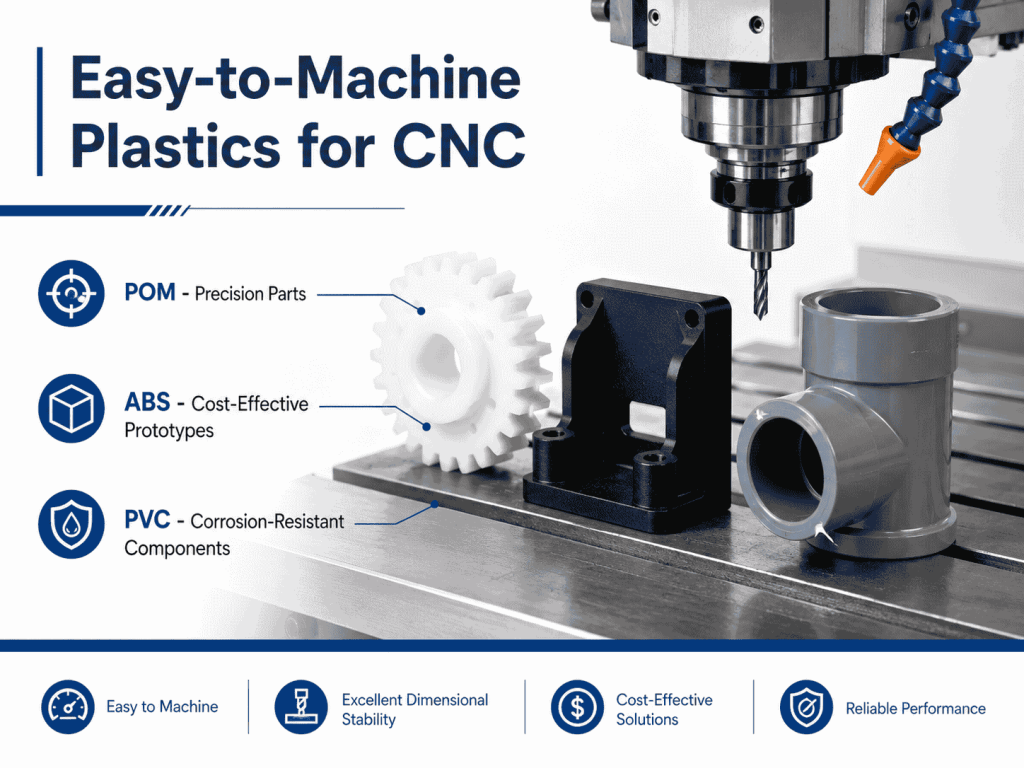
POM, also known as acetal or polyoxymethylene, is one of the most predictable engineering plastics for precision machining. It combines relatively high stiffness with low moisture absorption and good dimensional stability.
Sharp tools can produce clean edges, smooth surfaces, accurate holes, grooves, shoulders, and gear teeth. POM also generates chips that are generally easier to control than the long, flexible chips produced by softer polyethylene materials.
POM is commonly used for:
- Precision gears
- Bushings and sleeves
- Automation sliders
- Positioning blocks
- Jigs and fixtures
- Mechanical guide components
Ensinger describes unfilled POM-C as having high mechanical strength, rigidity, low moisture absorption, wear resistance, and excellent dimensional stability. Read the POM-C material reference from Ensinger.
POM is often the preferred starting point when a plastic part requires repeatable dimensions, but machining strategy still matters. Large stock shapes may contain residual stress, and excessive cutting heat can still affect final accuracy.
ABS: Suitable for Prototypes and General Structural Parts
ABS is relatively easy to turn, mill, drill, saw, and finish. It is commonly selected for prototypes, guards, housings, supports, and light-duty machine components.
Its main advantages include moderate cost, good impact resistance, and suitability for secondary operations such as bonding, painting, and assembly.
However, ABS is more sensitive to cutting heat than POM. A dull tool or excessively low feed may rub against the surface instead of cutting it cleanly, causing chips to soften and stick to the cutter.
Rigid PVC: Practical for Corrosion-Resistant Components
Rigid PVC can produce clean edges and stable machined features when sharp tools and suitable parameters are used. It is frequently selected for components exposed to water, chemicals, and corrosive industrial environments.
Typical applications include:
- Chemical-processing equipment parts
- Water-treatment components
- Electrical insulation parts
- Support plates
- Pipe-system components
Rigid PVC is not normally selected for high-temperature, high-impact, or heavily loaded rotating components. Overheating should be avoided, and appropriate workshop ventilation and chip-control procedures should be followed.
HDPE: Easy to Cut but Less Rigid
HDPE is generally considered easy to machine. Its cutting resistance is low, and it can be milled, routed, drilled, and turned efficiently with sharp plastic-cutting tools.
The main challenge is not whether HDPE can be cut, but whether the finished part can maintain the required geometry. Its relatively low stiffness means that thin walls, long sections, and unsupported areas may deflect under cutting or clamping forces.
HDPE is frequently used for:
- Food-processing fixtures
- Cutting and work surfaces
- Spacers and support blocks
- Water-treatment components
- General-purpose machined panels
Which Plastics Are More Difficult to Hold to Tight Tolerances?
UHMWPE: Excellent Performance but Greater Deformation Risk
UHMWPE offers excellent abrasion resistance, impact strength, low friction, and low moisture absorption. These properties make it highly suitable for sliding and wear applications.
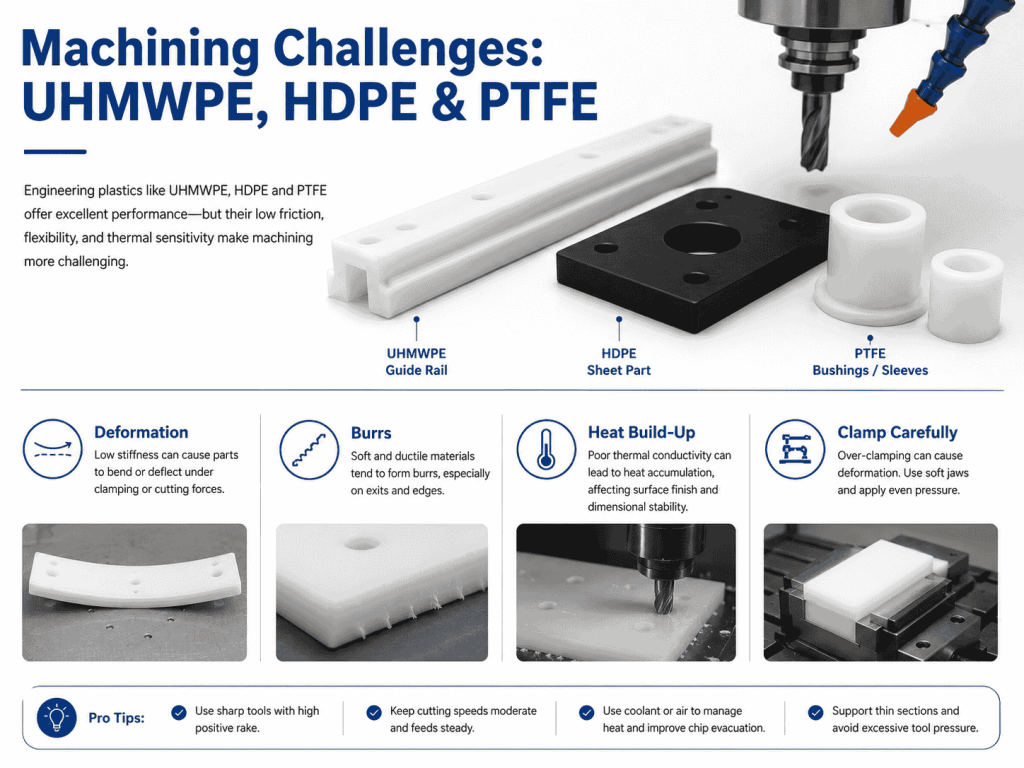
However, UHMWPE has lower stiffness and higher thermal expansion than POM and nylon. During CNC machining, it can be affected by cutting heat, uneven material removal, and excessive clamping pressure.
Common UHMWPE machining issues include:
- Compression under clamps
- Spring-back after the workpiece is released
- Warping in long guide rails
- Burrs and feathered edges
- Dimensional changes caused by heat
- Movement after deep or uneven machining
UHMWPE remains an excellent material for guide rails, wear strips, chain guides, liners, sliding blocks, and conveyor components. It should be selected for its functional advantages rather than for extremely tight long-term dimensional tolerances.
For a comparison of UHMWPE and nylon in wear applications, see the UHMW vs. Nylon guide from Curbell Plastics.
PTFE: Low Friction with Limited Dimensional Stability
PTFE is valued for extremely low friction, chemical resistance, electrical insulation, and broad service-temperature capability. It is widely machined into seals, gaskets, sleeves, valve components, and insulating parts.
Although PTFE has low cutting resistance, it is soft and prone to creep. The workpiece may deform under clamping pressure, move away from the cutting tool, or change dimensions under sustained load.
PTFE also has relatively high thermal expansion. Low moisture absorption does not automatically mean high dimensional stability because temperature, creep, geometry, and mechanical load can still influence the finished part.
PTFE is therefore best used where chemical resistance, sealing performance, or low friction is more important than high rigidity.
Nylon: Machinable but Sensitive to Moisture
Nylon machines well and provides greater mechanical strength and load-bearing capacity than UHMWPE. It is commonly used for gears, pulleys, rollers, bushings, wheels, and structural wear components.
The main selection issue is moisture absorption. Nylon can absorb moisture from the surrounding environment, which may change its dimensions and mechanical properties.
Precision nylon parts should be evaluated according to:
- The specific nylon grade
- Humidity in the operating environment
- The moisture condition of the stock shape
- Wall thickness and part geometry
- Required running or assembly clearance
- Storage and conditioning procedures
Some nylon grades absorb less moisture than standard PA6 or PA66. For example, PA612 is used when improved dimensional stability is needed. See the low-moisture nylon reference from Ensinger.
Which Plastics Are More Likely to Produce Burrs?
Soft, ductile, and highly tough plastics are more likely to stretch before they are completely cut. This behavior can produce feathered edges, stringy chips, and burrs around holes and grooves.
Materials that commonly require additional burr control include:
- UHMWPE
- HDPE
- PTFE
- Some nylon grades
POM, ABS, and rigid PVC often produce cleaner edges, but any plastic can develop burrs if the cutter is dull, the chip load is too low, or heat is allowed to build up.
Effective burr control usually involves:
- Using sharp tools with positive cutting geometry
- Maintaining enough feed for the tool to cut instead of rub
- Supporting thin sections close to the cutting area
- Keeping chips away from the tool and finished surface
- Using suitable entry and exit strategies around edges
Which Plastics Are Best for Tight-Tolerance Parts?
POM Is Often the First Choice
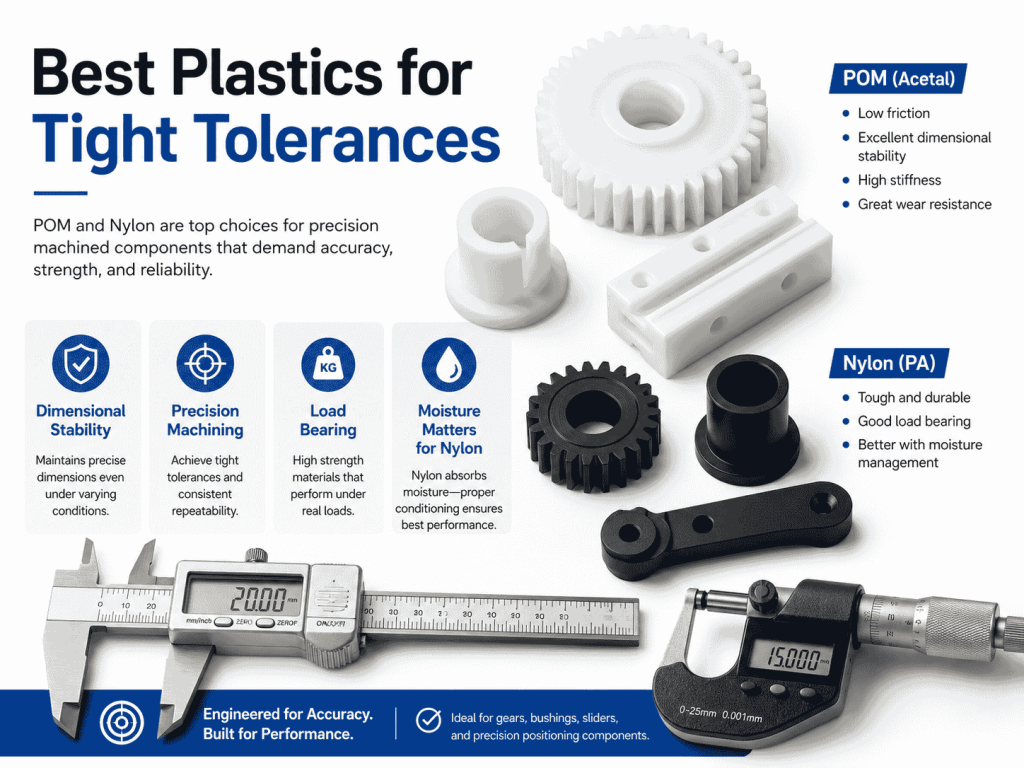
POM is commonly selected for tight-tolerance plastic parts because it offers a useful combination of stiffness, machinability, low moisture absorption, and dimensional stability.
It is suitable for precision holes, locating features, gear profiles, bearing surfaces, and sliding fits.
Nylon Requires Moisture Management
Nylon can be machined accurately, but the tolerance must account for moisture absorption and the actual operating environment. A nylon part that meets its drawing immediately after machining may change slightly after conditioning or exposure to humidity.
Low-moisture nylon grades may be considered when the application requires nylon strength with improved dimensional control.
UHMWPE and PTFE Require Realistic Tolerances
UHMWPE and PTFE can both be machined into complex components, but their stiffness, thermal expansion, creep behavior, and spring-back make very tight tolerances more difficult to maintain.
For these materials, the drawing should specify tolerances that reflect the material’s actual function rather than copying metal-part tolerances unnecessarily.
How to Control Heat and Deformation
Use Sharp Cutting Tools
Sharp cutters reduce cutting force and generate less friction. A worn tool may rub against the workpiece, increasing heat, burr formation, and surface damage.
Maintain an Effective Chip Load
Cutting parameters should allow each cutting edge to remove a defined chip. If the feed is too low, the tool may rub and melt the material rather than cut it.
Remove Chips Quickly
Chips trapped in a groove or hole can be cut repeatedly, creating additional heat and scratching the finished surface. Compressed air or another suitable chip-evacuation method may help, subject to machine and workplace safety requirements.
Control Clamping Pressure
Plastic workpieces should be held securely without being excessively compressed. Soft jaws, wider contact surfaces, backing plates, and distributed clamping can reduce local deformation.
Separate Roughing and Finishing
Large, thin, or highly machined parts may benefit from a staged process:
- Rough-machine the main features.
- Leave sufficient finishing allowance.
- Allow the part to cool and internal stress to stabilize.
- Recheck the workpiece before final machining.
- Finish-machine critical dimensions with light, balanced cuts.
Verify Coolant Compatibility
Cooling fluids should only be used after confirming compatibility with the plastic material. Some fluids may cause swelling, staining, contamination, or environmental stress cracking. Dry machining or compressed-air cooling may be suitable in some operations.
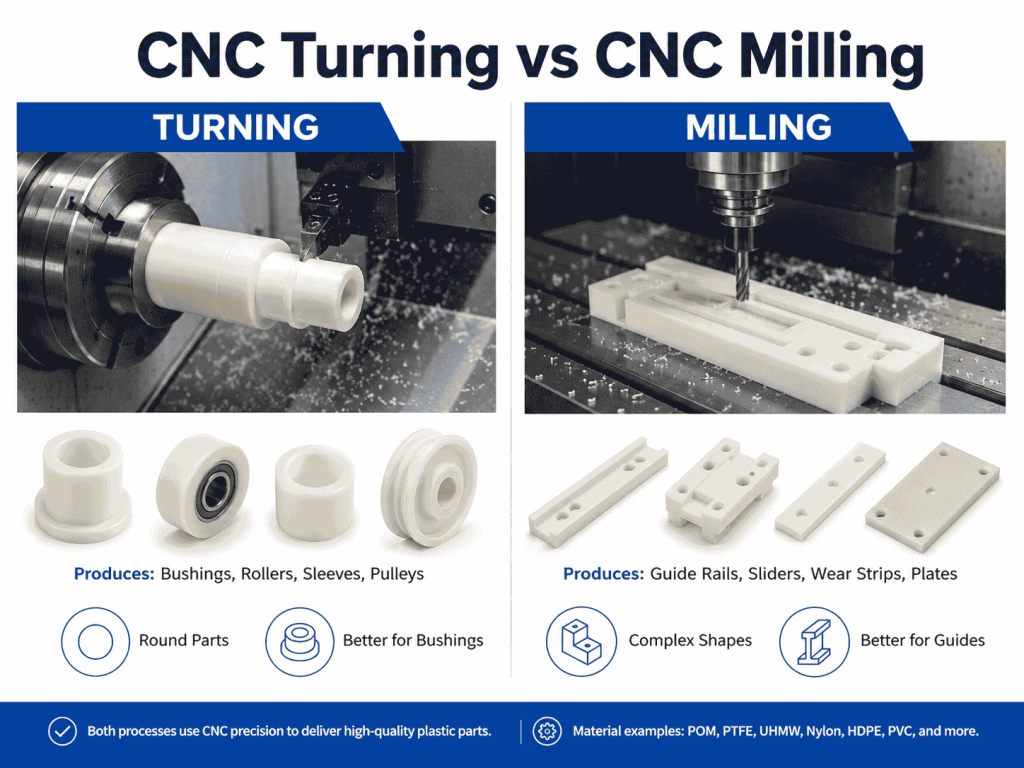
CNC Turning vs. CNC Milling for Plastic Parts
When to Use CNC Turning
CNC turning is suitable for rotationally symmetrical parts, including:
- Bushings
- Sleeves
- Rollers
- Pulleys
- Washers
- Seal rings
- Flanged components
Turning is normally the more efficient process for controlling outside diameters, bores, roundness, and concentricity.
When to Use CNC Milling
CNC milling is suitable for parts with flat surfaces, slots, pockets, mounting holes, and complex external profiles.
Common milled plastic parts include:
- UHMWPE guide rails
- Wear strips
- Machine sliders
- Fixture plates
- Nylon support blocks
- POM positioning components
- Rigid PVC structural parts
When Turning and Milling Are Both Required
Parts with an outside diameter, internal bore, keyway, cross-hole, flat surface, or mounting feature may require both turning and milling.
The machining sequence should minimize unnecessary repositioning because repeated setups can increase concentricity, position, and alignment errors.
How to Select the Right Plastic Quickly
- For precision and dimensional stability: Start with POM.
- For gears, rollers, and load-bearing wear parts: Consider nylon or POM.
- For guide rails, wear strips, liners, and sliding parts: Consider UHMWPE.
- For chemical resistance and extremely low friction: Consider PTFE.
- For cost-effective prototypes and housings: Consider ABS.
- For economical blocks, panels, and food-processing fixtures: Consider HDPE.
- For corrosion-resistant structural components: Consider rigid PVC.
These recommendations are starting points rather than absolute rules. Final material selection should consider load, sliding speed, temperature, humidity, chemical exposure, mating surface, lubrication, tolerance, geometry, and expected service life.
Wear should be evaluated as part of a complete system. The mating material, surface finish, pressure, speed, temperature, lubrication, and additives can all influence wear performance. More information is available in Curbell Plastics’ engineering plastics friction and wear article.
Typical Applications by Material
POM
Precision gears, bushings, sliders, locating blocks, automation components, and jigs.
Nylon
Gears, rollers, pulleys, rope guide wheels, bushings, support blocks, and load-bearing wear parts.
UHMWPE
Chain guides, conveyor rails, wear strips, liners, star wheels, sliding blocks, and low-friction guide components.
PTFE
Seals, gaskets, valve components, chemical-resistant sleeves, electrical insulation parts, and low-friction components.
HDPE
Food-processing fixtures, water-treatment parts, spacers, support blocks, cutting surfaces, and economical structural components.
ABS
Machine housings, guards, brackets, prototypes, fixtures, and light-duty equipment parts.
Rigid PVC
Chemical-processing parts, water-treatment components, corrosion-resistant supports, insulation parts, and pipe-system components.
Conclusion
There is no single best plastic for every CNC-machined component.
POM provides a strong balance of machinability, stiffness, and dimensional stability for precision parts. Nylon offers higher strength and good wear performance, but moisture absorption must be considered. UHMWPE is highly effective in sliding and wear applications, although heat and clamping deformation require careful control.
PTFE is suitable for low-friction and chemically aggressive environments, but its softness and creep limit tight-tolerance applications. HDPE, ABS, and rigid PVC provide practical solutions for economical structural parts, prototypes, food-processing components, and corrosion-resistant equipment.
The final choice should be based on part geometry, dimensional tolerance, mechanical load, motion type, temperature, humidity, chemical exposure, production quantity, and service-life requirements. Matching the machining process to the material is the key to reducing burrs, deformation, dimensional errors, and premature component failure.