

Wear is a common cause of failure in conveyor systems, packaging machinery, automated equipment, mining machines and material-handling systems. Components such as guide rails, wear strips, gears, rollers, bushings and liners are repeatedly exposed to sliding, rolling, impact and abrasive contact.
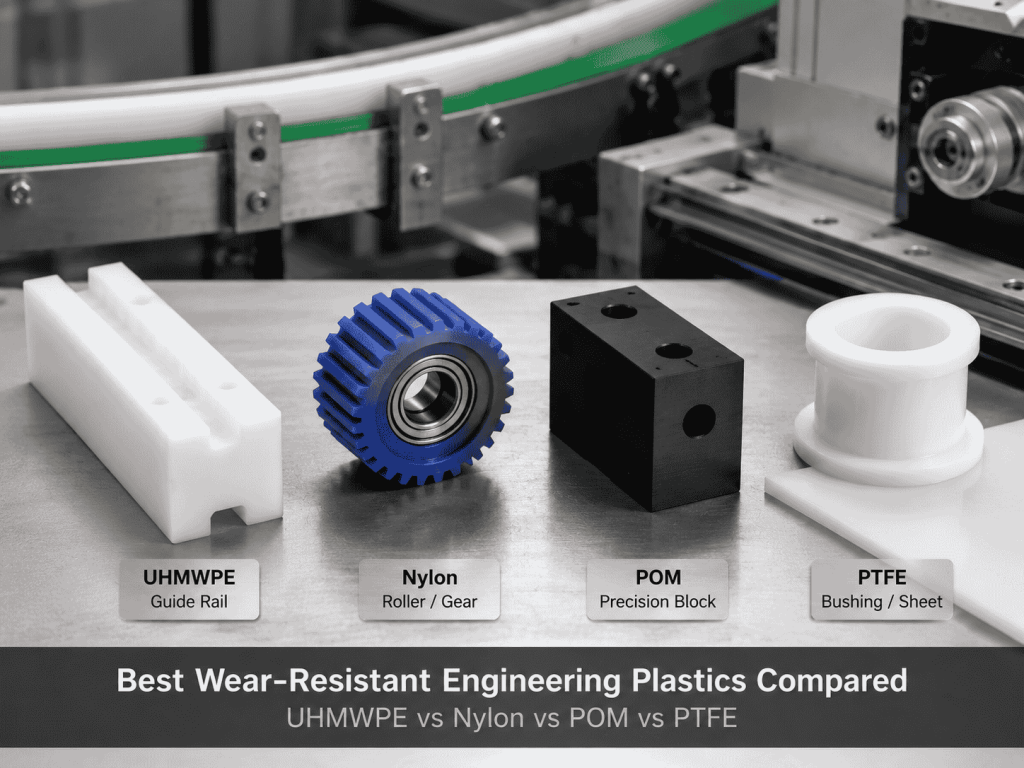
Metal components can provide high strength, but they may also require lubrication, generate operating noise, corrode in wet environments or damage mating surfaces. For these reasons, wear-resistant plastics such as UHMWPE, Nylon, POM and PTFE are widely used as alternatives to metal in many mechanical applications.
However, a low coefficient of friction does not automatically mean that a material will provide the longest wear life. Actual performance depends on load, speed, temperature, mating material, surface finish, lubrication and environmental conditions. This article explains how plastic wear occurs and compares four common engineering plastics.
What Is Wear Resistance?
Wear resistance is the ability of a material to resist the progressive loss of surface material caused by mechanical actions such as rubbing, sliding, rolling or scraping.
According to the Mitsubishi Chemical Group guide to wear resistance in engineering plastics , wear behavior is influenced by the type of contact, mating surfaces, surface roughness, clearance, temperature, moisture, chemicals, lubrication, pressure and movement velocity.
A wear-resistant plastic component normally provides several practical benefits:
- Lower surface material loss during operation
- Longer retention of the original shape and dimensions
- Reduced scoring, scratching and surface damage
- More stable operating clearances
- Less frequent maintenance and replacement
- Lower noise between moving components
Wear resistance is not a single fixed property. The same material may perform well in one machine but wear rapidly in another because operating conditions are different.
What Causes Plastic Parts to Wear?
Adhesive Wear
Adhesive wear occurs when microscopic areas on two mating surfaces temporarily bond under pressure. Relative movement then tears these bonded points apart, removing small amounts of material.
This type of wear is common in sliding blocks, bearings, guide rails, bushings and reciprocating components.
Abrasive Wear
Abrasive wear occurs when hard particles such as dust, sand, metal chips or mineral particles enter the contact area and scratch the plastic surface.
It is frequently found in mining equipment, outdoor machinery, bulk-material handling systems, conveyor equipment and agricultural machinery.
Fatigue Wear
Repeated loading can create small cracks below or near the material surface. Over time, these cracks can develop into pits, peeling or local material failure.
Gears, rollers, wheels and cyclically loaded bushings may experience fatigue wear during long-term operation.
Impact Wear
Impact wear is caused by repeated collision between the plastic component and falling material or moving machine parts. The repeated impact may produce deformation, cracking, chipping or surface loss.
Chute liners, hopper liners, guide plates, wear pads and impact blocks often need both wear resistance and impact strength.
Friction vs Wear: What Is the Difference?
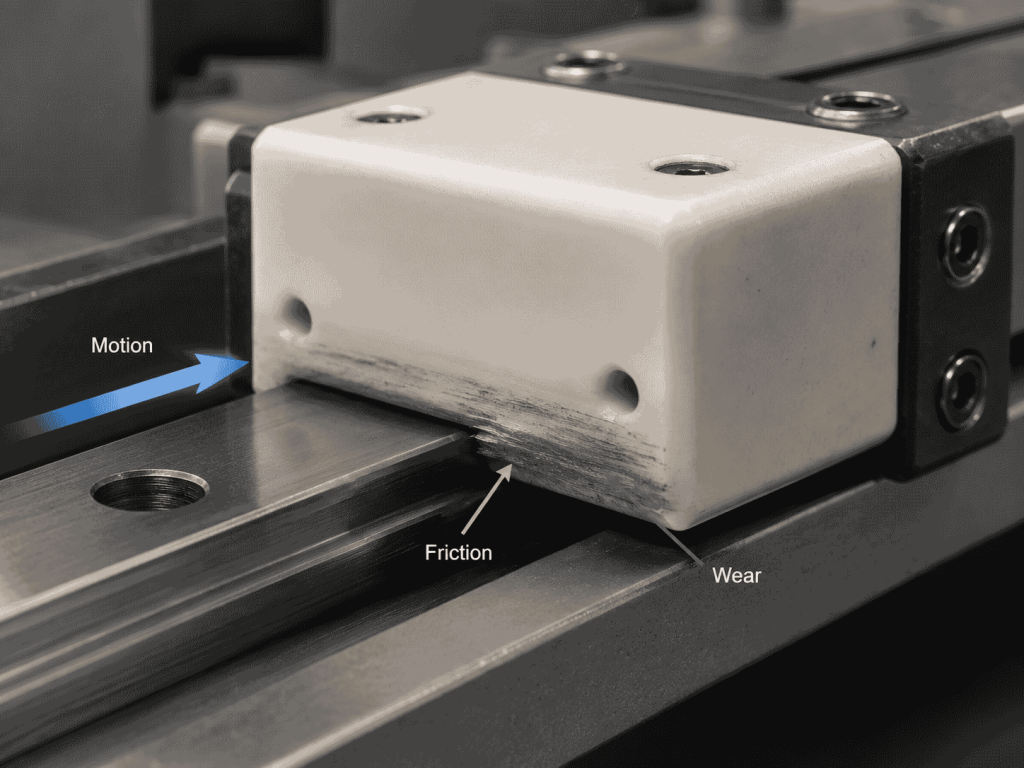
Friction and wear are related, but they are not the same.
Friction is the resistance to movement between two contacting surfaces. Wear is the gradual loss or deformation of material caused by that contact and movement.
A low-friction material can reduce operating resistance, heat generation, energy consumption, noise and stick-slip movement. However, wear life also depends on mechanical strength, hardness, toughness, thermal stability and resistance to creep.
PTFE, for example, is known for very low friction. However, unfilled PTFE is relatively soft and may deform under sustained pressure. In high-load applications, filled or reinforced PTFE grades may provide better dimensional stability and wear performance.
Material selection should therefore be based on the complete operating condition rather than friction coefficient alone.
How Load and Speed Affect Wear
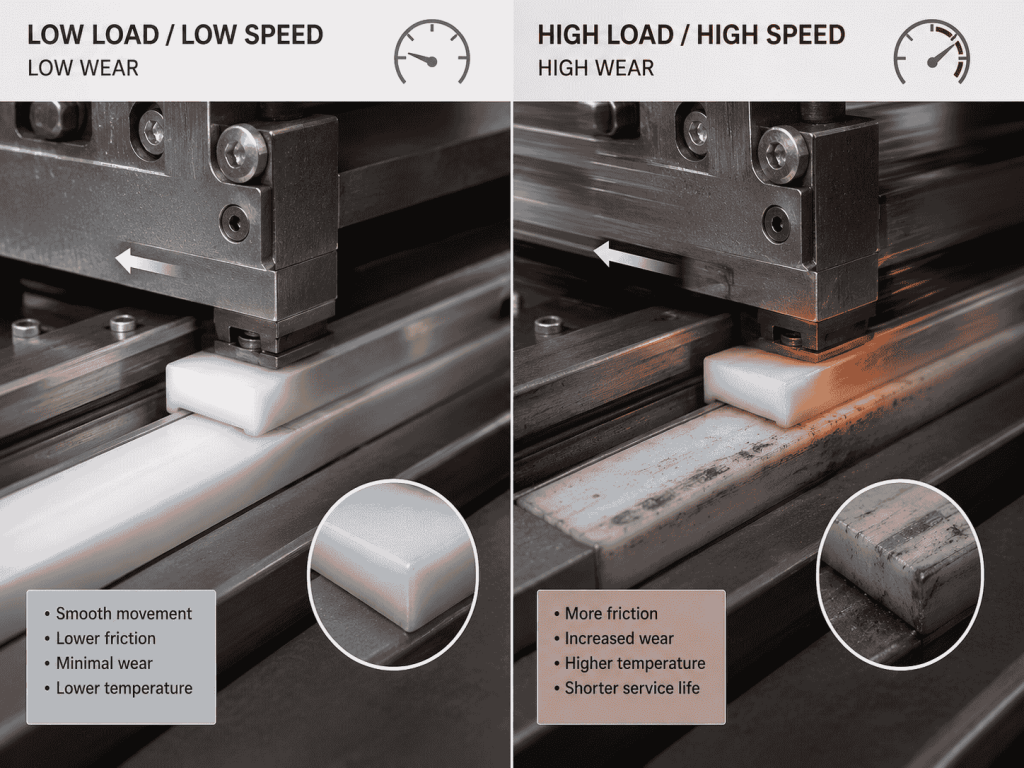
Load increases the contact pressure between mating surfaces. As pressure rises, the plastic may experience greater deformation, frictional heat and surface damage.
Speed also influences temperature. Faster sliding movement generally creates more heat at the contact area. If the heat cannot dissipate effectively, the plastic surface may soften, expand or wear more rapidly.
The combination of pressure and velocity is commonly considered when evaluating bearing, sliding and wear applications. Low-speed, high-load conditions may require different material properties from high-speed, low-load conditions.
Other operating factors must also be evaluated:
- Continuous or intermittent operation
- Frequency of starting and stopping
- Dry running or lubricated operation
- Presence of dust, sand or hard particles
- Alignment and installation accuracy
- Surface roughness of the mating component
- Clearance between moving parts
- Possibility of vibration or uneven loading
UHMWPE, Nylon, POM and PTFE Comparison
| Material | Main Advantages | Points to Consider | Typical Applications |
|---|---|---|---|
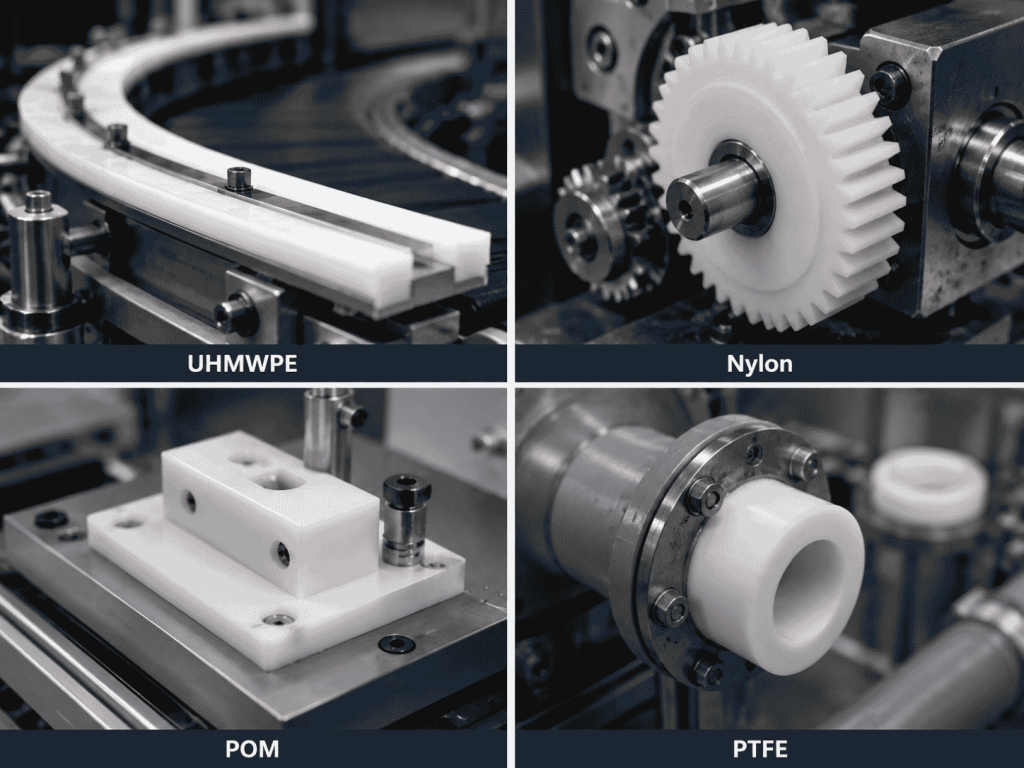
| UHMWPE | Excellent abrasion resistance, low friction, high impact strength, low water absorption and good chemical resistance | Relatively low stiffness and limited resistance to elevated temperatures | Guide rails, wear strips, liners, chain guides and sliding blocks |
| Nylon | Good mechanical strength, toughness, fatigue resistance, wear resistance and impact resistance | Moisture absorption may affect dimensions and mechanical properties | Gears, rollers, pulleys, wheels, bushings and support blocks |
| POM | High stiffness, good dimensional stability, low moisture absorption and good sliding properties | Impact performance is generally lower than UHMWPE and tough nylon grades | Precision sliders, gears, fixtures, positioning blocks and bushings |
| PTFE | Very low friction, excellent chemical resistance and broad operating-temperature capability | Unfilled grades have relatively low stiffness and may creep under continuous load | Bushings, seals, slide pads, gaskets and chemical-equipment components |
UHMWPE: Best for Abrasion and Impact Resistance
UHMWPE stands for ultra-high molecular weight polyethylene. It is widely used where sliding movement, material impact, moisture and abrasive particles are present.
The material combines low surface friction with good abrasion resistance, high impact strength, low water absorption and chemical resistance. Its self-lubricating surface can help reduce noise and hard contact between plastic and metal components.
Typical UHMWPE applications include:
- Conveyor chain guides
- Curved and straight guide rails
- Wear strips and sliding pads
- Hopper and chute liners
- Packaging-machine guide components
- Bottling and filling-machine parts
- Material-handling liners
UHMWPE is particularly useful for large wear components and applications involving repeated impact. However, it has lower stiffness than POM or Nylon and may not be suitable for high-temperature or extremely tight-tolerance applications.
Nylon: A Balance of Strength and Wear Resistance
Nylon, also known as polyamide or PA, provides a useful balance of mechanical strength, toughness, fatigue resistance and wear performance.
Compared with UHMWPE, Nylon is generally stiffer and more suitable for components that must transmit force or support mechanical loads. It is commonly machined into:
- Plastic gears and sprockets
- Guide rollers
- Rope pulleys
- Conveyor wheels
- Mechanical bushings
- Support blocks
- Guide and positioning components
The main consideration is moisture absorption. Nylon can absorb water from the surrounding environment, which may change its dimensions, stiffness and strength. Components with tight tolerances should be designed with humidity and conditioning requirements in mind.
POM: Best for Precision and Dimensional Stability
POM, commonly called acetal, is a rigid engineering plastic with good sliding properties, wear resistance, machinability and dimensional stability.
Its relatively low moisture absorption makes it suitable for precision-machined components where hole positions, clearances and part geometry must remain stable.
The Ensinger POM material guide highlights its good sliding behavior, wear resistance and low moisture absorption.
Typical POM applications include:
- Precision sliding blocks
- Small gears and sprockets
- Positioning fixtures
- Automation-machine components
- Guide blocks
- Mechanical bushings
- Packaging-machine parts
POM is often selected for medium-load applications requiring stable dimensions and accurate machining. For heavy impact or large wear liners, UHMWPE or Nylon may provide better toughness.
PTFE: Best for Low Friction and Chemical Resistance
PTFE, or polytetrafluoroethylene, is a fluoropolymer known for very low friction, excellent chemical resistance, electrical insulation and broad temperature capability.
The Ensinger PTFE material overview provides additional information about the characteristics and applications of PTFE engineering materials.
PTFE is commonly used for:
- Low-friction bushings
- Sliding support pads
- Sealing rings and gaskets
- Chemical-resistant scrapers
- Flange insulation components
- Valve and pump components
- Dry-running mechanical parts
Unfilled PTFE is relatively soft and can deform under continuous load. Glass fiber, carbon, graphite, bronze and other fillers may be added to improve wear resistance, stiffness or creep performance for demanding applications.
Application-Based Material Selection
Conveyor Guide Rails and Wear Strips
UHMWPE is usually a strong option because of its low friction, abrasion resistance, impact strength and low water absorption. It can reduce chain resistance, noise and wear on mating components.
Gears, Rollers and Pulleys
Nylon is commonly selected because it combines mechanical strength, toughness, fatigue resistance and wear performance. It can also reduce noise compared with metal gears and rollers.
Precision Sliders and Positioning Parts
POM is often suitable for parts requiring accurate dimensions, smooth sliding movement, low moisture absorption and good machinability.
Chemical Equipment and Low-Friction Seals
PTFE is frequently used where chemical resistance, low friction or temperature resistance is more important than high structural stiffness.
Large Wear Liners
UHMWPE is commonly used for large liners exposed to bulk material, moisture, corrosion, impact and abrasive particles.
How to Select the Right Wear-Resistant Plastic
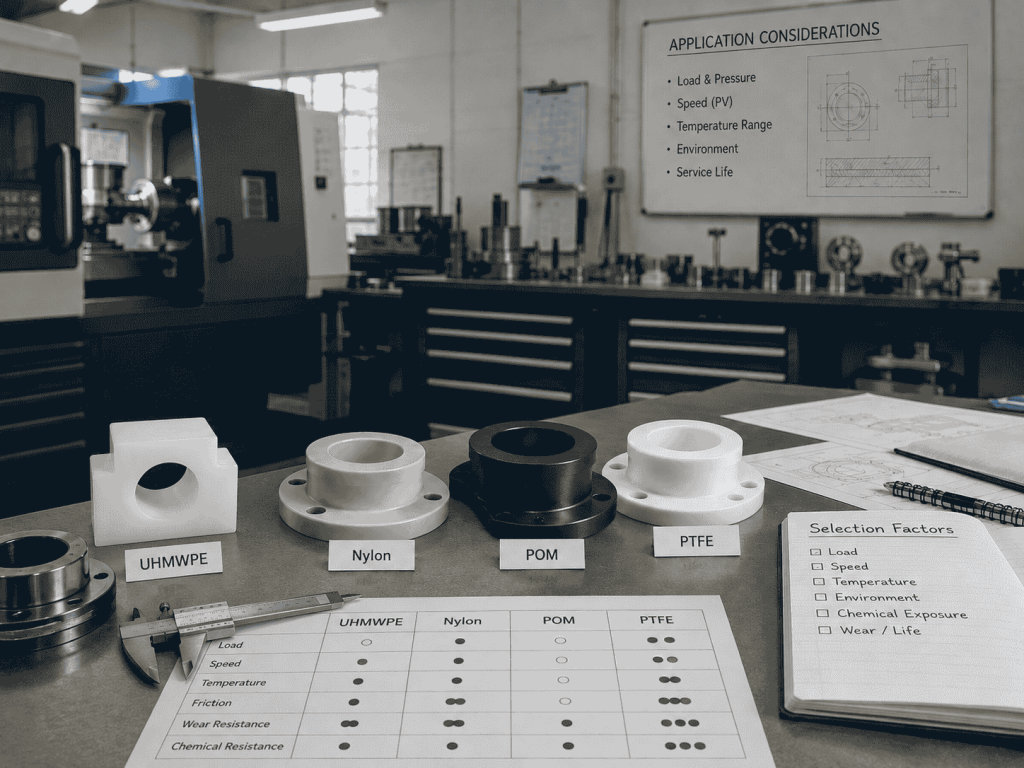
1. Identify the Type of Movement
Determine whether the component experiences sliding, rolling, rotation, oscillation or reciprocating motion. Each movement creates a different contact and wear pattern.
2. Determine the Operating Load
Evaluate the normal load, peak load and possibility of concentrated or uneven pressure. High loads may require greater stiffness, compressive strength or creep resistance.
3. Confirm the Operating Speed
Higher speeds can increase frictional temperature. Continuous high-speed movement may require a material with better thermal stability and pressure-velocity capability.
4. Check the Temperature Range
Consider both ambient temperature and heat generated at the contact surface. Excessive heat may soften the plastic, change clearances or accelerate deformation.
5. Evaluate the Working Environment
Confirm whether the part will contact water, oil, cleaning agents, acids, alkalis, food products or other chemicals. Outdoor applications may also require resistance to weathering and ultraviolet exposure.
6. Define the Required Accuracy
For components with tight tolerances, moisture absorption, thermal expansion and creep must be considered. POM is often preferred for dimensional stability, while Nylon may require allowances for moisture-related changes.
7. Evaluate Impact and Vibration
UHMWPE and tough Nylon grades are often considered for applications involving shock loads, vibration or repeated mechanical impact.
8. Review Lubrication and Maintenance
Self-lubricating plastics can operate with reduced external lubrication in many applications. However, whether lubrication is required still depends on load, speed, temperature and service-life expectations.
Frequently Asked Questions
Which Engineering Plastic Has the Best Wear Resistance?
No single plastic is best for every operating condition. UHMWPE often performs well in abrasive, sliding and impact applications. Nylon may be more suitable when mechanical strength and load support are required. POM is preferred for dimensional accuracy, while PTFE is used where low friction and chemical resistance are critical.
Does a Low-Friction Plastic Require No Lubrication?
Some engineering plastics can operate under dry or low-lubrication conditions. However, lubrication requirements depend on pressure, speed, temperature, surface finish and expected operating life.
Is POM or Nylon Better for Precision Parts?
POM generally has lower moisture absorption and better dimensional stability, making it suitable for precision sliders, positioning parts and small gears. Nylon usually provides better toughness and impact resistance.
Can UHMWPE Replace Nylon?
UHMWPE can replace Nylon in some low-friction, wear and impact applications. However, UHMWPE has lower stiffness and different thermal and dimensional characteristics. A direct replacement should be evaluated according to the component load, geometry and operating temperature.
Why Does PTFE Not Always Provide the Longest Wear Life?
PTFE has very low friction, but unfilled PTFE is relatively soft and may creep or deform under continuous pressure. Filled PTFE grades are often selected when improved stiffness, wear resistance or load capacity is needed.
Conclusion
UHMWPE, Nylon, POM and PTFE are all useful wear-resistant plastics, but each material is suited to different operating conditions.
UHMWPE is suitable for abrasion, impact, low-friction sliding and large wear liners. Nylon provides a balance of strength, toughness and wear resistance for gears, rollers and pulleys. POM is appropriate for precision components requiring dimensional stability and smooth movement. PTFE is preferred for low-friction, chemical-resistant and temperature-demanding applications.
The final selection should consider movement type, load, speed, temperature, environment, mating surface, dimensional accuracy and maintenance requirements. Combining the correct material with an appropriate component design and installation method is essential for achieving reliable performance and longer service life.