
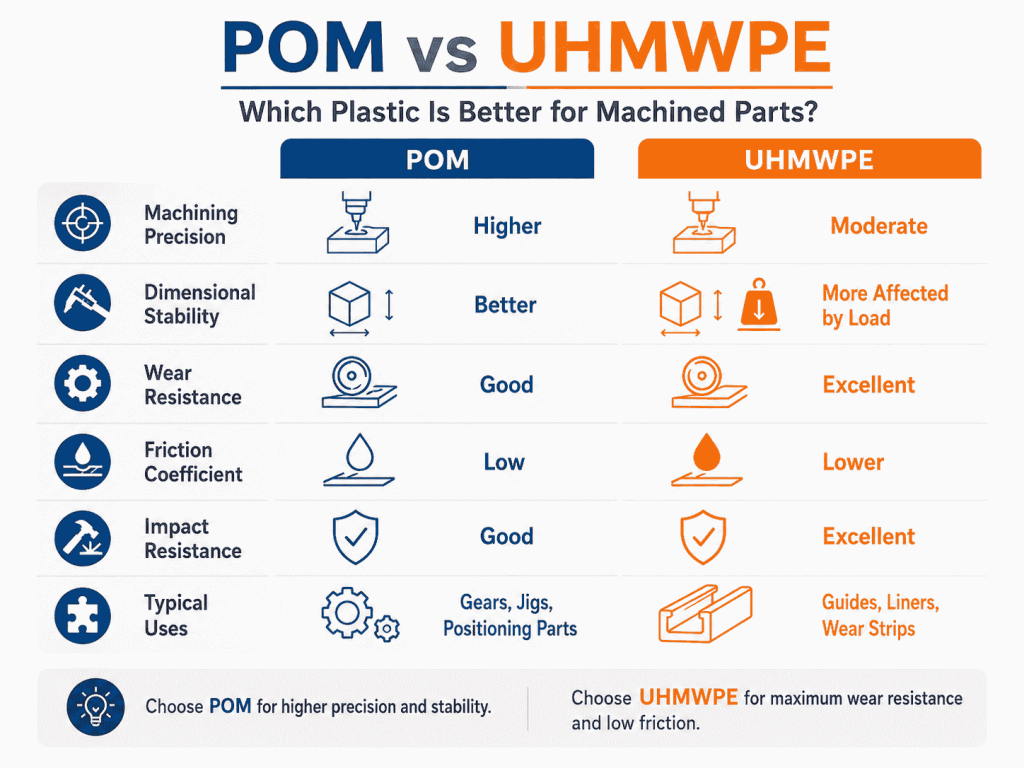
Both are lightweight, corrosion-resistant, wear-resistant, and suitable for CNC machining. However, they perform very differently in terms of machining accuracy, dimensional stability, rigidity, friction, and impact resistance.
POM is generally more suitable for precision components that require tight tolerances, structural rigidity, and stable dimensions. UHMWPE is usually preferred for sliding, impact, and high-wear applications where low friction and toughness are more important than precision.
This POM vs UHMWPE comparison explains the main differences between the two materials and helps you select the right plastic for gears, jigs, guide rails, liners, wear strips, and other machined parts. For an additional overview, see this Acetal vs. UHMW material comparison .
What Is POM?
POM, or polyoxymethylene , is also known as acetal plastic. It is a semi-crystalline engineering thermoplastic with relatively high mechanical strength, rigidity, surface hardness, and dimensional stability.
POM can be machined by turning, milling, drilling, boring, and tapping. Its combination of rigidity and machinability makes it suitable for parts that require accurate dimensions, smooth surfaces, and consistent mechanical performance.
Typical POM machined parts include:
- Precision gears and racks
- Jigs, fixtures, and positioning blocks
- Bushings, rollers, and sliding blocks
- Washers, spacers, and structural components
- Automation equipment parts
- Precision components with holes, slots, or threads
The main advantages of POM are its good machining accuracy, higher rigidity, stable dimensions, good wear resistance, and relatively low friction.
What Is UHMWPE?
UHMWPE, or ultra-high-molecular-weight polyethylene , is a polyethylene material with an extremely high molecular weight. It is widely used for its excellent wear resistance, impact strength, toughness, low friction, and self-lubricating performance.
Compared with POM, UHMWPE is softer and more flexible. It can absorb impact energy without cracking easily, making it suitable for components exposed to vibration, material flow, repeated impact, dust, water, and abrasive particles.
Typical UHMWPE machined parts include:
- Conveyor guide rails
- Chain guides and wear strips
- Hopper, chute, and bunker liners
- Sliding plates and protective panels
- Support pads and buffer blocks
- Conveyor star wheels and change parts
- Heavy-duty wear and impact components
The main advantages of UHMWPE are excellent wear resistance, low friction, high impact strength, low moisture absorption, and reduced material adhesion.
POM vs UHMWPE: Key Differences
| Comparison Factor | POM | UHMWPE |
|---|---|---|
| Machining precision | Higher | Moderate |
| Dimensional stability | Better | More affected by load and temperature |
| Rigidity | Higher | Lower and more flexible |
| Surface hardness | Higher | Lower |
| Wear resistance | Good | Excellent |
| Friction performance | Low friction | Lower friction |
| Impact resistance | Good | Excellent |
| Moisture absorption | Low | Extremely low |
| Typical applications | Gears, jigs, fixtures, and precision components | Guide rails, liners, wear strips, and buffer parts |
Machining Precision and Dimensional Stability
POM normally offers better machining accuracy and dimensional stability than UHMWPE. Its higher rigidity helps the workpiece maintain its shape during turning, milling, drilling, and inspection.
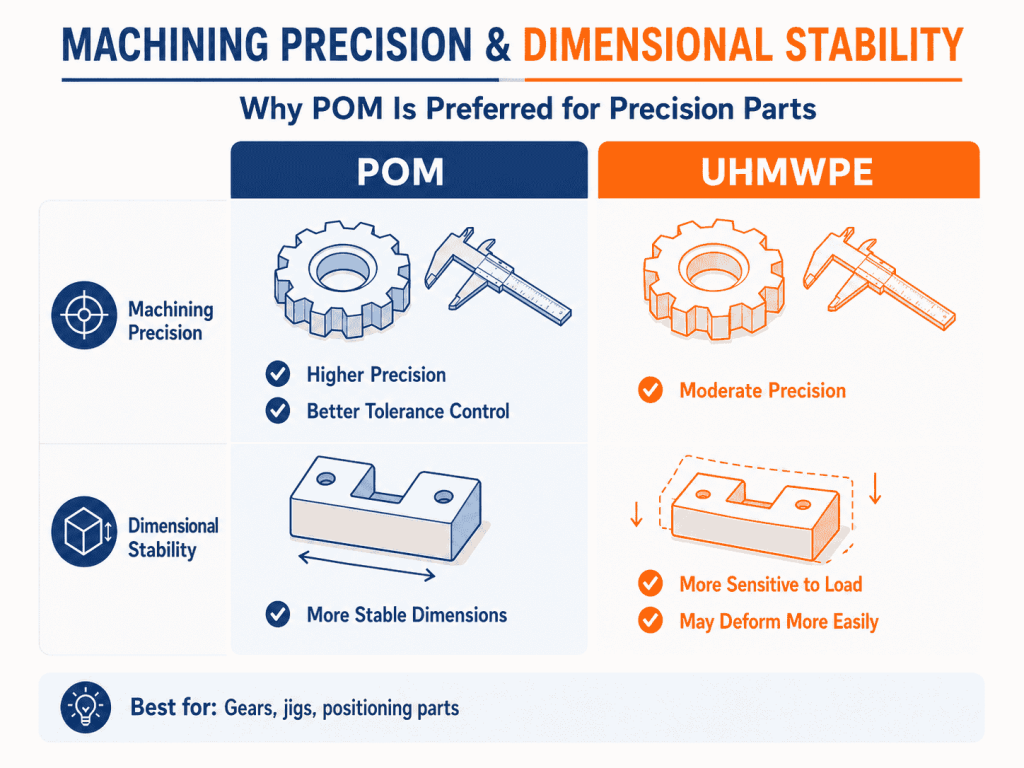
For components with tight tolerances, accurate hole spacing, controlled flatness, or precise mating dimensions, POM is often the more suitable choice.
Examples include:
- Precision gears
- Positioning blocks
- Inspection jigs
- Fixture plates
- Bushings with controlled internal diameters
- Parts with multiple precision holes
UHMWPE is softer and has a higher tendency to expand, contract, or deform under machining pressure, temperature changes, and continuous load. If clamping force is excessive, the workpiece may compress during machining and recover after it is removed from the fixture.
When machining UHMWPE, manufacturers should consider:
- Using sharp cutting tools
- Reducing cutting heat
- Controlling clamping pressure
- Separating rough machining from finish machining
- Allowing time for internal stress release
- Avoiding unnecessarily thin or long unsupported structures
For highly accurate components, POM generally provides more predictable machining results.
Wear Resistance and Friction Performance
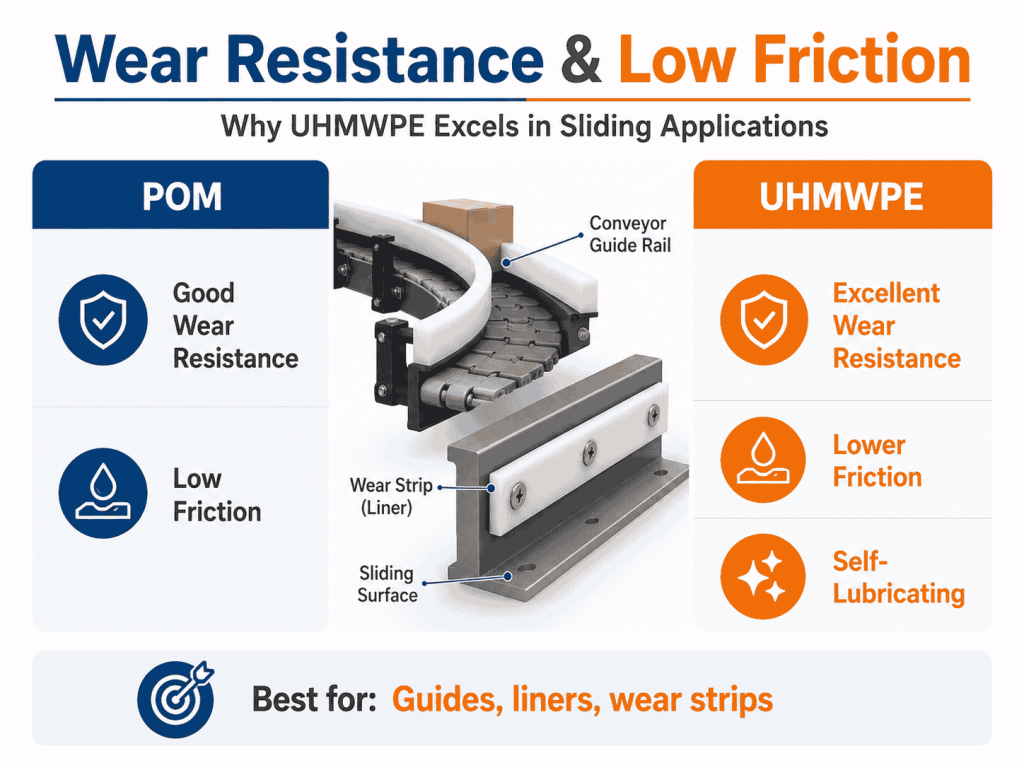
UHMWPE normally performs better in continuous sliding, abrasive material handling, and conveyor applications. Its low coefficient of friction helps reduce resistance between plastic guides, chains, metal components, and transported products.
UHMWPE is commonly used for conveyor guide rails, chain guides, liners, and sliding strips because it can help:
- Reduce chain and conveyor resistance
- Lower operating noise
- Reduce direct metal-to-metal contact
- Protect mating components from wear
- Reduce lubrication requirements
- Extend maintenance intervals
These characteristics make UHMWPE particularly useful in packaging and conveyor equipment .
POM also provides good wear resistance and low friction. However, UHMWPE is often the better option when the component is exposed to continuous sliding, abrasive particles, or long-term contact with moving products.
Rigidity and Load-Bearing Performance
POM has greater rigidity and surface hardness than UHMWPE. It is therefore more suitable for structural parts that must retain their shape, hole positions, and assembly dimensions under mechanical load.
POM is often selected for:
- Load-bearing positioning blocks
- Machine fixtures
- Precision support components
- Gears and transmission parts
- Parts with threaded holes or metal inserts
UHMWPE has excellent toughness but lower rigidity. Under long-term static load, it may gradually deform through a behavior known as creep.
UHMWPE is generally more suitable as a:
- Wear surface
- Sliding surface
- Impact buffer
- Protective liner
- Guide component
- Low-friction support pad
When rigidity, thread retention, or dimensional accuracy is critical, POM is normally the safer choice.
Impact Resistance and Toughness
UHMWPE has excellent impact resistance and toughness. It can absorb repeated shock and vibration without cracking as easily as more rigid plastics.
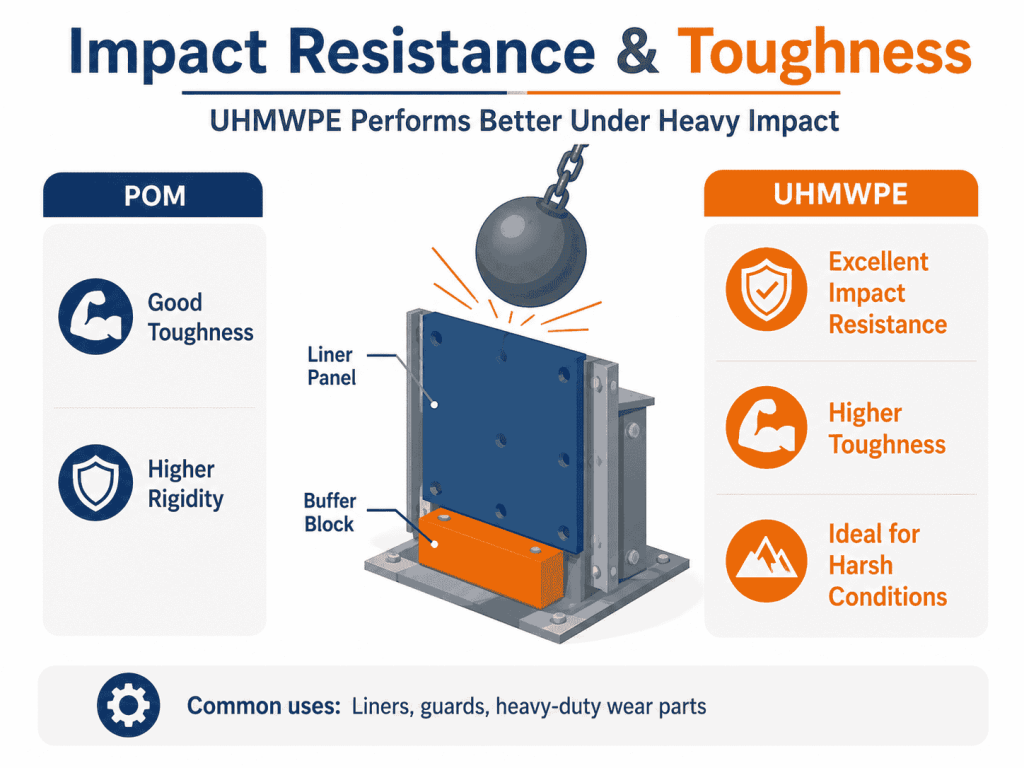
This performance makes UHMWPE suitable for mining equipment, agricultural machinery, ports, bulk-material handling systems, and heavy conveyor equipment.
Common impact-resistant UHMWPE components include:
- Chute and hopper liners
- Impact plates
- Buffer blocks
- Machine guards
- Protective panels
- Heavy-duty wear components
POM also offers good toughness, but its higher rigidity can make it more sensitive to sharp corners, notches, stress concentrations, and repeated heavy impact.
A harder material is not automatically more impact-resistant. The actual selection should consider the direction, frequency, and energy of the impact.
How to Choose Between POM and UHMWPE
Choose POM for High Machining Precision
Select POM when the component requires tight tolerances, accurate holes, stable dimensions, or precise mating surfaces.
Typical examples include gears, jigs, fixtures, positioning blocks, precision bushings, and automation components.
Choose UHMWPE for Continuous Wear
Select UHMWPE when the component is exposed to continuous sliding, abrasive materials, conveyor chains, or moving products.
Typical examples include guide rails, chain guides, wear strips, liners, and sliding plates.
Choose POM for Higher Rigidity
POM is more suitable when the part must retain its shape under load or provide structural support within an assembly.
Choose UHMWPE for Heavy Impact
UHMWPE is more suitable for parts exposed to repeated impact, vibration, falling materials, or harsh operating conditions.
Choose UHMWPE to Reduce Material Adhesion
The low-friction surface of UHMWPE can help reduce sticking and material buildup in hoppers, chutes, bunkers, and bulk-material handling equipment.
Choose POM for Complex Precision Features
POM is usually more suitable for components with precise slots, counterbores, holes, threads, or other detailed machined features.
UHMWPE threads are softer and may not provide the same long-term holding strength. For repeated assembly and disassembly, metal inserts or an alternative fastening design may be required.

Can POM and UHMWPE Directly Replace Each Other?
POM and UHMWPE should not be considered direct substitutes without evaluating the operating conditions.
For example, replacing a POM gear with UHMWPE may reduce noise, but the lower rigidity and dimensional stability of UHMWPE could affect tooth engagement and long-term accuracy.
Similarly, replacing a UHMWPE conveyor guide with POM may increase rigidity, but the guide may not provide the same impact absorption, wear performance, or low-friction behavior.
Before replacing one material with the other, evaluate:
- Required machining tolerance
- Continuous and intermittent loads
- Impact and vibration levels
- Sliding speed and contact pressure
- Operating temperature
- Part thickness and unsupported length
- Thread and fastening requirements
- Food-contact, antistatic, or conductive requirements
Food-grade, antistatic, conductive, and other special properties depend on the specific material grade. They should not be assumed solely from the general material name.
POM vs UHMWPE: Final Conclusion
Neither material is universally better. The correct choice depends on what the component must do.
Choose POM when machining precision, rigidity, dimensional stability, and reliable assembly are the main requirements.
Choose UHMWPE when wear resistance, low friction, impact strength, toughness, and reduced material adhesion are more important.
In simple terms:
- POM = precision, rigidity, and dimensional stability
- UHMWPE = wear resistance, low friction, and impact performance
Before making the final selection, review the component drawing, tolerance, load, speed, temperature, installation method, and operating environment. A material selected according to the actual working conditions will usually provide more stable performance and a longer service life.