
Chains, modular belts, and transported products repeatedly slide across guide surfaces and support components.
When the original wear strips are made from an unsuitable material, the system may experience increased friction, rapid wear, excessive noise, unstable conveying, and frequent maintenance stops. These problems can reduce production efficiency and increase the operating load on motors, chains, and other transmission components.
Installing UHMWPE wear strips in suitable sliding, guiding, and supporting positions can help reduce conveyor friction, extend component service life, and minimize unnecessary equipment downtime.
Project Background
A food packaging production line used a tabletop chain conveyor to transport bottled and boxed products. The conveyor operated for long periods every day and frequently started and stopped according to the production schedule.
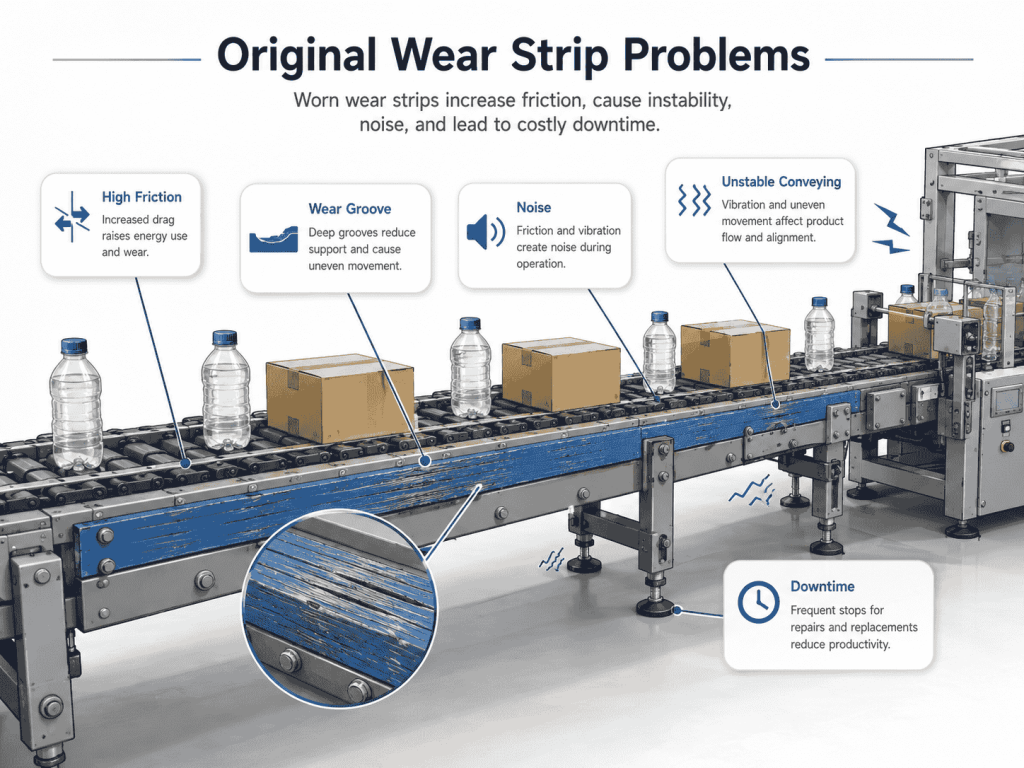
The original conveyor used standard plastic wear strips beneath the chain as supporting and guiding components. After a period of continuous operation, visible grooves and deformation appeared on the wear strip surfaces. The uneven surfaces gradually increased the resistance between the chain and the conveyor guide.
As wear became more severe, the conveyor began to produce abnormal noise, vibration, and unstable product movement. Bottles and packages could no longer maintain consistent spacing and alignment. Maintenance personnel had to stop the production line regularly to inspect, adjust, or replace the worn components.
Problems with the Original Conveyor Wear Strips
Rapid Surface Wear
The conveyor chain continuously slid across the wear strip surface. Under repeated friction, the original material developed deep wear grooves. Once the supporting surface became uneven, chain movement became less stable and wear accelerated further.
High Sliding Resistance
A wear strip with poor sliding properties creates additional resistance between the conveyor chain and its support surface. The drive motor must then work harder to maintain the required conveying speed.
Excessive resistance may also contribute to chain vibration, irregular movement, and increased stress on sprockets and transmission components.
Moisture-Related Dimensional Changes
Food and beverage conveyor systems are often cleaned with water. Some engineering plastics absorb more moisture than others and may experience dimensional changes after prolonged exposure to wet environments.
Changes in the wear strip dimensions can affect mounting clearances, guide accuracy, and the alignment of the conveyor chain.
Frequent Replacement and Downtime
Wear strips are replaceable components, but an unnecessarily short replacement cycle increases both material and labor costs. Each replacement may require conveyor disassembly, installation, alignment, testing, and production restart.
Frequent maintenance therefore affects more than the cost of the wear strip itself. It can also reduce production availability and create additional workload for maintenance personnel.
Operating Conditions
Before selecting a wear strip material, it is important to evaluate the actual operating conditions of the conveyor system. Important factors include:
- Weight and dimensions of the transported products
- Conveyor chain or belt speed
- Daily operating time
- Frequency of starting and stopping
- Working temperature
- Exposure to water, cleaning agents, or chemicals
- Presence of dust or abrasive particles
- Straight, inclined, or curved conveyor sections
- Wear strip mounting and fastening method
In this project, the conveyor operated continuously and was cleaned regularly. The replacement material therefore needed to provide wear resistance, low sliding friction, low moisture absorption, impact resistance, and stable performance in a wet processing environment.
Conveyor Wear Strip Material Selection
Common materials used for conveyor wear strips and guide components include nylon, POM, HDPE, and UHMWPE. Each material offers different mechanical and sliding characteristics.
Nylon
Nylon provides good mechanical strength, toughness, and wear resistance. However, its moisture absorption must be considered when it is used in humid or frequently washed environments. Moisture absorption may affect dimensions and installation clearances.
POM
POM, also known as acetal, offers good rigidity, dimensional stability, and low friction. It is commonly used for precision guides, gears, rollers, and packaging machinery components. However, material selection should still be based on load, impact, temperature, and continuous operating conditions.
HDPE
HDPE has low moisture absorption, good chemical resistance, and relatively low weight. It is suitable for many general-purpose guides, liners, pads, and light-duty sliding components.
UHMWPE
UHMWPE combines excellent wear resistance, low sliding friction, high impact strength, low moisture absorption, and good chemical resistance. These properties make it suitable for long-running conveyor guides, chain supports, wear strips, slide plates, and curved guide rails.
According to the official Ensinger polyethylene material guide, polyethylene materials are characterized by properties such as low moisture absorption, impact strength, and wear resistance. Material grades and actual performance should always be evaluated according to the specific application.
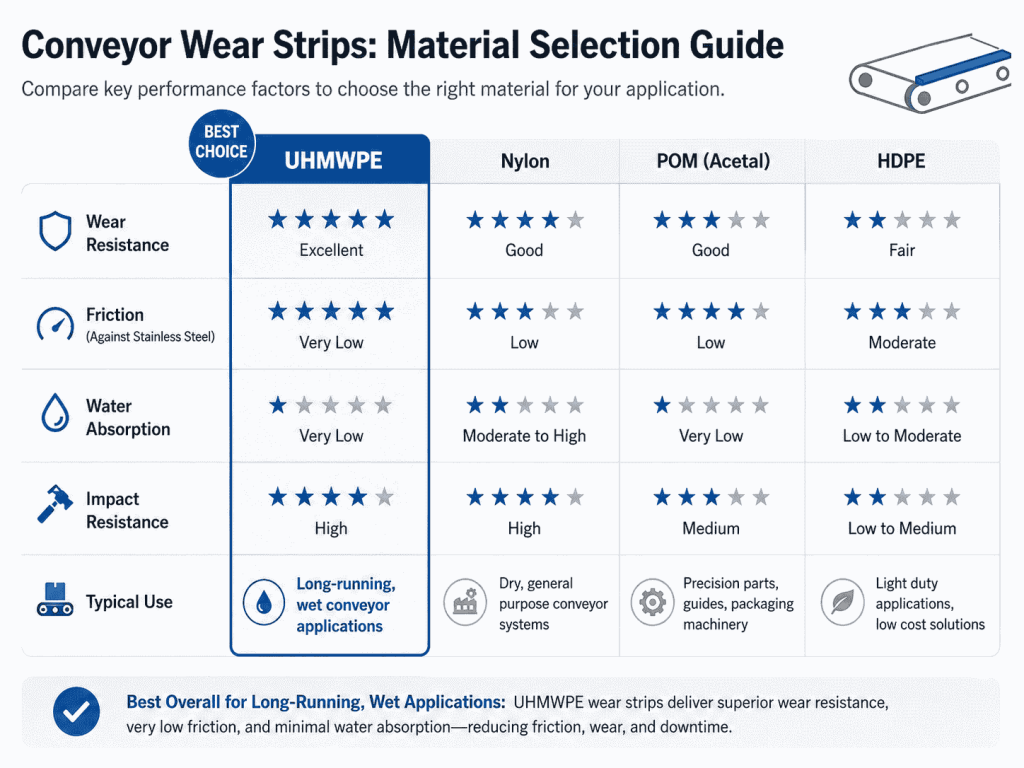
After reviewing the operating conditions and maintenance requirements, UHMWPE was selected for the replacement conveyor wear strips.
Why UHMWPE Was Selected
High Wear Resistance
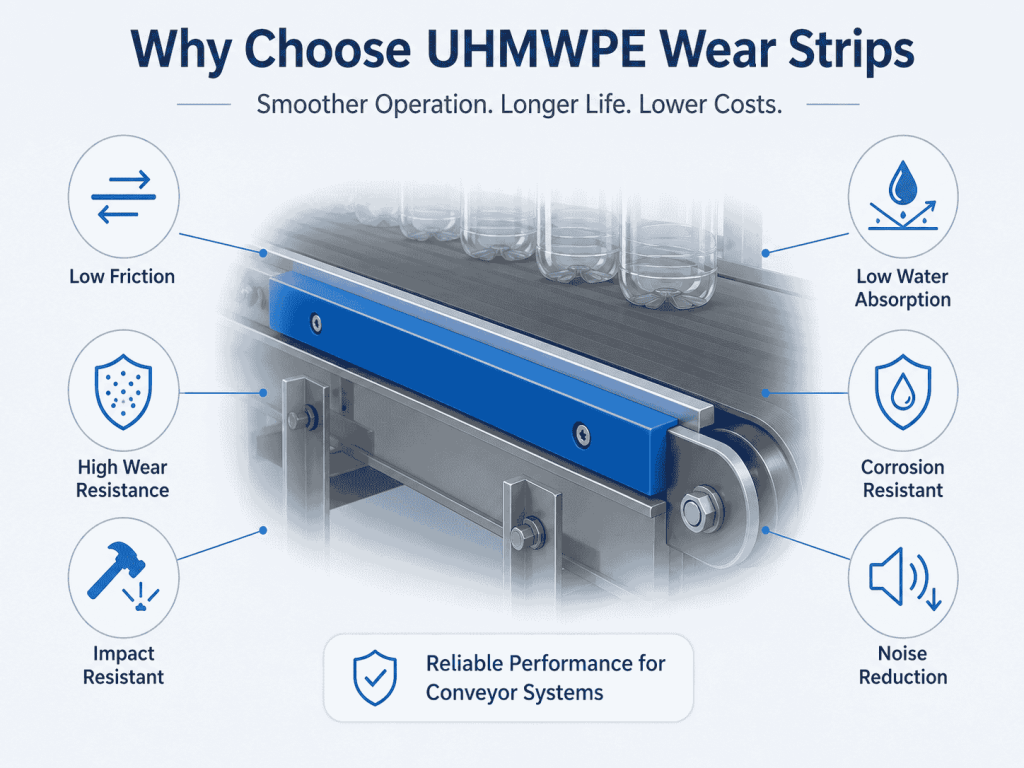
UHMWPE is well suited for components exposed to continuous sliding and abrasive contact. When installed beneath a conveyor chain or along a guide surface, it can help reduce the rate at which grooves and uneven wear develop.
Röchling describes its PE-UHMW wear strip material as having strong sliding characteristics, abrasion resistance, and chemical resistance for applications including mechanical engineering, material handling, beverage production, and packaging equipment. More information is available in its official overview of PE-UHMW wear strips.
Low Sliding Friction
The smooth surface and self-lubricating characteristics of UHMWPE help reduce sliding resistance between the conveyor chain and the supporting guide.
Lower resistance can improve chain movement, reduce unnecessary drive load, and help the conveyor operate more consistently. It may also reduce stick-slip movement in applications where products or components repeatedly slide across the guide surface.
High Impact Resistance
Conveyor systems are exposed to impact during startup, shutdown, product accumulation, and occasional material jams. UHMWPE offers good toughness and impact resistance, helping the wear strip withstand repeated mechanical loading without easily cracking or chipping.
Low Water Absorption
Wear strips used in food processing, bottling, and washing equipment are frequently exposed to water. UHMWPE absorbs very little moisture, helping the component maintain more stable dimensions in wet environments.
This characteristic is particularly useful when maintaining consistent conveyor clearances and guide alignment is important.
Corrosion and Chemical Resistance
Unlike metal guide components, UHMWPE does not rust. It also provides resistance to many commonly encountered chemicals, making it useful in wet, corrosive, or frequently cleaned operating environments.
The suitability of the material should still be confirmed when it will be exposed to concentrated chemicals, high temperatures, or unusual cleaning agents.
Noise Reduction
UHMWPE can reduce direct metal-to-metal contact between the conveyor chain and the supporting frame. The plastic guide surface also helps absorb some vibration and impact, which may reduce friction-related noise during operation.
Machining and Installation
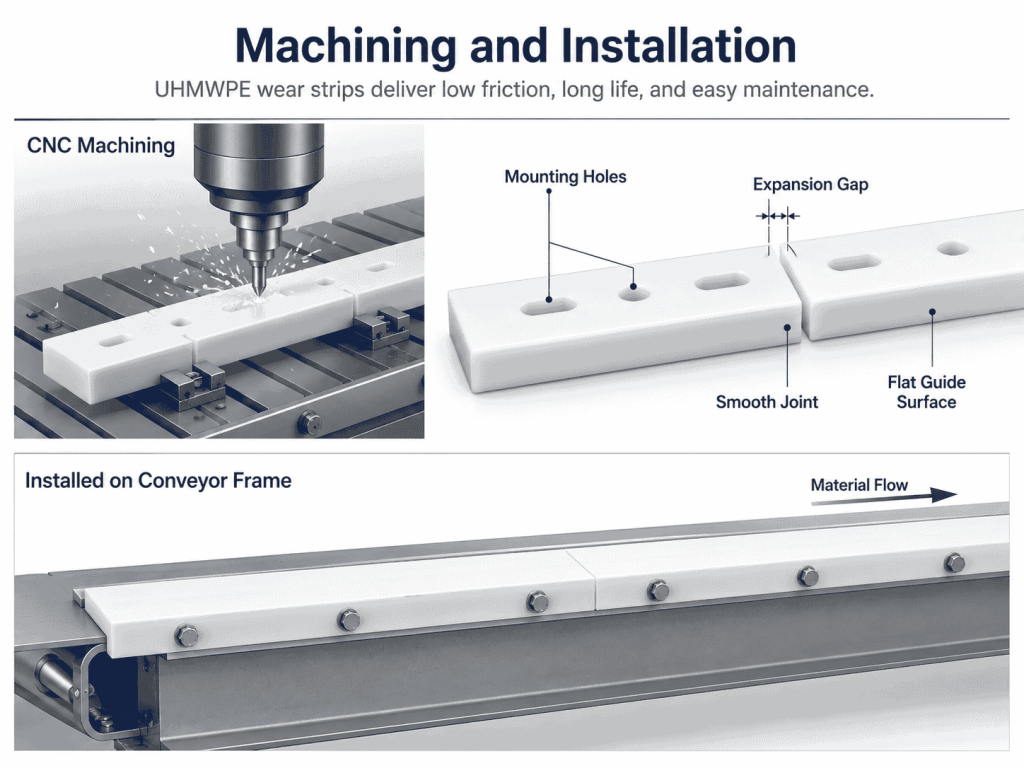
UHMWPE wear strips can be machined according to the conveyor structure and installation drawing. Common designs include:
- Flat wear strips
- L-shaped guide strips
- U-shaped chain guides
- T-shaped guide profiles
- Curved conveyor guides
- Slide plates
- Wear strips with round or elongated mounting holes
For this project, the length, width, thickness, hole spacing, guide dimensions, and mounting locations were checked against the original conveyor structure. The replacement parts were then machined using CNC equipment.
Allow for Thermal Expansion
UHMWPE has a higher thermal expansion rate than metal. Long wear strips should not be installed without suitable clearance. An appropriate expansion gap helps prevent the strip from buckling, arching, or pressing against adjacent components when the operating temperature changes.
Use Suitable Mounting Holes
Mounting holes must align correctly with the conveyor frame. Elongated slots are often used in longer wear strips because they allow limited dimensional movement while keeping the component securely positioned.
Fasteners should hold the wear strip in place without restricting all thermal movement or deforming the plastic surface.
Keep Joints Smooth
When multiple wear strip sections are installed in sequence, the joints should remain smooth and properly aligned. Raised edges, steps, or large gaps may cause the chain to vibrate, jump, or catch as it moves across the connection.
In some installations, the ends can be machined or angled according to the direction of travel to create a smoother transition.
Maintain a Flat Guide Surface
After installation, the complete guide surface should be inspected for flatness, alignment, and consistent width. Local dimensional errors may affect chain movement even when the correct material has been selected.
Additional examples of PE-UHMW conveyor components can be found on Röchling’s official page for sliding profiles used in conveyor systems.
Results After Replacement
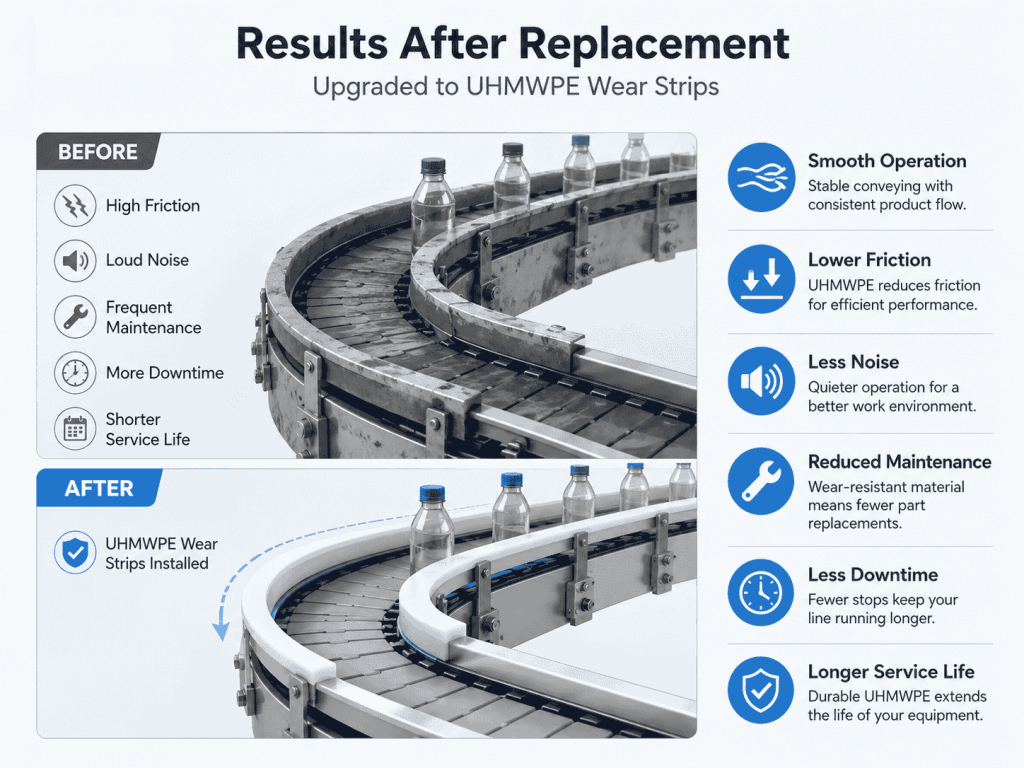
After the original components were replaced with CNC-machined UHMWPE wear strips, the conveyor chain moved more smoothly across the supporting surfaces. Friction-related noise and vibration were reduced, and product movement became more stable.
The new wear strips were less likely to develop deep grooves within a short operating period. Maintenance personnel no longer needed to make frequent adjustments or repeatedly replace the guide components.
The main improvements included:
- Lower sliding resistance between the chain and guide surface
- Smoother and more stable conveyor movement
- Reduced friction-related vibration and noise
- Fewer wear strip replacements
- Lower maintenance frequency
- Reduced load on drive and transmission components
- Less downtime caused by guide wear
- Longer service intervals
Actual service life and performance depend on conveyor speed, load, alignment, operating temperature, product accumulation, cleaning methods, and installation accuracy. UHMWPE should therefore be selected as part of a complete evaluation rather than solely on the basis of material name or price.
Recommended Applications
Beverage Bottling Lines
UHMWPE wear strips can be used as chain supports, side guides, and curved guide rails in bottled water, beverage, and container handling equipment.
Food Packaging Machinery
Typical applications include packaging lines, filling machines, cartoning systems, sorting equipment, and food conveyor guides that require low friction and frequent cleaning.
Paper and Printing Equipment
UHMWPE components can be used in paper handling, sheet guiding, sliding support, and other positions where reducing friction and avoiding direct metal contact are important.
Wastewater Treatment Equipment
Low moisture absorption and corrosion resistance make UHMWPE suitable for selected chain guides, wear plates, scraper components, and sliding parts used in wet environments.
Industrial Automation Systems
Automated production lines, logistics conveyors, assembly equipment, and sorting systems commonly use UHMWPE wear blocks, guide strips, slide plates, and chain support components.
Curved Conveyor Systems
Curved UHMWPE guide rails can be machined according to the conveyor path. They support and guide the chain through turning sections while helping reduce friction, vibration, and lateral movement.
How to Select the Right Conveyor Wear Strip
Selecting the correct wear strip requires more than confirming the external dimensions. The following information should be reviewed before production:
- Conveyor drawing and installation dimensions
- Chain or belt type
- Operating speed
- Product weight and distribution
- Continuous operating time
- Maximum and minimum temperatures
- Exposure to water or chemicals
- Required dimensional accuracy
- Fastener type and mounting method
- Straight or curved running path
HDPE, nylon, and POM may be suitable for general or application-specific conveyor components. However, UHMWPE is often preferred for long-running systems that require a combination of low friction, wear resistance, impact strength, low moisture absorption, and corrosion resistance.
If the existing conveyor experiences rapid guide wear, chain noise, unstable movement, excessive drive load, or frequent shutdowns, the material, guide geometry, installation clearance, and conveyor alignment should all be reviewed before producing a direct replacement.
Conclusion
A conveyor wear strip may appear to be a simple component, but it directly affects chain resistance, noise, product stability, maintenance frequency, and production availability.
When properly selected, machined, and installed, UHMWPE wear strips can provide a durable, low-friction guide surface for conveyor chains, belts, and transported products. They help reduce wear, improve conveying stability, and extend the time between maintenance shutdowns.
The best results depend on matching the material grade, component structure, machining tolerances, mounting method, and expansion allowance to the actual operating conditions of the conveyor system.