

A CNC machined nylon bushing is an engineering plastic component installed between a shaft, pin, roller, or moving mechanism and its metal housing. It supports rotating or oscillating parts, reduces direct metal-to-metal contact, controls movement clearance, and protects expensive shafts and mounting holes from premature wear.
In industrial machinery, shafts and pins are frequently exposed to repeated rotation, reciprocating movement, vibration, dust, moisture, and intermittent impact. Without a suitable bushing, the shaft may rub directly against the equipment frame, resulting in noise, heat generation, unstable movement, enlarged mounting holes, and increased maintenance costs.
CNC machining allows nylon bushings to be manufactured according to technical drawings, physical samples, or measured equipment dimensions. The inside diameter, outside diameter, length, flange, shoulder, lubrication groove, and mounting structure can be adjusted to match the original machinery.
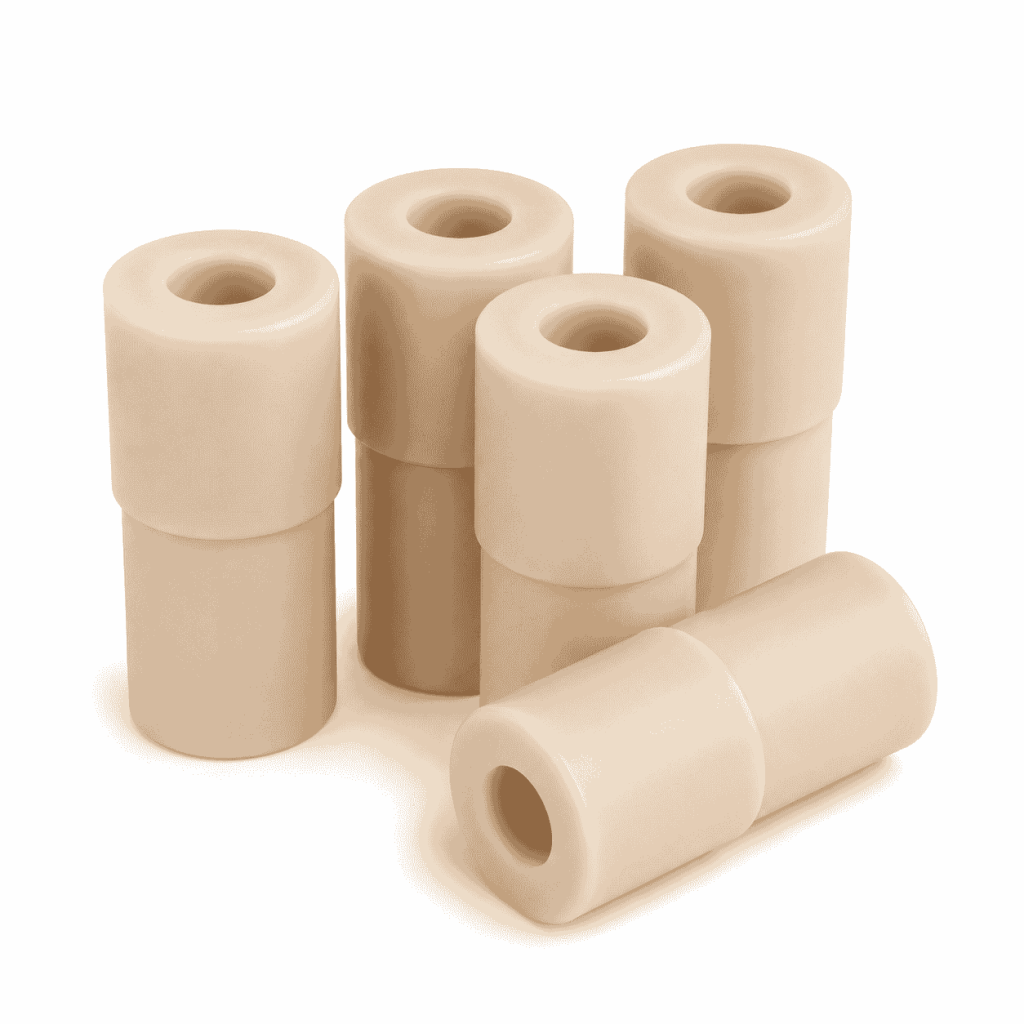
Applications of CNC Machined Nylon Bushings
CNC machined nylon bushings can be used in a wide range of industrial machinery, including:
- Conveyor systems
- Material-handling equipment
- Industrial rollers
- Lifting and positioning machinery
- Agricultural machinery
- Woodworking equipment
- Textile machinery
- Mining auxiliary equipment
- Construction-material machinery
- Automated production equipment
Typical installation positions include roller shafts, pivot pins, linkage mechanisms, swing arms, guide assemblies, hinges, support shafts, and low-speed rotating components.
Main Functions of a Nylon Bushing
1. Supporting Shafts and Pivot Pins
A nylon bushing forms a supporting layer between the shaft and the equipment housing. It helps maintain shaft alignment and limits unnecessary sideways movement during rotation, swinging, or reciprocating operation.
This function is useful in rollers, connecting rods, pivot joints, lifting mechanisms, and other assemblies where the shaft must move while remaining within a controlled position.
2. Reducing Metal-to-Metal Contact
When a steel shaft rotates directly inside a steel mounting hole, both surfaces can experience friction, scoring, and progressive wear. A nylon bushing separates the two metal surfaces and becomes a replaceable wear component.
When the bushing reaches its wear limit, it can normally be replaced without changing the complete shaft support or repairing the machine frame.
3. Controlling Movement Clearance
The inner bore of the bushing is machined according to the shaft diameter and required operating clearance. Correct clearance helps the shaft rotate or oscillate without excessive resistance while limiting vibration and unstable movement.
A bore that is too tight may cause difficult assembly, increased friction, heat generation, or seizure. A bore that is too loose may result in shaft movement, noise, poor positioning, and uneven wear.
4. Reducing Noise and Vibration
Nylon provides a degree of mechanical damping and is less rigid than steel. In suitable low-speed and moderate-load applications, it can reduce the noise and vibration produced by direct contact between metal components.
5. Protecting Shafts and Equipment Housings
Replacing a worn shaft or repairing an enlarged machine-frame bore can be costly. A replaceable nylon bushing is designed to accept part of the sliding wear, helping protect the original shaft and mounting structure.
Industrial Machinery Problems Addressed by Nylon Bushings
A properly designed CNC machined nylon bushing can help address several common equipment problems:
- Direct friction between a steel shaft and metal housing
- Increasing clearance caused by worn mounting holes
- Noise generated by loose pivot pins
- Rollers or swing arms moving from side to side
- Frequent lubrication of conventional metal bushings
- Corrosion of ordinary carbon-steel bushings
- Difficulty sourcing discontinued replacement parts
- Standard bushings not fitting non-standard machinery
- High repair costs for shafts and bearing housings
- Vibration and impact during repeated starting and stopping
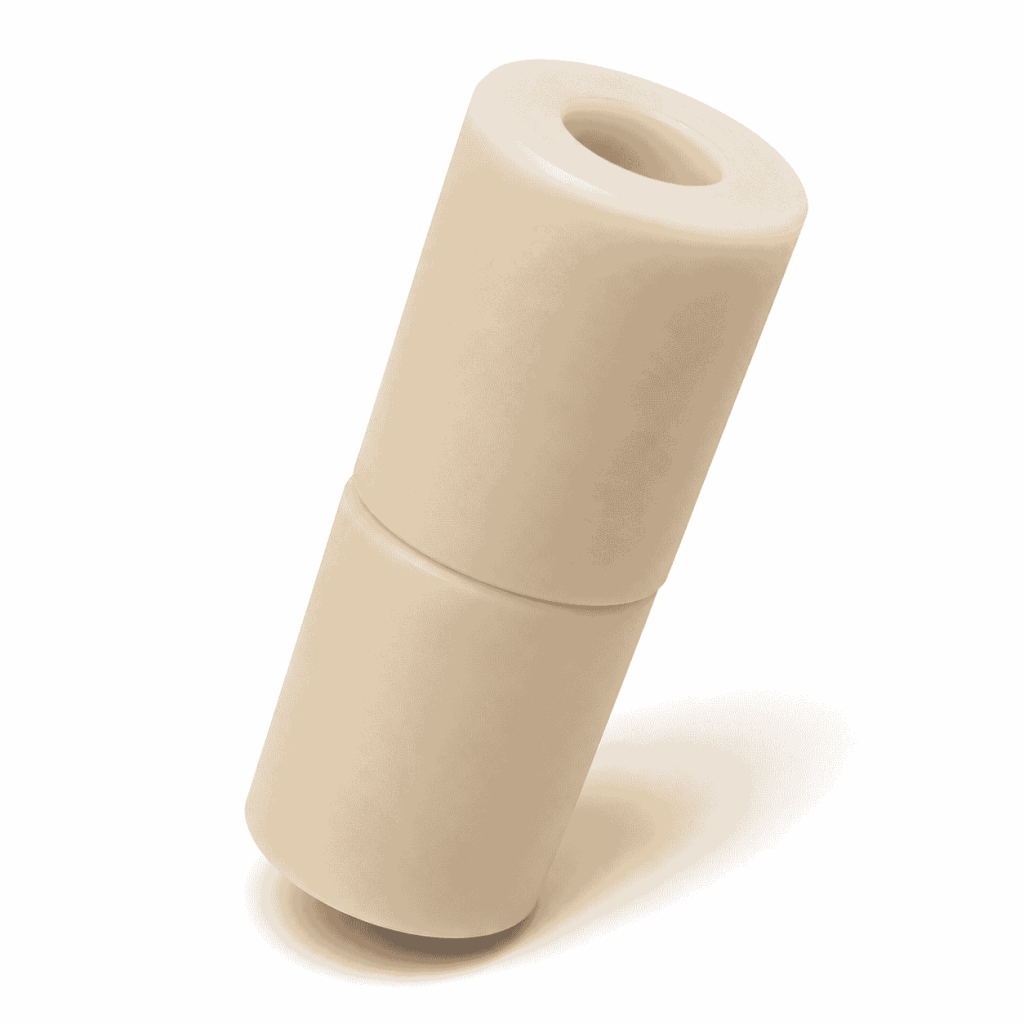
Why Nylon Is Used for Industrial Bushings
Wear and Abrasion Resistance
Engineering nylon offers useful wear and abrasion resistance for many sliding, oscillating, and low-speed rotating applications. This makes it suitable for replaceable bushings, guide components, rollers, and wear parts.
Low-Friction Sliding Performance
Nylon has relatively good sliding properties and a lower coefficient of friction than many metal-to-metal combinations. Depending on the load, speed, nylon grade, and operating environment, it may reduce the amount of external lubrication required.
More information about the sliding, wear, mechanical, and moisture-absorption characteristics of polyamide materials is available in the Ensinger polyamide material guide.
Mechanical Strength and Toughness
Nylon combines strength with a degree of toughness, allowing a properly designed bushing to withstand moderate radial loads, repeated movement, and intermittent impact.
The allowable load depends on the material grade, wall thickness, shaft diameter, contact area, speed, temperature, and duty cycle. Nylon should not automatically replace a metal bearing in every load-bearing position.
Corrosion Resistance
Unlike ordinary carbon steel, nylon does not rust. It can therefore be useful in machinery exposed to humidity, water spray, industrial dust, or other environments where corrosion of an unprotected metal bushing may be a concern.
Lower Weight
A nylon bushing is lighter than a solid steel or bronze bushing of similar dimensions. This can be useful in rollers, moving arms, lifting assemblies, and mechanisms where reducing moving mass is beneficial.
Machinability
Nylon can be turned, bored, drilled, milled, grooved, and faced using CNC equipment. This makes it suitable for producing non-standard bushings in small batches or repeated production quantities.
Common CNC Machined Nylon Bushing Designs
Different installation conditions require different bushing structures. Common designs include:
- Straight sleeve nylon bushings
- Flanged nylon bushings
- Stepped nylon bushings
- Thin-wall nylon bushings
- Heavy-wall nylon bushings
- Split nylon bushings
- Slotted nylon bushings
- Bushings with lubrication grooves
- Bushings with locating shoulders
- Bushings with keyways or positioning holes
- Nylon bushings with metal inserts
Straight Sleeve Bushing
A straight sleeve bushing has a simple cylindrical structure and is commonly installed in rollers, pivots, support shafts, and general rotating mechanisms.
Flanged Nylon Bushing
A flange at one end provides axial positioning and prevents the bushing from moving completely through the mounting hole. The flange can also separate adjacent metal surfaces.
Stepped Nylon Bushing
A stepped structure is suitable for equipment with different housing diameters, locating shoulders, or multi-stage installation surfaces.
Lubrication-Groove Bushing
Lubrication grooves can distribute grease across the sliding surface when external lubrication is required. The groove shape and position should be designed so that they do not excessively reduce the load-bearing area.
CNC Machining and Dimensional Control
The operating performance of a nylon bushing depends on the accuracy of its inner bore, outside diameter, length, flange, and positioning surfaces.
Inner Bore
The inner bore determines the operating clearance between the bushing and shaft. The required clearance should consider shaft tolerance, rotational speed, temperature, moisture exposure, load, and whether lubrication is used.
Outside Diameter
The outside diameter determines the fit between the bushing and equipment housing. If the interference is excessive, pressing the bushing into the housing may compress the wall and reduce the inner bore diameter.
If the fit is too loose, the bushing may rotate inside the housing, move axially, or become unstable during machine operation.
Concentricity
The concentricity between the inner bore and outside diameter affects shaft alignment. Excessive deviation can cause uneven loading, local wear, increased friction, and unstable movement.
Flange and End Faces
For flanged bushings, the flange thickness, outside diameter, and end-face flatness influence axial positioning and assembly with adjacent components.
Nylon Material Options
PA6 Nylon
PA6 offers a practical combination of toughness, machinability, and wear resistance for general industrial bushings and sliding parts.
PA66 Nylon
PA66 normally provides greater rigidity and thermal performance than standard PA6, but its dimensional behavior under moisture exposure must still be considered.
Cast Nylon PA6C
Cast nylon is commonly used for larger and thicker machined components, including heavy-wall bushings, rollers, guide wheels, wear blocks, and other non-standard industrial parts.
Oil-Filled or Lubricated Nylon
Lubricated nylon grades are designed to improve sliding and wear performance in suitable applications. The selected grade must still be checked against the actual pressure, speed, temperature, and environmental conditions.
An example of a lubricated cast nylon material and its technical characteristics is available in the Ensinger oil-filled cast nylon guide.
Moisture Absorption and Dimensional Stability
Nylon absorbs moisture from its environment. Moisture absorption can change the dimensions and mechanical properties of a finished bushing, particularly where the wall is thick or the machining tolerance is tight.
For precision assemblies, the designer should consider:
- Humidity in the operating environment
- Direct exposure to water
- Material conditioning before machining
- Expected dimensional change after installation
- Allowable shaft clearance
- Press-fit effects on the inner bore
Nylon moisture absorption and the resulting dimensional changes are explained in the Ensinger PA6 technical overview.
Important Operating Factors
Before manufacturing a CNC machined nylon bushing, the following information should be confirmed:
| Operating Factor | Why It Matters |
|---|---|
| Shaft diameter and tolerance | Determine the bushing bore and operating clearance |
| Housing diameter | Determines the outside diameter and installation fit |
| Radial load | Affects wall thickness, bearing area, and material grade |
| Rotational speed | Influences friction, heat generation, and wear rate |
| Movement type | Rotation, oscillation, and reciprocation produce different wear patterns |
| Operating temperature | Affects strength, clearance, and dimensional stability |
| Moisture exposure | May change nylon dimensions and mechanical properties |
| Lubrication method | Affects friction, wear, and maintenance requirements |
| Continuous operating time | Influences heat buildup and expected service life |
Installation Considerations
Before installing the bushing, the shaft and housing should be checked for burrs, corrosion, scoring, and dimensional damage. A worn shaft or deformed mounting hole may prevent a newly machined bushing from operating correctly.
The bushing should be pressed evenly into the housing using suitable tooling. Direct hammer impact can damage the flange, deform the wall, or reduce the inner bore diameter.
After installation, the shaft should be checked for free movement, correct alignment, and suitable operating clearance before the equipment returns to service.
When Nylon Bushings May Not Be Suitable
A nylon bushing is not the correct solution for every industrial application. Alternative materials or bearing systems should be evaluated when the equipment involves:
- Very high rotational speed
- High continuous radial load
- Elevated operating temperature
- Extremely tight dimensional tolerances
- Long-term immersion in water or aggressive chemicals
- Insufficient heat dissipation
- Very thin bushing walls
- Critical safety-related load-bearing mechanisms
Depending on the working conditions, alternative solutions may include POM bushings, PTFE-based bearings, PEEK components, composite plain bearings, bronze bushings, or rolling-element bearings.
General information about engineered self-lubricating polymer plain bearings is available from the igus polymer plain bearing guide.
Custom Nylon Bushing Manufacturing
CNC machined nylon bushings can be produced from technical drawings, physical samples, or verified measurements taken from the equipment. Before production, the original part and installation location should be checked carefully.
Important manufacturing information includes:
- Inside diameter and tolerance
- Outside diameter and tolerance
- Overall length
- Flange diameter and thickness
- Step and shoulder dimensions
- Required nylon grade
- Lubrication-groove design
- Shaft and housing materials
- Operating load and speed
- Working temperature and humidity
- Required production quantity
When reproducing a worn bushing, the damaged dimensions should not be copied automatically. The shaft, housing, original drawing, and wear condition should be evaluated to determine the correct finished size.
Conclusion
A CNC machined nylon bushing is used in industrial machinery to support shafts, guide pivot pins, reduce friction, control movement clearance, lower noise, and protect equipment housings from direct wear.
Straight, flanged, stepped, split, grooved, and other non-standard nylon bushings can be manufactured according to equipment drawings or physical samples. The final material and dimensions should be selected according to the shaft size, housing fit, load, speed, temperature, humidity, lubrication method, and operating cycle.
Similar CNC machined nylon components include guide rollers, wear blocks, gears, rope pulleys, sliding plates, spacers, and positioning components for industrial machinery.