

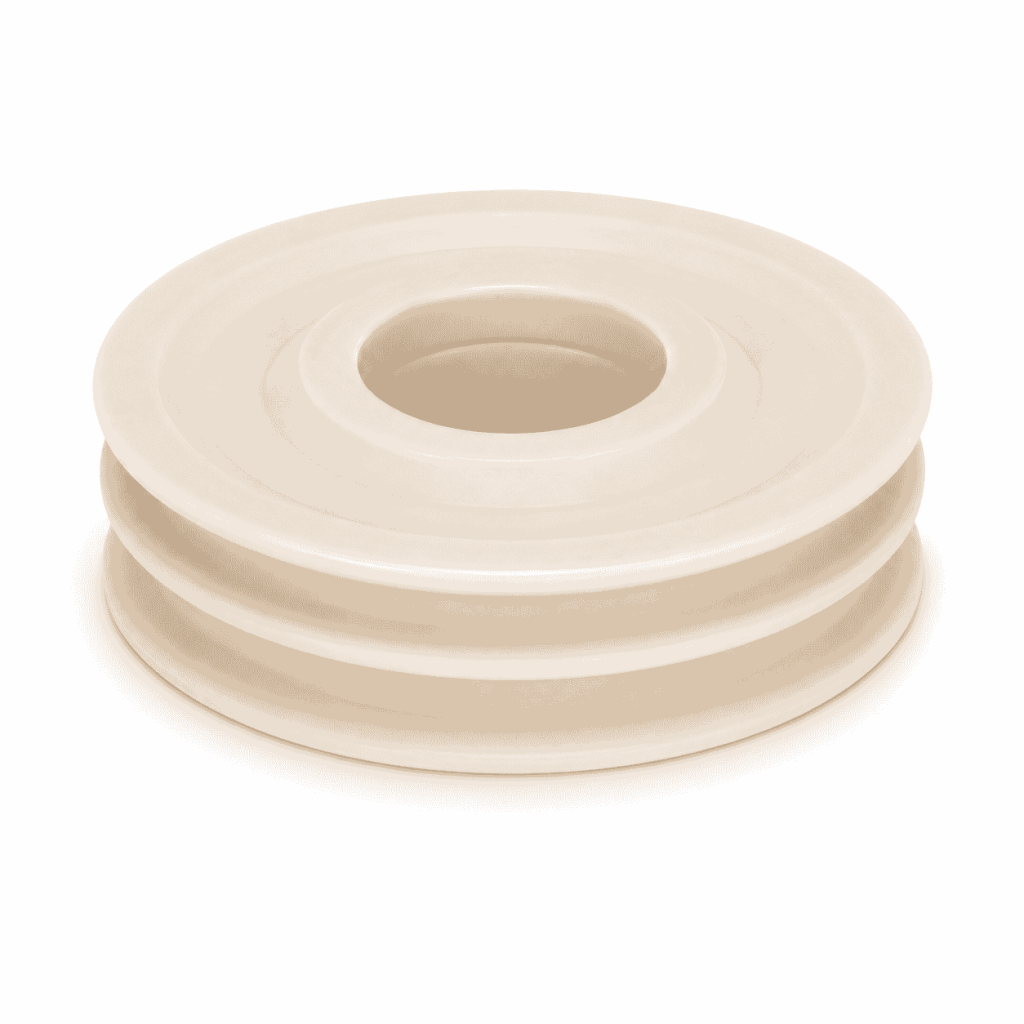
A CNC machined nylon rope guide pulley is used in tower cranes and other industrial lifting machinery to guide, position, and redirect wire ropes along a specified operating path. It is normally installed on a shaft or support bracket near a hoist, trolley mechanism, rope drum, or auxiliary lifting system.
During crane operation, the wire rope repeatedly moves, changes direction, and enters or leaves the winding system. Without an appropriately designed guide pulley, the rope may swing sideways, rub against nearby metal structures, enter the drum at an incorrect angle, or become unstable during starting and braking.
A CNC machined nylon rope guide pulley can be produced according to an equipment drawing, an existing sample, or measured installation dimensions. Its outer diameter, rope groove, center bore, bearing seat, wheel width, and mounting structure can be customized for the original machinery.
Applications in Tower Cranes and Industrial Machinery
CNC machined nylon rope guide pulleys can be used in several auxiliary wire-rope guiding positions, including:
- Tower crane hoisting rope guide mechanisms
- Trolley traveling and luffing rope systems
- Hoist drum rope-entry positions
- Auxiliary rope-positioning mechanisms
- Material hoists and lifting platforms
- Industrial winches
- Warehouse lifting equipment
- Wire-rope traction systems
In these applications, the pulley groove keeps the wire rope within a controlled path and helps direct it toward the drum, sheave group, or traction mechanism.
General information about crane lifting systems is available in the crane machinery overview.
Guiding the Wire Rope During Operation
Tower cranes rely on wire ropes for lifting, trolley movement, and other mechanical functions. The rope must enter the related drum or pulley system at a suitable position and angle.
A nylon rope guide pulley limits unnecessary lateral movement and helps maintain a more stable rope path. This is especially useful near rope-entry points, auxiliary redirecting positions, and locations where the rope could otherwise contact a bracket, frame, or protective cover.
More information about wire-rope construction and operation can be found in the wire rope overview.
Main Functions of a Nylon Rope Guide Pulley
1. Maintaining the Wire-Rope Path
The machined rope groove limits sideways movement and helps the wire rope follow the intended route during lifting, lowering, winding, and direction changes.
2. Reducing Contact with Metal Structures
If a wire rope repeatedly rubs against a metal bracket or frame edge, concentrated wear may develop on the outer wires. A guide pulley separates the moving rope from surrounding structural components.
3. Supporting Rope Direction Changes
The pulley can help redirect a wire rope at an auxiliary turning point. The groove profile should match the rope diameter and operating geometry so the rope remains supported during movement.
4. Reducing Operating Noise
Nylon provides more flexible contact than an uncoated metal wheel. It can reduce some of the impact, vibration, and noise produced when a steel wire rope runs across a rigid guiding component.
5. Reducing Component Weight
A nylon pulley is generally lighter than a solid steel pulley of similar dimensions. Lower weight can simplify installation and reduce the load applied to auxiliary brackets and supporting assemblies.
Equipment Problems the Nylon Guide Pulley Can Address
A correctly designed CNC machined nylon rope guide pulley can help address the following operating problems:
- Wire rope swinging from side to side
- Unstable rope entry into the winding drum
- Wire rope rubbing against a metal bracket
- Excessive noise from steel-to-steel contact
- Rope movement outside the intended operating path
- Corrosion of ordinary steel guide components
- Difficulty sourcing discontinued replacement pulleys
- Standard pulley dimensions not matching older equipment
- Excessive pulley weight at an auxiliary guiding position
For replacement projects, the original pulley, mounting shaft, support bracket, and wire-rope path should be checked before machining. Copying only the outer diameter may not provide the correct installation or operating result.
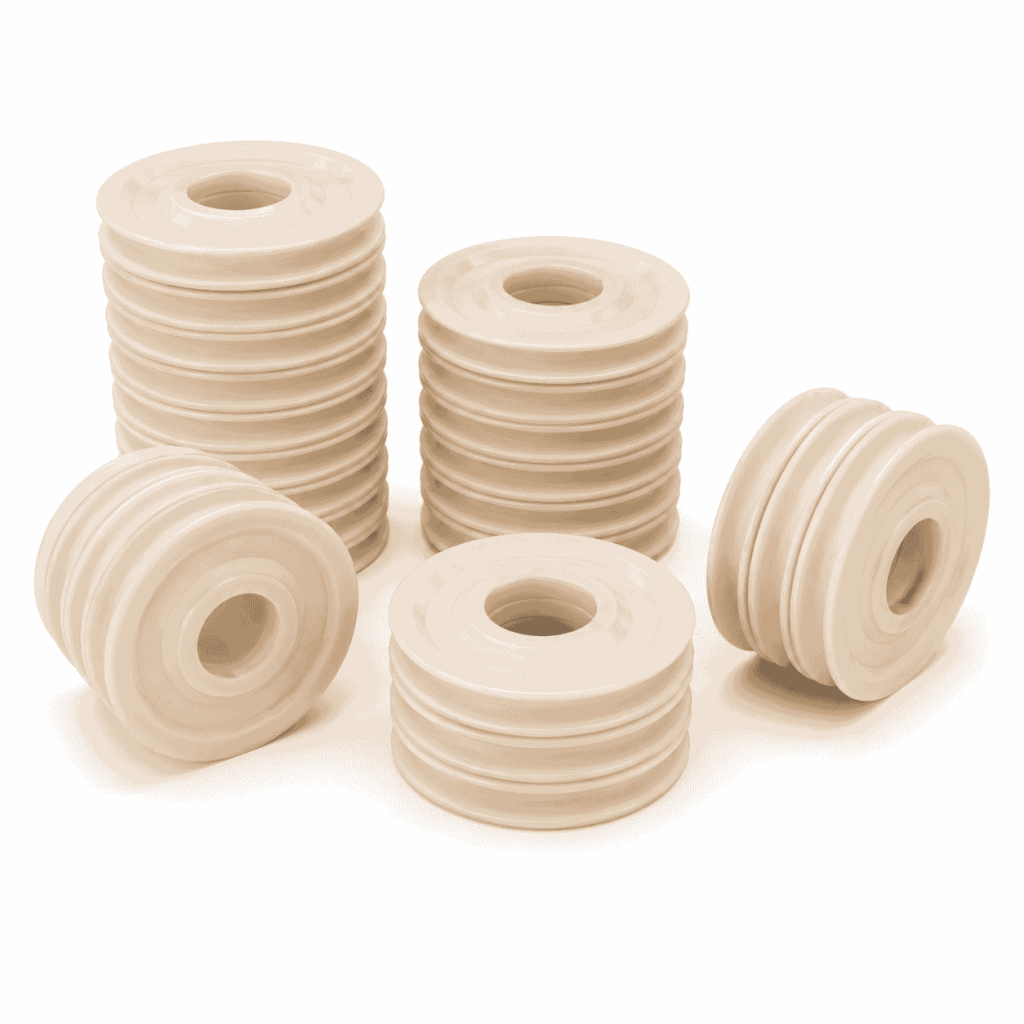
Why Nylon Is Used for Rope Guide Pulleys
Wear Resistance
Engineering nylon provides suitable wear resistance for many rolling and guiding applications. When the groove profile and alignment are correct, the pulley can support repeated contact with a moving wire rope.
Low-Friction Performance
Nylon has relatively low sliding friction and can reduce resistance at the bore, bushing, bearing seat, or rope-contact surface, depending on the pulley design.
Impact Resistance
Starting, braking, and reversing movements can apply changing forces to the rope-guiding mechanism. Nylon has useful toughness and can absorb part of the vibration generated by intermittent operation.
Corrosion Resistance
Nylon does not rust like ordinary carbon steel. This is useful for auxiliary components used outdoors or exposed to rain, humidity, and industrial dust.
Machinability
Nylon can be turned, milled, drilled, bored, and grooved using CNC machining equipment. This allows manufacturers to reproduce non-standard pulleys with specific dimensions and installation features.
Additional background information about the material is available in the nylon material overview.
CNC Machining Requirements
A tower crane nylon rope guide pulley may require several precision-machined features:
- Outer wheel diameter
- Wire-rope groove
- Center shaft bore
- Bearing installation seat
- Stepped center hole
- Retaining-ring groove
- Positioning shoulder
- Metal hub mounting position
- Side flanges
- Mounting or locking holes
The center bore and bearing seat affect rotational stability. Excessive clearance may cause the pulley to shake during operation, while insufficient clearance may make installation difficult or increase rotational resistance.
Wire-Rope Groove Design
The rope groove is one of the most important features of a CNC machined nylon guide pulley. Its width, depth, opening, and bottom radius should be selected according to the wire-rope diameter and operating angle.
A groove that is too narrow may pinch the rope and create concentrated pressure. A groove that is too wide may provide insufficient lateral control and allow the rope to move inside the pulley.
The following information should be confirmed before machining:
- Wire-rope nominal diameter
- Actual measured rope diameter
- Required groove radius
- Rope-entry and exit angles
- Allowable lateral movement
- Pulley rotational speed
- Expected radial load
Common Nylon Rope Guide Pulley Structures
Different industrial machines may require different pulley structures. Common designs include:
- Solid nylon rope guide pulleys
- Nylon pulleys with installed bearings
- Nylon pulleys with metal hubs
- Single-groove guide pulleys
- Double-groove guide pulleys
- Flanged nylon pulleys
- Stepped-bore guide pulleys
- Split nylon guide pulleys
- Custom-profile rope guide wheels
A metal-hub and nylon-wheel combination may be used when the mounting position requires greater bore strength or more stable connection with the shaft. The final structure should be determined by load, speed, installation method, and available space.
Replacement Manufacturing from an Existing Sample
Replacement pulleys for older tower cranes and industrial lifting machines may be difficult to purchase in standard sizes. In these cases, the original part can be measured and reproduced by CNC machining.
Important sample dimensions include:
- Overall outside diameter
- Total wheel width
- Rope-groove profile
- Center-bore diameter
- Bearing model and seat dimensions
- Hub width and shoulder position
- Retaining-ring groove dimensions
- Distance between mounting surfaces
The condition of the old part should also be evaluated. A worn groove, enlarged bore, or deformed mounting surface should not automatically be copied as the original design dimension.
Material and Operating Considerations
Nylon guide pulleys should be selected according to the actual operating conditions rather than appearance alone. The following factors must be considered:
- Static and dynamic radial loads
- Wire-rope tension
- Pulley rotational speed
- Frequency of starting and braking
- Outdoor temperature changes
- Rain, humidity, dust, and sunlight exposure
- Bearing or bushing configuration
- Required dimensional stability
- Inspection and replacement intervals
Nylon can absorb moisture and may experience dimensional changes. Bearing seats, precision bores, and tightly controlled installation positions should therefore be designed with the selected nylon grade and service environment in mind.
Safety Limitations
A nylon rope guide pulley is generally more suitable for auxiliary guiding, positioning, and redirecting applications. It must not automatically replace a primary load-bearing crane sheave merely because the dimensions appear similar.
For a main hoisting sheave, critical load-bearing pulley, or other safety-related crane component, the material and structure must be approved by the equipment manufacturer or a qualified engineering professional. Load capacity, deformation, fatigue life, temperature, shaft strength, bearing performance, and failure consequences must be evaluated.
Tower crane operation and wire-rope inspection should follow the equipment manufacturer’s requirements and applicable safety regulations. Relevant guidance is available from the OSHA tower crane standard and the OSHA wire-rope inspection standard.
Conclusion
A CNC machined nylon rope guide pulley is used in tower cranes and other industrial lifting machinery to guide, position, and redirect wire ropes. It can reduce unwanted rope movement, metal contact, corrosion, vibration, and operating noise while providing a lightweight structure suitable for custom machining.
The pulley can be manufactured from a technical drawing, physical sample, or verified equipment dimensions. Its rope groove, center bore, bearing seat, wheel width, hub structure, and mounting features should be designed according to the wire-rope diameter, load, speed, installation position, and operating environment.
Similar CNC machined nylon components include wire-rope sheaves, guide rollers, shaft bushings, wear blocks, sliding guides, gears, and chain wheels for industrial machinery.