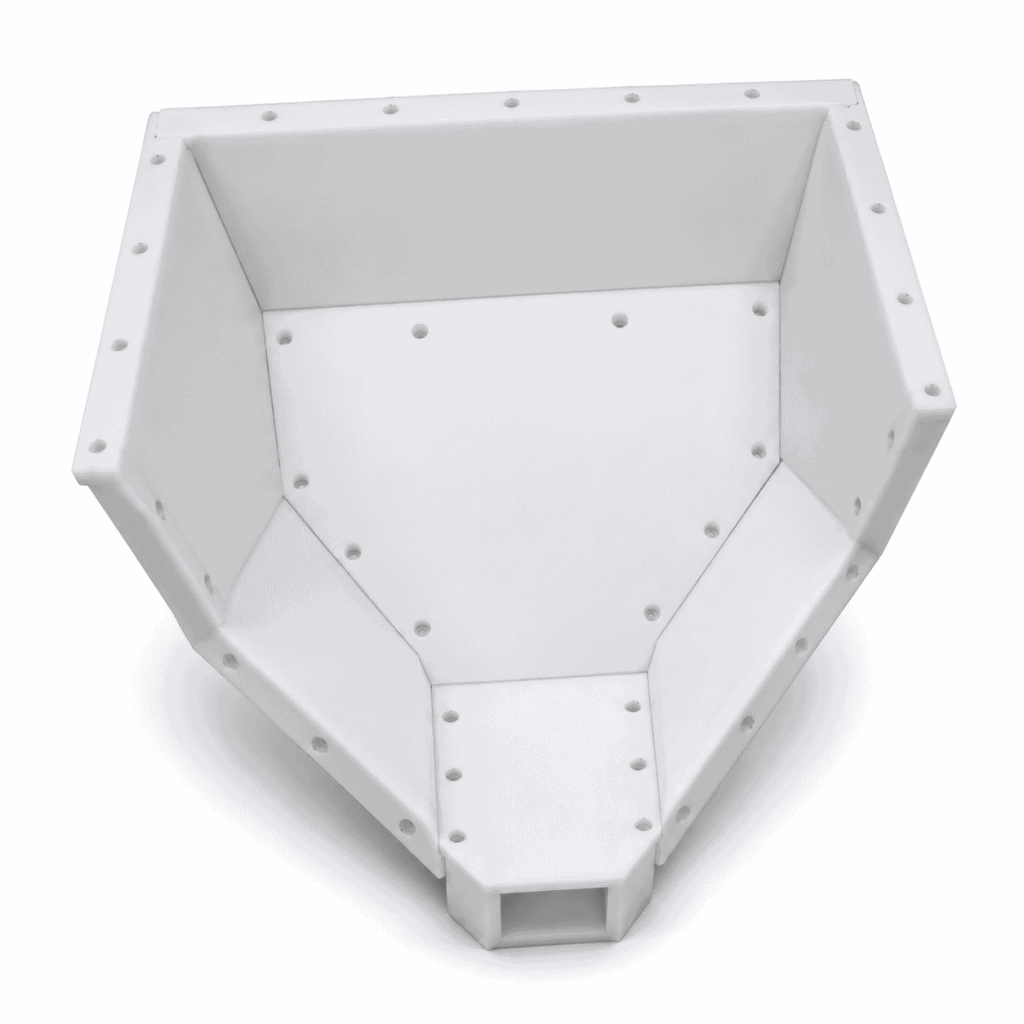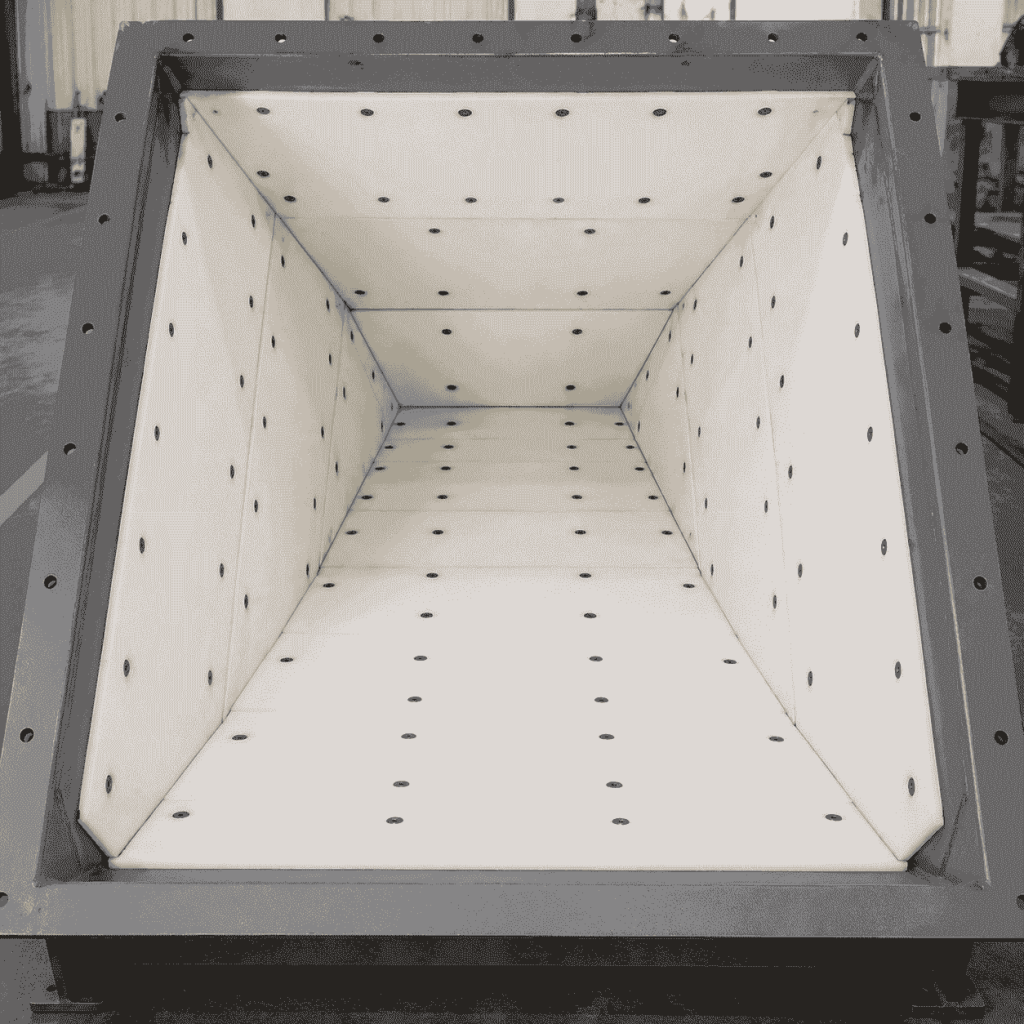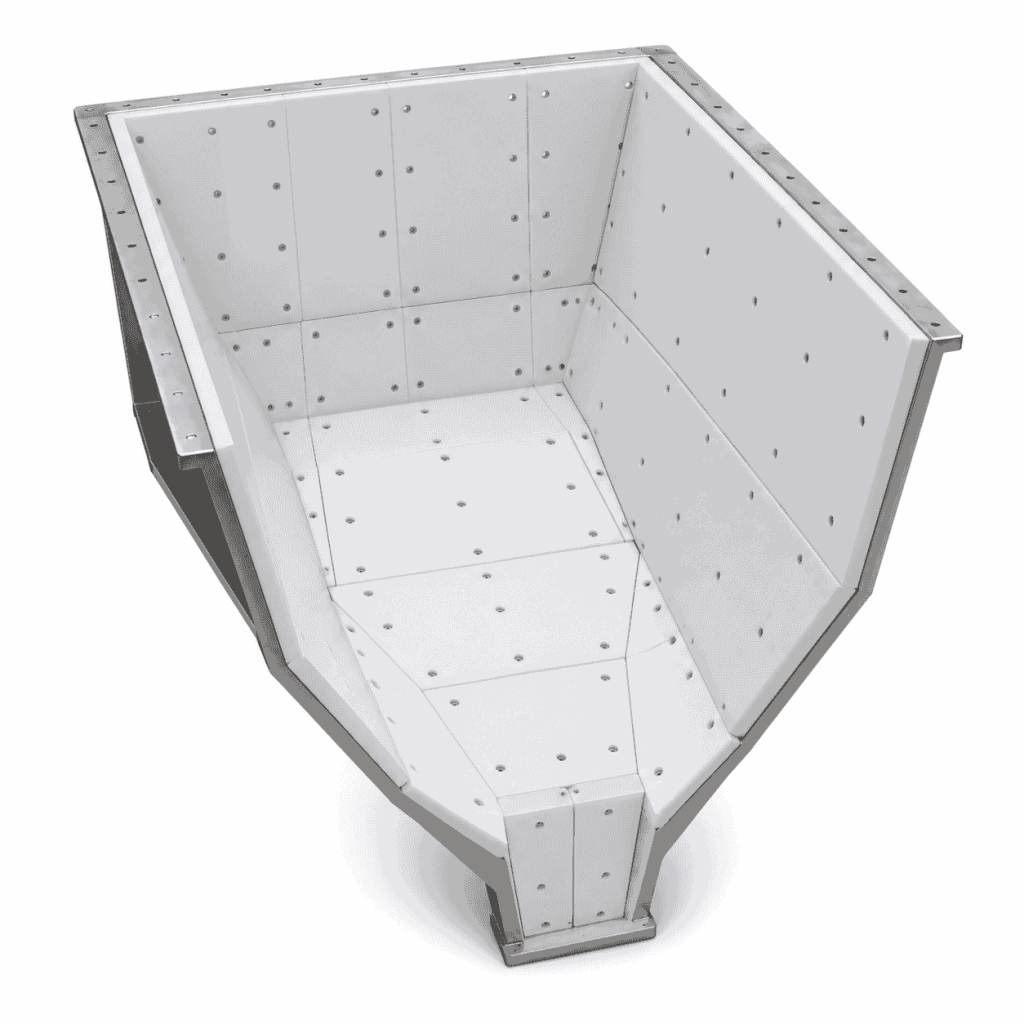

A Food Grade UHMWPE Liner is commonly installed inside food-processing screw conveyors to separate powders or granular ingredients from the metal trough. It provides a replaceable, low-friction wear surface that can reduce abrasion, material buildup, corrosion-related problems, and operating noise.
Food factories frequently use screw conveyors to transfer flour, starch, grain, salt, sugar, seasoning powder, food additives, and other ingredients between storage hoppers, mixers, processing machines, and weighing systems. During continuous operation, these materials slide against the conveyor trough and may gradually wear, scratch, or adhere to the metal surface.
Ultra-high-molecular-weight polyethylene, generally known as UHMWPE or PE1000, offers low sliding friction, wear resistance, impact resistance, low moisture absorption, and resistance to many commonly encountered chemicals. These properties make it suitable for replaceable liners used in many screw conveyor applications.
Functions of a Food Grade UHMWPE Liner
The UHMWPE liner does not replace the structural metal trough or the conveying screw. Its primary function is to form a protective sliding layer between the food ingredient and the conveyor body.
Main functions include:
- Separating food ingredients from the metal conveyor trough
- Reducing abrasion caused by powders and granular materials
- Lowering friction between the product and the trough wall
- Reducing material adhesion and buildup
- Protecting the bottom and sides of the conveyor trough
- Reducing impact and operating noise
- Limiting direct exposure of metal components to moisture and salt
- Providing a replaceable wear component for easier maintenance

UHMWPE Liners for Flour Screw Conveyors
Flour is a fine powder that can collect around joints, corners, mounting hardware, and discharge openings. In humid production environments, flour may absorb moisture, form lumps, and adhere more strongly to rough metal surfaces.
Installing a Food Grade UHMWPE Liner inside the conveyor trough provides a smoother internal surface. This can help flour move toward the discharge area while reducing residue on the bottom and side walls.
Typical equipment includes:
- Flour feeding machines
- Bakery ingredient conveyors
- Dough mixer feeding systems
- Flour dosing equipment
- Noodle production lines
- Premixed flour handling systems
For flour applications, liner surfaces should remain smooth and mounting hardware should not protrude excessively into the product path. Joints should also be designed to minimize material accumulation.
UHMWPE Liners for Grain and Granular Food Conveyors
Rice, wheat, corn, beans, nuts, seeds, and other granular foods repeatedly slide and impact against the conveyor trough. Over time, the bottom section and transition areas may experience concentrated wear.
UHMWPE provides a replaceable wear surface that helps protect the original steel or stainless steel trough. When the liner reaches the end of its service life, the worn section can usually be replaced without manufacturing a completely new conveyor body.
Common applications include:
- Rice conveying equipment
- Wheat and corn feeding systems
- Bean and seed transfer conveyors
- Nut processing lines
- Grain cleaning equipment
- Granular food dosing systems
UHMWPE Liners for Salt Conveying Equipment
Salt is abrasive and may accelerate corrosion when moisture is present. Carbon steel troughs can develop rust, while rough or corroded surfaces may increase conveying resistance and retain more material.
A UHMWPE liner creates a non-rusting separation layer between the salt and the metal trough. Its wear resistance also helps protect areas that are continuously exposed to moving salt particles.
Suitable equipment includes:
- Salt feeding conveyors
- Seasoning salt production lines
- Salt dosing machines
- Pickled food ingredient systems
- Compound seasoning equipment
- Salt powder transfer machinery
The final material and mounting structure should be selected according to salt concentration, humidity, operating temperature, cleaning procedures, and mechanical load.
UHMWPE Liners for Sugar Conveyors
Granulated sugar, powdered sugar, glucose powder, and other sugar-based ingredients can accumulate at joints, corners, and discharge openings. Powdered sugar may also absorb moisture and form compacted deposits.
The low-friction surface of UHMWPE helps reduce adhesion and allows sugar to move more freely along the conveyor trough. It can be installed on the bottom, side walls, inlet section, or discharge section of the conveyor.
Typical applications include:
- Granulated sugar conveyors
- Powdered sugar feeding equipment
- Bakery ingredient systems
- Candy production lines
- Beverage ingredient handling systems
- Automatic sugar dosing machines
A low-friction liner can reduce sticking, but it cannot completely prevent caking caused by moisture, temperature changes, or the characteristics of the ingredient. Effective sealing, humidity control, and cleaning procedures are still required.

UHMWPE Liners for Starch and Food Powder Conveyors
Starch, milk powder, cocoa powder, protein powder, spices, food additives, and compound seasoning powders may absorb moisture, adhere to rough surfaces, or bridge inside the feeding system.
A Food Grade UHMWPE Liner provides a smoother surface than many untreated metal troughs. This can reduce sliding resistance and limit the amount of powder retained on the inner walls.
Typical equipment includes:
- Starch conveying machines
- Milk powder feeding equipment
- Cocoa powder transfer systems
- Seasoning powder conveyors
- Food additive dosing equipment
- Protein powder production lines
- Premixed powder handling systems
For powders that easily bridge or compact, liner selection should be combined with suitable hopper angles, screw pitch, rotation speed, discharge opening size, and vibration or agitation devices.
UHMWPE Liners for Inclined Screw Feeders
Inclined screw feeders are used to lift ingredients from a low-level hopper to mixers, blenders, packing machines, weighing systems, or other food-processing equipment.
During inclined conveying, the product is affected by both gravity and screw thrust. The bottom of the trough may therefore experience concentrated friction and wear. A UHMWPE liner helps protect this area while reducing resistance between the ingredient and the conveyor surface.
Common applications include:
- Food mixer feeding machines
- Seasoning ingredient feeders
- Flour and starch lifting conveyors
- Granular food screw feeders
- Automatic weighing and batching lines
- Continuous ingredient transfer systems
UHMWPE Liners for Food Additive Dosing Systems
Food additives, flavoring powders, coloring powders, and micro-ingredients often need to be conveyed in controlled quantities. Material retained inside the trough may affect batch consistency and increase the risk of cross-contamination between formulations.
A smooth UHMWPE liner can reduce the amount of powder remaining on the conveyor walls and make routine cleaning easier. However, dosing accuracy also depends on ingredient density, screw diameter, screw pitch, rotation speed, weighing equipment, and control programming.
Advantages of UHMWPE Screw Conveyor Liners
Wear Resistance
Powders and granular ingredients continuously rub against the trough during conveying. UHMWPE acts as a replaceable wear layer and helps reduce direct damage to the metal structure.
Low Sliding Friction
The smooth UHMWPE surface reduces resistance between the conveyed material and the trough wall. This can improve material movement and reduce unnecessary drive load.
Reduced Material Buildup
Sugar, flour, starch, seasoning powder, and other ingredients are less likely to adhere strongly to a smooth UHMWPE surface than to a rough or corroded metal surface.
Corrosion-Free Lining Surface
UHMWPE does not rust like carbon steel. It can be used in humid food-processing environments and in equipment exposed to water, salt, or frequent cleaning.
Impact Resistance
Grains, beans, nuts, salt particles, and other materials can create repeated impact at the inlet and transition sections. UHMWPE helps absorb part of this impact and protects the supporting structure.
Lower Operating Noise
The polymer liner reduces direct contact between the product and the metal trough, helping lower impact and sliding noise during operation.
Replaceable Wear Components
The liner can be divided into individual sections. When one area becomes worn, that section can be replaced without removing the entire screw conveyor trough.
Common UHMWPE Liner Structures
Food screw conveyor liners can be CNC machined or formed according to the internal structure of the trough.
Common designs include:
- Flat bottom liner plates
- Curved trough liner plates
- U-shaped conveyor liners
- Segmented semicircular liners
- Liners with countersunk mounting holes
- Liners with adjustable slotted holes
- Inlet impact-resistant liners
- Discharge anti-stick liners
- Custom irregular wear liners
For tubular screw conveyors, several curved liner sections may be assembled around the internal circumference. For U-trough conveyors, separate curved bottom liners and straight side liners may be used.
Clearance Between the Screw and UHMWPE Liner
Adding a liner reduces the internal space between the screw flight and the conveyor trough. The screw outside diameter, original trough dimensions, liner thickness, operating temperature, and required running clearance must therefore be confirmed before production.
Insufficient clearance may cause the screw flight to contact and damage the liner. Excessive clearance may allow more material to remain between the screw and the trough, reducing conveying efficiency.
UHMWPE Liner Mounting Methods
Common installation methods include countersunk bolts, metal retaining strips, clamping structures, grooves, and segmented mechanical fasteners.
Fasteners should not protrude excessively into the product path because raised bolt heads can create material accumulation points. The supporting metal trough must also remain strong enough to carry the mechanical load because the UHMWPE liner is not intended to replace the structural conveyor body.
Thermal Expansion and Installation Allowance
UHMWPE and metal have different thermal expansion characteristics. Long liner sections can expand or contract as the operating temperature changes.
Appropriate expansion allowance, mounting-hole design, liner length, and joint spacing should be considered. Without suitable allowance, a long liner may buckle, lift, or deform inside the conveyor trough.
Reducing Material Accumulation at Joints
Segmented liners inevitably create joints. The width, height difference, direction, and shape of these joints should be controlled to reduce powder entry and buildup.
Where possible, joints should follow the material flow direction. Uneven edges and large gaps should be avoided, particularly in equipment conveying fine powders or sticky ingredients.
Information Required for Custom UHMWPE Liners
Before manufacturing a Food Grade UHMWPE Liner, the following information should be provided:
- Name and type of conveyed ingredient
- Powder or particle size
- Ingredient and environmental temperature
- Conveyor trough structure
- Internal trough diameter or dimensions
- Screw flight outside diameter
- Required liner length, width, and thickness
- Mounting-hole size and spacing
- Number of liner sections
- Joint and assembly method
- Continuous or intermittent operation
- Cleaning method and cleaning media
- Required dimensional tolerances
- Food-contact material requirements
- Drawings, samples, or verified installation dimensions
For long, thin, or deeply curved liners, manufacturing deformation, packaging, transportation, and installation sequence should also be considered.
Food-Contact Material Requirements
When the UHMWPE liner directly contacts food ingredients, the selected raw material should have appropriate food-contact documentation for the destination market and final operating conditions.
A component being manufactured from UHMWPE does not automatically mean that every finished product is approved for all food-contact applications. Material certificates, additives, processing conditions, operating temperature, food type, and contact duration should be reviewed before use.
General information about food manufacturing processes is available from the Food Processing reference page.
Custom Food Grade UHMWPE Liner Manufacturing
UHMWPE screw conveyor liners are generally manufactured according to the dimensions of the conveyor trough, screw flight, installation position, and operating conditions. Customers can provide complete drawings, old liner samples, trough measurements, or verified equipment dimensions.
Available machining options include:
- CNC milling
- Curved profile machining
- Drilling and countersinking
- Slot machining
- Segmented liner production
- Inlet and discharge profile machining
- Small-batch production
- Volume production with dimensional classification
In addition to UHMWPE screw conveyor liners, other engineering plastic components used in food machinery include:
- UHMWPE chain guide rails
- UHMWPE conveyor wear strips
- UHMWPE side guide plates
- PTFE scraper blades
- POM gears and sprockets
- Nylon rollers
- Plastic bushings
- Food machinery spacers
- Conveyor guide blocks
- Custom wear-resistant plastic components
Components with different dimensions, curves, mounting holes, and profiles can be manufactured according to drawings or samples. Finished parts can also be packed and labeled by size to simplify identification and installation at the customer’s site.
Conclusion
A Food Grade UHMWPE Liner is commonly used in screw conveyors handling flour, grain, salt, sugar, starch, seasoning powder, food additives, and other food ingredients. It creates a protective layer between the conveyed product and the metal trough, reducing wear, friction, adhesion, corrosion-related problems, and operating noise.
The liner design should be based on the ingredient, trough structure, screw diameter, operating clearance, temperature, speed, mounting method, and food-contact requirements. Accurate dimensions and proper installation are essential for stable operation and reliable service life.
More information about material-handling equipment is available from the Conveyor System reference page.