
UHMWPE Chain Guide Rail Applications in Conveyor Systems

In modern automated production lines, conveyor chains must operate continuously while carrying products, pallets, containers, or machine components. Without suitable support and guidance, the chain may experience lateral movement, vibration, excessive noise, uneven wear, or derailment. A UHMWPE Chain Guide Rail is installed beneath or alongside the conveyor chain to support the chain and keep it moving along the intended path.

Ultra-high-molecular-weight polyethylene, commonly known as UHMWPE or PE1000, combines low-friction sliding performance with wear resistance, impact resistance, low moisture absorption, and resistance to many chemicals. These characteristics make it a practical material for wear components used in continuously operating conveyor systems.

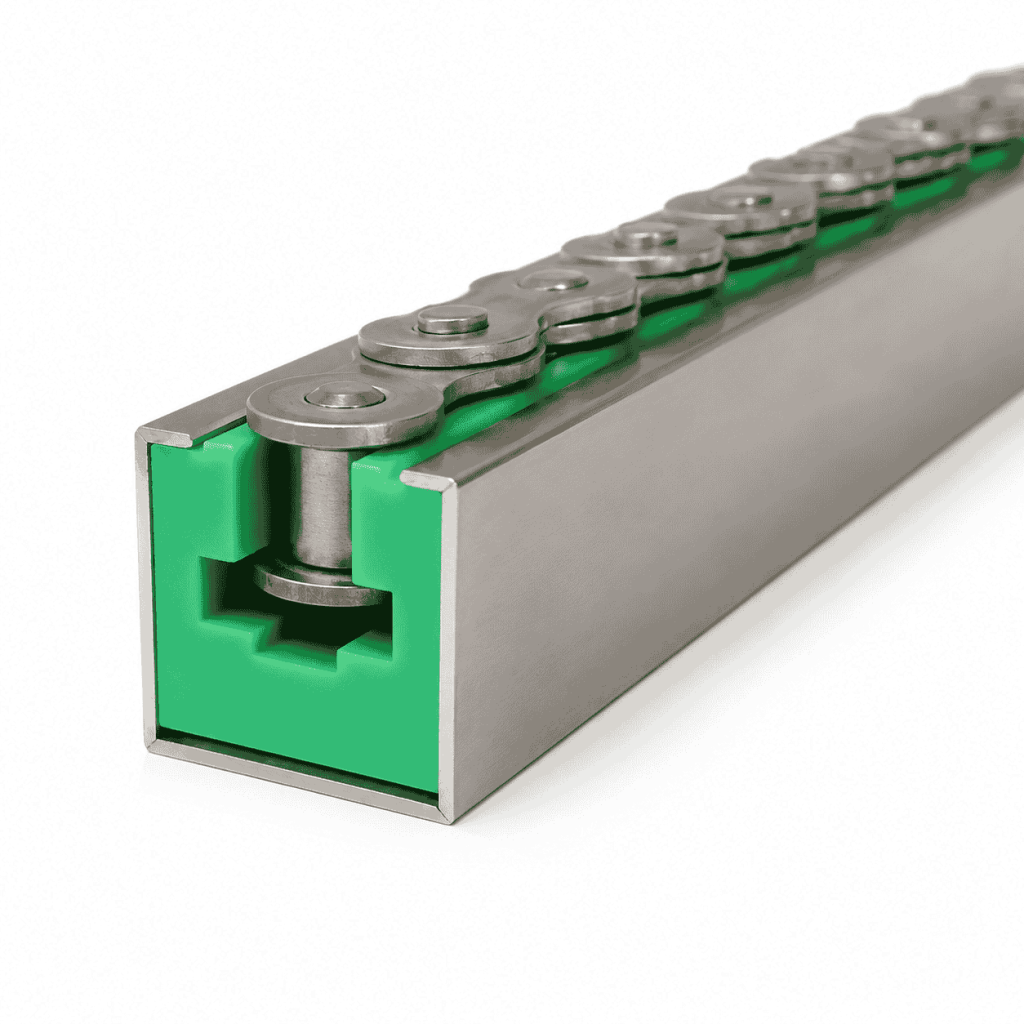
UHMWPE Chain Guide Rail with Roller Chain and Stainless Steel Support
Green UHMWPE chain guide rail installed inside a stainless steel support channel for stable roller chain movement.

What Does a UHMWPE Chain Guide Rail Do?

A UHMWPE chain guide rail creates a controlled sliding surface between the conveyor chain and the machine frame. Depending on the conveyor structure, it may support the bottom of the chain, guide its sides, control movement around curves, or prevent the chain from lifting out of position.

The main functions of a UHMWPE chain guide rail include:

  • Supporting the conveyor chain and reducing chain sagging
  • Keeping the chain aligned with the sprockets and conveyor frame
  • Reducing direct contact between the metal chain and metal structure
  • Lowering friction, vibration, and operating noise
  • Reducing wear on the chain and supporting frame
  • Improving stability through straight and curved conveyor sections
  • Providing a replaceable wear component for easier maintenance
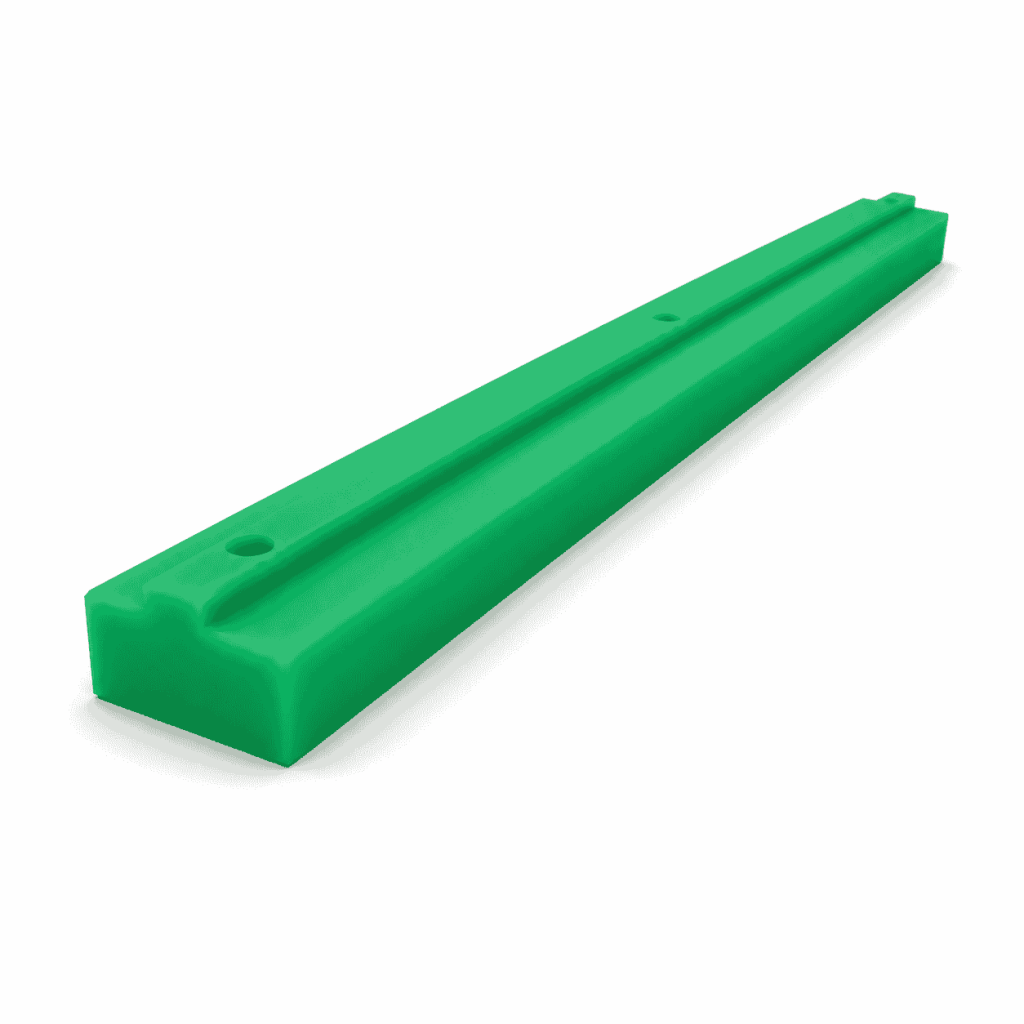
Green UHMWPE Roller Chain Guide Rail for Industrial Conveyor Equipment
UHMWPE roller chain guide designed to support and align chains in automated conveyor equipment.

Food and Beverage Processing Lines

Food and beverage factories frequently use chain conveyors to transport bottles, cans, cartons, trays, and packaged products between filling, sealing, labeling, inspection, and packing stations. These systems often operate continuously and may be exposed to water, cleaning agents, product residue, and frequent washdown procedures.

UHMWPE Chain Guide Rail is suitable for these conveyor systems because it has low moisture absorption and does not rust like an unprotected metal guide. Its smooth sliding surface helps the chain move steadily while reducing friction between the chain and the conveyor frame.

Typical applications include:

  • Bottled water production lines
  • Soft drink filling and packaging equipment
  • Beer and beverage can conveyors
  • Dairy product processing lines
  • Canned food transportation systems
  • Carton and tray packaging conveyors

For applications involving direct or indirect food contact, the UHMWPE material grade should be selected according to the hygiene and regulatory requirements of the target market.

Packaging Machinery

Automatic packaging equipment requires accurate and repeatable product movement. Chain guides can be installed in cartoning machines, case packers, sealing machines, labeling systems, palletizers, and automatic wrapping equipment.

In these machines, the chain guide supports the drive chain and helps maintain the correct chain path during repeated starts, stops, and changes in speed. A properly machined UHMWPE guide rail can reduce chain movement and help prevent irregular operation caused by excessive clearance or uneven support.

Depending on the machine design, the guide rail can be manufactured with straight, T-shaped, U-shaped, C-shaped, rectangular, curved, or customer-specific profiles.

Logistics and Warehouse Conveyor Systems

Distribution centers and automated warehouses use conveyor systems to transport cartons, parcels, bins, totes, and pallets. Many of these systems operate for long periods and experience frequent loading cycles.

UHMWPE Chain Guide Rail provides a replaceable wear surface between the chain and the conveyor frame. When the guide reaches the end of its service life, it can usually be replaced without changing the complete steel structure. This can simplify maintenance and reduce equipment downtime.

Common applications include:

  • Parcel sorting conveyors
  • Carton transportation lines
  • Automated storage and retrieval systems
  • Warehouse pallet conveyors
  • Distribution center handling equipment
  • Plastic tote and container conveyor lines

Automotive and Industrial Assembly Lines

Automotive, appliance, electronics, and general manufacturing plants commonly use chain conveyors to move workpiece carriers, fixtures, pallets, components, and partially assembled products between workstations.

These systems may be exposed to vibration, repeated impact, heavy loading, and frequent start-stop cycles. UHMWPE offers good impact resistance and sliding properties, making it suitable for chain support and guiding components in many industrial assembly environments.

The guide rail can be machined according to the chain profile, mounting structure, equipment load, operating speed, and installation space. Correct dimensional control is important because excessive clearance may allow chain movement, while insufficient clearance may increase friction and drive load.

Cold Storage and Low-Temperature Conveying

Cold storage warehouses, frozen food factories, meat processing lines, and seafood handling facilities often operate in wet and low-temperature environments. Conveyor components in these systems must tolerate repeated temperature changes, cleaning procedures, moisture, and impact.

UHMWPE Chain Guide Rail can be used in many low-temperature conveyor applications because the material maintains useful impact performance under cold operating conditions. However, the exact material grade should be confirmed according to the minimum working temperature, mechanical load, chain speed, and cleaning requirements.

Typical applications include:

  • Frozen food processing conveyors
  • Meat and poultry handling lines
  • Seafood sorting and packaging equipment
  • Cold-room transportation systems
  • Refrigerated warehouse conveyors

Chemical and Corrosive Processing Environments

Conveyor equipment used in chemical processing, water treatment, pharmaceutical production, plating, and surface-treatment lines may be exposed to moisture, salt spray, cleaning solutions, oils, or chemical substances.

UHMWPE resists many commonly encountered chemicals and does not corrode like carbon steel. It can therefore be considered for chain guide rails used in wet or mildly corrosive environments.

Chemical compatibility should always be evaluated before production. The chemical type, concentration, operating temperature, contact time, mechanical load, and cleaning process can all affect material selection. General information about UHMWPE properties and industrial applications is also available from Celanese GUR UHMW-PE.

Curved Chain Conveyor Sections

Curved conveyor sections are among the most demanding areas of a chain conveyor. As the chain travels around a bend, it creates additional lateral force against the guide surface. An incorrect radius, unsuitable clearance, or uneven guide surface can increase friction and cause vibration, chain climbing, or concentrated wear.

A curved UHMWPE Chain Guide Rail can be CNC machined to match the required conveyor radius and chain profile. Accurate machining helps the chain follow the intended path while maintaining stable contact with the guide.

Curved chain guides are commonly used in beverage production, packaging machinery, food processing equipment, accumulation conveyors, and compact automated production lines.

Heavy-Duty Material Handling Equipment

Chain conveyors are also used to transport industrial components, steel parts, timber products, construction materials, and loaded pallets. In these applications, the guide rail may experience higher pressure and impact than guides used in light packaging equipment.

UHMWPE can provide a durable sliding surface, but the final guide design must consider chain load, contact pressure, guide thickness, mounting method, support spacing, conveyor speed, and operating temperature. For high-load applications, a thicker profile or continuous metal support may be required to control deformation.

Advantages of UHMWPE Chain Guide Rail

Low Sliding Friction

The low-friction surface of UHMWPE helps reduce resistance between the moving chain and the guide rail. Lower resistance can contribute to smoother chain movement and reduce unnecessary load on the drive system.

Wear Resistance

UHMWPE is frequently used for sliding and wear components. When the material grade and guide structure are correctly selected, it can provide a long-lasting wear surface in continuously operating conveyor equipment.

Reduced Conveyor Noise

Replacing direct metal-to-metal sliding contact with a polymer guide surface can reduce vibration and mechanical noise. This is particularly useful in packaging, food processing, warehouse, and indoor assembly environments.

Corrosion-Free Guide Surface

UHMWPE does not rust and has very low moisture absorption. It is therefore suitable for many wet, humid, or frequently cleaned conveyor installations.

Impact Resistance

The material can tolerate repeated impact and vibration, making it suitable for conveyor systems that experience frequent starting, stopping, loading, or product accumulation.

Easy Replacement

A chain guide rail acts as a replaceable wear component. Replacing the guide rather than the complete conveyor frame can simplify maintenance and help protect more expensive machine components.

How to Select a UHMWPE Chain Guide Rail

A chain guide should not be selected only according to its external width or general appearance. The guide profile must match the chain and the actual operating conditions of the conveyor.

Important information includes:

  • Chain type, series, and pitch
  • Roller diameter and inner chain width
  • Straight or curved conveyor structure
  • Required curve radius
  • Conveyor speed and transported load
  • Working temperature range
  • Continuous or intermittent operation
  • Exposure to water, oil, chemicals, or cleaning agents
  • Food-contact or antistatic requirements
  • Guide length, profile, and mounting method
  • Mounting hole size, spacing, and position
  • Required machining tolerances

The construction of the roller chain or conveying chain should be confirmed before determining the guide profile. A suitable running clearance must be retained so that the chain can move freely without excessive side play.

Custom Machining for Conveyor Equipment

UHMWPE Chain Guide Rail can be produced according to customer drawings, physical samples, chain models, or conveyor installation dimensions. Available machining options may include straight cutting, groove milling, curved machining, drilling, countersinking, slotting, stepped profiles, and shaped mounting surfaces.

Custom products can include:

  • Straight UHMWPE chain guides
  • Curved UHMWPE chain guides
  • Chain support strips
  • Side guide rails
  • Conveyor wear strips
  • T-profile chain guides
  • U-profile chain guides
  • C-profile chain guides
  • Custom CNC-machined conveyor components

Before machining, the chain model, installation method, operating temperature, load, speed, and application environment should be reviewed. This reduces the risk of dimensional mismatch, excessive friction, difficult installation, or premature wear after the guide rail is installed.

Conclusion

UHMWPE Chain Guide Rail is widely used in food and beverage production, packaging equipment, logistics systems, automated assembly lines, cold storage facilities, chemical processing equipment, and other chain-driven conveyor systems.

By supporting and guiding the conveyor chain, the guide rail helps reduce friction, noise, vibration, and direct wear on the equipment frame. The most suitable guide design depends on the chain type, load, speed, temperature, conveyor layout, and installation structure.

For reliable operation, UHMWPE chain guides should be manufactured according to accurate drawings or verified chain dimensions. Proper material selection and machining control help improve conveyor stability, simplify maintenance, and extend the service life of related conveyor components.

Picture of Author : Hone xi
Author : Hone xi

Wear-resistant UHMWPE sheets, liners, wear strips, guide rails and CNC machined plastic components for industrial equipment.

Facebook
Twitter
LinkedIn
Pinterest
Products
We Love to Hear From You

Need UHMWPE sheets & custom plastic machined/OEM parts?Send specs & material needs, free quote within 24h.