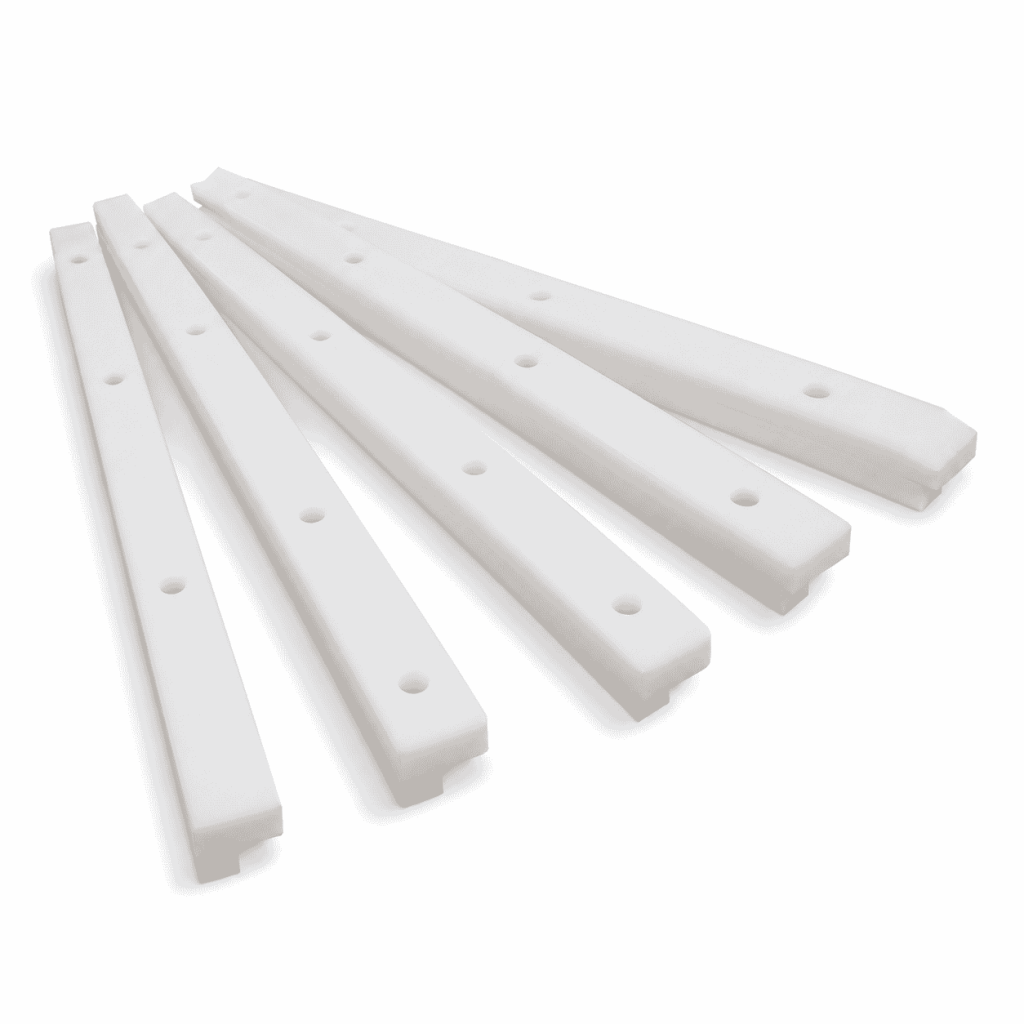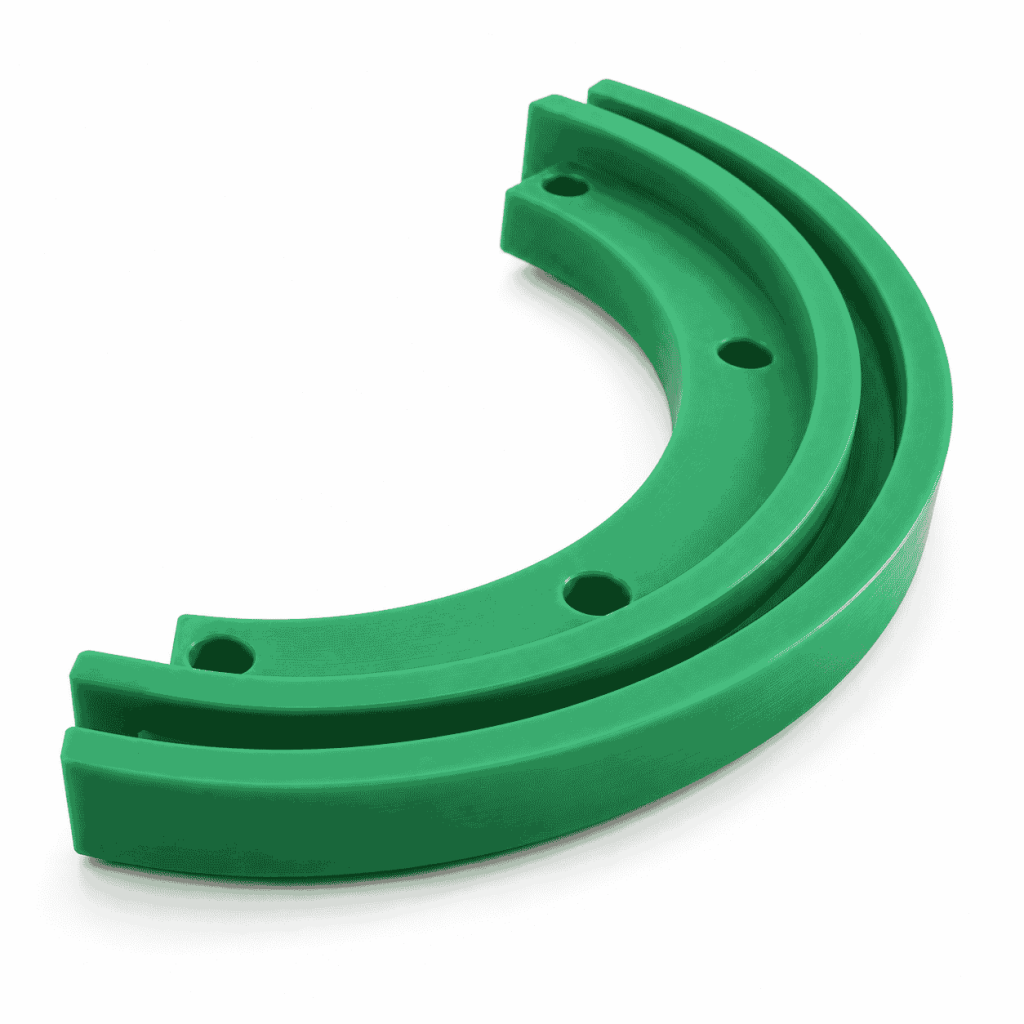

UHMWPE Wear Strips and Guide Rails are widely used in mining conveyors, coal-handling systems, aggregate production lines, scraper conveyors, apron conveyors, and other bulk material handling equipment. They support, guide, and limit moving components while creating a replaceable wear surface between conveyor parts and the steel machine structure.
Mining and bulk material handling equipment frequently transports ore, coal, gravel, sand, mineral powder, limestone, and other abrasive materials. Continuous operation, heavy loading, dust, moisture, impact, and misalignment can cause rapid wear on steel guides, conveyor frames, chains, scraper bars, and belt edges.
Ultra-high-molecular-weight polyethylene, commonly called UHMWPE or PE1000, combines low sliding friction with wear resistance and impact strength. When machined into wear strips, chain guides, side rails, or sliding profiles, it provides a replaceable engineering plastic surface between moving conveyor components and the supporting metal structure.

Functions of UHMWPE Wear Strips and Guide Rails
UHMWPE wear strips and guide rails are generally not intended to replace the main load-bearing steel structure of a conveyor. Their primary purpose is to support, guide, protect, and separate moving parts from the conveyor frame.
Main functions include:
- Supporting conveyor belts, chains, scraper bars, or conveyor plates
- Guiding moving components along a controlled operating path
- Limiting lateral movement and reducing conveyor misalignment
- Preventing direct contact between moving metal parts and steel frames
- Reducing sliding friction and unnecessary drive resistance
- Reducing mechanical vibration and operating noise
- Protecting steel rails, conveyor troughs, and structural frames
- Providing replaceable wear components for easier maintenance
- Improving conveyor stability during continuous operation
UHMWPE profiles are also used commercially to support and guide conveyor chains and belts because of their low friction, wear resistance, impact resistance, corrosion resistance, and low-noise operation. More information about industrial conveyor guides is available from Habasit conveyor guide systems.
UHMWPE Wear Strips for Mining Belt Conveyors
Belt conveyors are used throughout mining operations to transport iron ore, copper ore, coal, limestone, crushed rock, and mineral concentrates. Uneven loading, impact at transfer points, incorrect roller alignment, frame deformation, and tension problems can cause the conveyor belt to move sideways.
UHMWPE side guide strips can be installed along selected sections of the conveyor to provide auxiliary lateral control. Flat wear strips may also be used in supported sliding-bed sections where the belt requires a continuous low-friction surface.
Typical installation positions include:
- Conveyor belt side-limiting areas
- Short sliding-bed conveyor sections
- Loading and transfer zones
- Inspection and maintenance sections
- Transitions between conveyor units
- Compact heavy-load conveying equipment
- Return-belt guiding positions
Compared with an exposed steel guide, a UHMWPE guide surface can reduce direct scratching and abrasion on the conveyor belt edge. The replaceable plastic strip also helps protect the more expensive steel conveyor structure.
Side guide strips should only provide controlled auxiliary guidance. They cannot correct severe belt tracking problems caused by incorrect pulley alignment, uneven material loading, damaged rollers, poor tensioning, or a distorted conveyor frame. The source of continuous belt misalignment should be inspected and corrected.
UHMWPE Guide Rails for Coal-Handling Systems
Coal mines, preparation plants, power stations, storage yards, and port terminals use belt conveyors, scraper conveyors, and chain conveyors to transport raw coal, washed coal, coal blocks, and coal powder.
Coal-handling environments often contain large amounts of dust and may also be exposed to rainwater, washing water, and outdoor humidity. Steel sliding rails can become worn or corroded, increasing friction and causing irregular chain movement.
UHMWPE wear strips can be installed under chains, scraper bars, return sections, and lateral guiding positions. They separate moving components from steel structures and provide a smoother sliding surface.
Common applications include:
- Raw coal conveyor systems
- Coal preparation and washing plants
- Coal screening and sorting lines
- Coal storage and reclaim equipment
- Coal powder transfer systems
- Power station fuel conveyors
- Port coal loading equipment
Coal and mining environments may have specific requirements concerning static electricity, flame performance, dust hazards, and equipment grounding. Standard natural UHMWPE should not automatically be considered suitable for every coal-handling application.
Where antistatic, conductive, or flame-related performance is required, the selected material must have appropriate technical documentation. Material selection should also be coordinated with the conveyor manufacturer, site safety requirements, electrical grounding design, and applicable local regulations.

UHMWPE Guide Rails for Scraper Conveyors
A scraper conveyor uses chains and scraper bars to push coal, mineral powder, grain, ash, sand, or other bulk materials through an enclosed or semi-enclosed trough. During operation, the chain and scraper assembly can continuously rub against the steel trough and guide structure.
UHMWPE scraper conveyor guide rails can be installed along the chain path or beneath the scraper assembly. They provide a low-friction sliding surface and reduce direct metal-to-metal contact.
Common installation positions include:
- Bottom support for scraper chains
- Lateral chain guidance
- Return-chain support rails
- Scraper-bar side-limiting positions
- Trough-mounted sliding strips
- Transition and discharge sections
- Chain tensioning areas
The guide profile must match the chain dimensions and scraper structure. Important dimensions include groove width, groove depth, guide height, chain-link clearance, scraper-bar clearance, mounting-hole position, and overall straightness.
Insufficient clearance may cause the chain to bind, particularly after dust enters the guide or the material expands due to temperature changes. Excessive clearance may allow the chain to move laterally, vibrate, or strike the conveyor structure.
UHMWPE Wear Strips for Apron and Chain Plate Conveyors
Apron conveyors and chain plate conveyors are used to transport large pieces of ore, coal, clinker, stone, construction aggregate, and other heavy bulk materials. The steel plates are driven by heavy chains, creating high contact pressure at the supporting and guiding positions.
UHMWPE wear strips can be installed beneath or alongside the conveyor chains to support movement and keep the chains on their intended path.
Typical applications include:
- Main chain support surfaces
- Return-chain guide surfaces
- Apron plate side-limiting positions
- Conveyor transition sections
- Chain tensioning areas
- Heavy-duty straight conveyor sections
- Discharge-end guide rails
For heavy conveyor systems, the contact pressure, impact load, chain weight, conveyor speed, and support spacing must be evaluated before selecting the UHMWPE grade and profile thickness.
The wear strip should normally be supported by a continuous steel surface or closely spaced structural supports. A thin UHMWPE profile should not be expected to carry a heavy chain over a large unsupported distance.
UHMWPE Wear Strips in Sand and Aggregate Production Lines
Quarries and aggregate plants usually include crushing, screening, conveying, washing, and stockpiling processes. Crushed stone, gravel, sand, and mineral fines are abrasive and can rapidly wear exposed metal guides and support components.
UHMWPE wear strips and side guides can be used in selected belt-support, chain-guiding, and lateral-limiting positions to reduce direct contact between conveyor components and the steel frame.
Suitable equipment includes:
- Crusher discharge conveyors
- Vibrating screen transfer conveyors
- Sand and gravel belt conveyors
- Washing plant conveyor systems
- Aggregate storage feeding systems
- Stockpiling conveyors
- Mobile crushing and conveying equipment
In aggregate environments, hard particles may become trapped between the wear strip and the moving conveyor component. The guide structure should therefore avoid unnecessary grooves and deep corners that can retain abrasive particles.
UHMWPE wear strips are more suitable for sliding, support, and guiding positions than for areas receiving continuous direct impact from large rocks falling from a significant height. Heavy-impact zones may require steel structures, rubber impact systems, impact beds, or specially designed heavy-duty liner assemblies.
UHMWPE Guides for Mineral Powder Conveyors
Iron ore powder, coal dust, cement raw material, lime powder, fly ash, and other fine bulk materials can enter the gaps between chains, guide rails, and conveyor frames. Compacted powder increases friction and may accelerate wear on metal sliding surfaces.
UHMWPE guide rails provide a relatively smooth sliding surface for chains and scraper assemblies. Their low moisture absorption and non-rusting surface are also useful in dusty environments exposed to intermittent moisture.
Typical applications include:
- Mineral powder scraper conveyors
- Fine-material chain conveyors
- Cement raw material handling systems
- Lime powder transfer equipment
- Fly ash conveying systems
- Powder dosing and feeding machinery
- Enclosed bulk material conveyors
Guide profiles for fine powder equipment should be designed to reduce inaccessible gaps, deep recesses, and compacting points. Maintenance personnel must be able to inspect and clean the chain path without completely dismantling the conveyor whenever possible.
UHMWPE Wear Strips for Port Bulk Handling Equipment
Bulk terminals use belt conveyors, ship loaders, ship unloaders, stackers, and reclaimers to handle coal, ore, grain, fertilizer, and other bulk products.
This equipment is often installed outdoors and may be exposed to rain, salt spray, dust, sunlight, and wide temperature changes. Corroded steel sliding surfaces can increase resistance and accelerate wear on chains, belts, and moving frames.
UHMWPE wear strips may be used in:
- Ship-loader conveyor guiding positions
- Stacker and reclaimer chain supports
- Port conveyor side guide rails
- Return-chain support systems
- Sliding components in mobile conveyor structures
- Outdoor transfer conveyor equipment
- Maintenance access and extension mechanisms
For outdoor applications, ultraviolet exposure, working temperature, contact pressure, mounting length, expansion allowance, and environmental conditions should be reviewed. Where long-term sunlight exposure is expected, a suitable UV-stabilized grade may be required.
UHMWPE Guide Strips Around Hoppers and Transfer Chutes
Ore, coal, sand, and powder are commonly stored in hoppers or bins before being discharged onto belt, chain, or scraper conveyors. The conveyor inlet area experiences concentrated loading, material impact, and irregular flow.
UHMWPE wear strips can be installed around the conveyor entry section to support chains, guide the belt, or provide lateral protection near the discharge opening.
Typical positions include:
- Both sides of the belt below a hopper outlet
- Feeder-to-conveyor transition sections
- Loading points and transfer zones
- Scraper conveyor inlet sections
- Chain support rails below storage bins
- Side-guiding components near chutes
- Replaceable wear blocks at conveyor interfaces
Large hopper and chute surfaces that require anti-stick or abrasion protection normally use UHMWPE liner sheets. Narrow UHMWPE wear strips and guide rails are more appropriate for moving-component support, lateral guidance, and replaceable sliding surfaces.
Problems Addressed by UHMWPE Conveyor Wear Strips
Conveyor Belt or Chain Misalignment
Uneven loading, vibration, installation errors, and impact can cause conveyor components to move laterally. Side guides help restrict this movement within an acceptable operating range and reduce direct collision with the steel frame.
Severe Wear on Steel Guide Rails
Chains and scraper bars running directly on steel create continuous sliding friction. A replaceable UHMWPE wear strip protects the conveyor frame and reduces the need to repair structural components.
High Conveyor Resistance
Corroded, damaged, or rough metal surfaces increase sliding resistance. A correctly machined UHMWPE guide provides a smoother contact surface for chains and scraper assemblies.
Excessive Operating Noise
Direct contact between steel chains, scraper bars, and machine frames produces vibration and mechanical noise. Engineering plastic guide rails can reduce some of this metal-to-metal contact.
Corrosion in Wet Environments
UHMWPE does not rust like carbon steel. It can be used as a guiding and wear surface in wet preparation plants, outdoor conveyors, ports, and equipment exposed to wash water.
Frequent Conveyor Maintenance
A worn UHMWPE strip can be removed and replaced without replacing the complete steel frame or conveyor trough. Segmented guide designs can also allow only the damaged section to be replaced.
Advantages of UHMWPE for Mining Conveyor Guides
Wear Resistance
Mining conveyors operate for extended periods and their guide surfaces experience continuous sliding contact. UHMWPE is used for replaceable wear components that help protect the underlying metal structure.
Low Sliding Friction
The low-friction surface helps reduce resistance between chains, scraper bars, belts, and guiding components. Industrial UHMWPE sliding profiles are used in conveyor systems where wear resistance and smooth movement are required. Additional technical information is available from Röchling industrial sliding profiles.
Impact Resistance
Conveyor guides can experience repeated impact caused by equipment starting, chain movement, vibration, and material loading. UHMWPE can absorb part of this mechanical shock when the profile is correctly supported.
Low Moisture Absorption
Low moisture absorption helps UHMWPE components retain more stable dimensions in humid conveyor environments than many moisture-sensitive engineering plastics.
Corrosion-Free Material
UHMWPE does not corrode in the same way as exposed carbon steel, making it useful for wet, outdoor, and frequently washed conveyor equipment.
Custom Machining Capability
UHMWPE can be CNC machined into straight, curved, grooved, drilled, stepped, countersunk, and irregular profiles to match different belts, chains, scraper bars, and conveyor frames.
UHMWPE and HDPE Guide Strip Selection
Both UHMWPE and HDPE can be machined into conveyor wear strips and guide rails, but they are not interchangeable in every operating condition.
UHMWPE Is Generally Considered for:
- Continuously operating chain guides
- High-frequency sliding contact
- Mining conveyors exposed to impact
- Applications requiring lower friction
- Heavy scraper or apron conveyor guides
- Longer-term replaceable wear components
HDPE May Be Considered for:
- Lower-load side guide strips
- General conveyor limiting components
- Large protective strips with limited sliding contact
- Applications with moderate wear requirements
- Projects where material cost is a major consideration
The final selection should be based on contact pressure, sliding speed, temperature, impact, support structure, required service life, environmental conditions, and project safety requirements.
Common UHMWPE Wear Strip and Guide Rail Profiles
Custom conveyor guide components can include:
- Flat conveyor belt wear strips
- Rectangular chain support rails
- U-profile chain guides
- T-profile chain guides
- C-profile chain guides
- Grooved scraper conveyor rails
- Curved chain guide rails
- Conveyor belt side guides
- Wear strips with countersunk holes
- Guide rails with slotted mounting holes
- UHMWPE profiles installed in metal channels
- Return-chain support strips
- Conveyor sliding-bed strips
- Custom CNC-machined wear components
Long conveyor guides can be produced in sections for transportation and installation. Different guide profiles should be marked according to their dimensions, conveyor position, or equipment number so that maintenance personnel can identify them correctly.
Information Required for Custom Manufacturing
Before manufacturing UHMWPE Wear Strips and Guide Rails for mining or bulk material handling equipment, the following information should be confirmed:
- Type of conveyor equipment
- Conveyed material
- Material particle size and maximum lump weight
- Conveyor speed
- Mechanical load and contact pressure
- Chain, belt, scraper, or apron plate model
- Guide groove width and depth
- Required profile cross-section
- Product length, width, and thickness
- Straight or curved configuration
- Curve radius and direction
- Mounting-hole diameter and spacing
- Continuous or intermittent operation
- Minimum and maximum working temperature
- Indoor or outdoor installation
- Exposure to water, salt spray, oil, or chemicals
- Antistatic, conductive, UV-resistant, or other special requirements
- Drawings, samples, chain models, or verified installation dimensions
When complete drawings are unavailable, an existing guide rail, chain model, installation measurements, and equipment photographs can be used to confirm the required profile. Final running clearance should be verified before batch production.
Installation Considerations
Maintain Suitable Running Clearance
The guide groove should not fit the chain or scraper assembly too tightly. Clearance is required for normal movement, dimensional tolerances, dust entry, and temperature-related expansion.
Provide Sufficient Back Support
UHMWPE wear strips should be installed on flat, continuous, or closely spaced supporting structures. Thin profiles should not remain unsupported across a large distance under heavy load.
Use Recessed Fasteners
Mounting bolts should normally remain below the working surface. Exposed bolt heads can contact the chain, belt, or scraper bar and may create concentrated wear.
Allow for Thermal Expansion
UHMWPE expands differently from steel. Long strips may require segmented installation, slotted mounting holes, controlled fastener tightening, or suitable end clearances.
Control Joint Alignment
Joints between guide sections should remain smooth and level. A raised edge can be repeatedly struck by a chain, belt, or scraper assembly, causing vibration and premature damage.
Inspect Wear Regularly
The guide surface, fasteners, joints, and supporting structure should be inspected as part of routine conveyor maintenance. Worn-through, loose, cracked, or severely deformed components should be adjusted or replaced.
Custom UHMWPE Wear Strip and Guide Rail Manufacturing
Mining and bulk material conveyors have different chain models, frame dimensions, loads, speeds, and installation structures. UHMWPE wear strips and guide rails are therefore commonly manufactured according to drawings, samples, equipment dimensions, or verified chain specifications.
Custom products can include:
- Conveyor belt wear strips
- Conveyor side guide rails
- Mining chain guides
- Scraper conveyor guide rails
- Return-chain support strips
- Apron conveyor wear rails
- Curved chain guides
- Conveyor sliding-bed strips
- Side-limiting blocks
- Hopper discharge guide plates
- Custom UHMWPE wear-resistant components
Batch components with different lengths, grooves, profiles, mounting holes, and installation positions can be machined separately according to the approved drawings. Finished parts can be packed and labeled by specification or equipment number to simplify identification and installation at the operating site.
Conclusion
UHMWPE Wear Strips and Guide Rails are used in mining belt conveyors, coal-handling systems, scraper conveyors, apron conveyors, aggregate production lines, mineral powder conveyors, port terminals, and other bulk material handling equipment.
These components support, guide, and limit conveyor belts, chains, and scraper assemblies while reducing direct contact with steel frames. They can help reduce friction, vibration, noise, guide-rail wear, and maintenance requirements when correctly selected and installed.
The final material grade and guide profile should be selected according to the conveyed material, conveyor load, speed, working temperature, impact level, installation structure, and site safety requirements. Correct machining dimensions, running clearance, back support, and fastening methods are essential for reliable long-term operation.
Technical standards and industry publications concerning belt conveyors and bulk material handling equipment are available from the Conveyor Equipment Manufacturers Association.