

Engineering plastics are increasingly used in industrial machinery, automated production lines, conveyor systems, packaging equipment, and food-processing machines. Materials such as nylon, UHMWPE, POM, and PTFE can provide wear resistance, low friction, corrosion resistance, reduced noise, and lower component weight.
Replacing metal with plastic is not simply a cost-saving decision. In suitable sliding, guiding, positioning, sealing, and light-duty transmission applications, engineering plastic components can reduce lubrication requirements, protect mating surfaces, and simplify equipment maintenance.
This article introduces ten common engineering plastic parts used in industrial machinery. Each section explains where the component is installed, what function it performs, why plastic may be selected instead of metal, and which materials are commonly recommended.
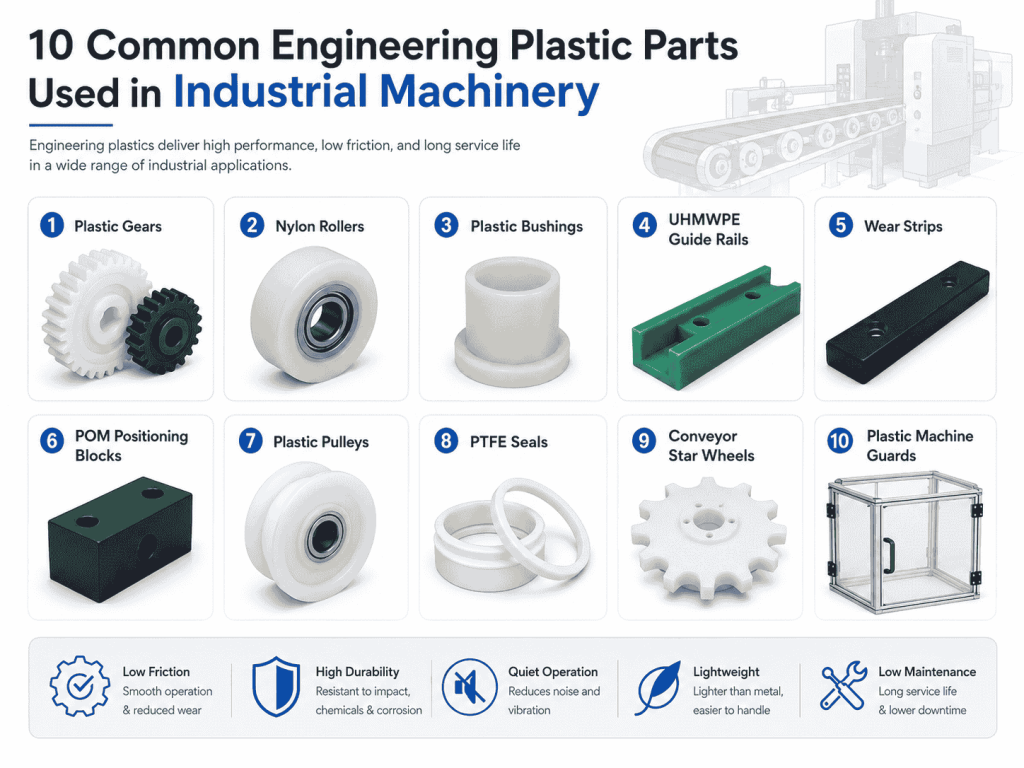
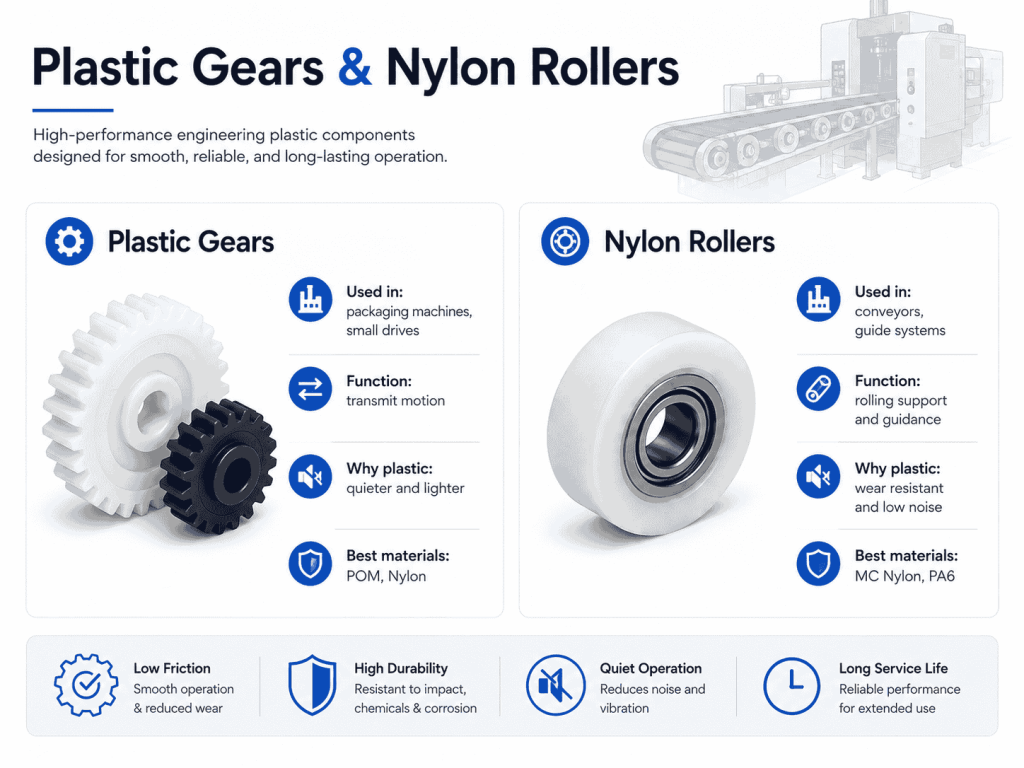
1. Plastic Gears
Plastic gears are commonly installed in packaging machines, food-processing equipment, textile machinery, printing systems, instruments, office equipment, and small automated mechanisms. Their primary purpose is to transmit motion, change rotational speed, and control the direction of mechanical movement.
Compared with steel gears, plastic gears are lighter and generally produce less operating noise. Certain engineering plastics also offer low-friction or self-lubricating characteristics, which may reduce the need for additional grease or oil.
Plastic gears can also reduce hard metal-to-metal contact. When properly designed, they may help protect mating components and reduce vibration during gear engagement.
However, plastic gears are not suitable for every transmission system. High torque, continuous high temperatures, heavy shock loading, and extremely tight tolerances must be carefully evaluated before selecting a plastic material.
Recommended Materials
- POM: Good dimensional stability, rigidity, machinability, and wear resistance for precision gears.
- PA6 or PA66 Nylon: Good toughness, impact resistance, and wear performance for medium-duty gears.
- PEEK: Suitable for demanding applications involving higher temperatures, chemicals, or mechanical loads.
For additional information about POM performance in mechanical components, see the official Delrin® acetal material resource.
2. Nylon Rollers
Nylon rollers are widely used in conveyor systems, lifting equipment, logistics lines, sliding doors, packaging machines, steel-processing equipment, and material-handling systems. They provide rolling support, product guidance, load distribution, and controlled movement.
Steel rollers can be heavy and noisy, especially when they run directly against metal tracks. Nylon rollers are lighter and can reduce hard contact between the roller and guide surface. Their natural toughness also helps absorb minor vibration and impact.
Another advantage is corrosion resistance. Nylon rollers do not rust, making them suitable for many humid or intermittently wet operating environments.
Moisture absorption and temperature changes can affect the dimensions of standard nylon. For rollers with precise bearing seats or tight dimensional tolerances, material conditioning, machining allowance, and shaft fit should be considered during design.
Recommended Materials
- MC Nylon: Commonly selected for larger rollers and medium-to-heavy mechanical loads.
- PA6 Nylon: A practical general-purpose material for industrial rollers.
- PA66 Nylon: Provides relatively high rigidity and improved heat resistance.
- Oil-Filled Nylon: Suitable for applications requiring reduced friction and less frequent lubrication.
More information about industrial polyamide materials is available from the official BASF Ultramid® polyamide resource.
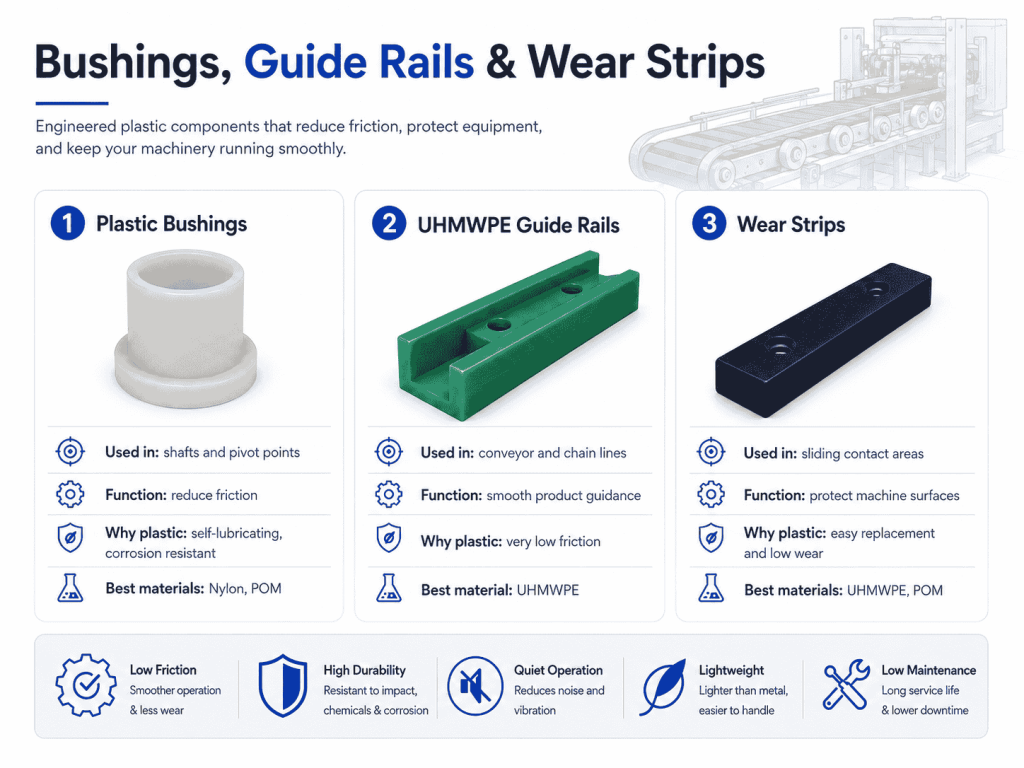
3. Plastic Bushings
Plastic bushings are installed around rotating shafts, pivot pins, hinge points, guide rods, agricultural machinery joints, conveyor mechanisms, and automated equipment. They support the shaft, reduce friction, and prevent direct contact between two metal surfaces.
Traditional metal bushings often require regular lubrication. In dusty, wet, or corrosive environments, inadequate lubrication may lead to noise, seizure, or accelerated wear.
Engineering plastic bushings can provide low-friction operation without intensive lubrication. They can also serve as replaceable wear components. When the bushing reaches its wear limit, it can be replaced without changing the more expensive shaft or housing.
The correct running clearance is important. Plastic materials may expand because of heat, moisture, or mechanical loading, so the final dimensions should be based on the actual operating environment.
Recommended Materials
- Nylon: Suitable for general-purpose bushings requiring toughness and impact resistance.
- POM: Suitable for precision bushings requiring dimensional stability and low moisture absorption.
- UHMWPE: Suitable for low-speed sliding, wet conditions, and low-friction contact.
- PTFE: Suitable for corrosive media, low-friction systems, and special temperature conditions.
4. UHMWPE Guide Rails
UHMWPE guide rails are commonly installed in chain conveyors, bottling lines, packaging systems, food-processing machines, canning lines, and automated material-handling equipment. They support chains, guide containers, control product movement, and reduce sliding resistance.
When metal guide rails contact conveyor chains or packaged products directly, they may generate noise and damage chains, bottles, cans, or containers. UHMWPE offers a low-friction surface that helps products and chains move more smoothly.
UHMWPE also provides good wear resistance, impact resistance, low water absorption, and resistance to many common chemicals. It does not rust and is therefore suitable for production environments that are frequently washed or exposed to moisture.
Food-contact-compliant, antistatic, oil-filled, and enhanced-wear grades are available for different operating requirements.
Recommended Materials
- Virgin UHMWPE: Suitable for standard conveyor and guiding applications.
- Food-Grade UHMWPE: Suitable for food, beverage, and packaging production lines.
- Antistatic UHMWPE: Suitable for equipment where static electricity must be controlled.
- Enhanced-Wear UHMWPE: Suitable for high-frequency sliding and demanding conveyor systems.
The official Mitsubishi Chemical TIVAR™ UHMWPE resource provides further information about the wear, impact, friction, and corrosion performance of UHMWPE shapes.
5. Wear Strips
Plastic wear strips are installed beneath conveyor chains, along conveyor frames, under moving belts, on machine sliding surfaces, and at material-contact points. They provide support, reduce friction, and protect the main equipment structure from direct wear.
If a moving chain or product repeatedly contacts a metal frame, the equipment may develop scratches, vibration, noise, and increasing running resistance. A replaceable plastic wear strip creates a sacrificial sliding surface between the moving component and the machine frame.
Compared with metal strips, plastic wear strips are lightweight, corrosion resistant, and often require less lubrication. Once worn, they can usually be replaced without removing or rebuilding the entire supporting structure.
Recommended Materials
- UHMWPE: Preferred for low-friction, high-wear conveyor applications.
- POM: Suitable for accurately machined sliding parts and stable dimensions.
- Nylon: Suitable for components requiring mechanical strength and impact resistance.
- PTFE: Suitable for very low friction, chemical exposure, or special temperature requirements.
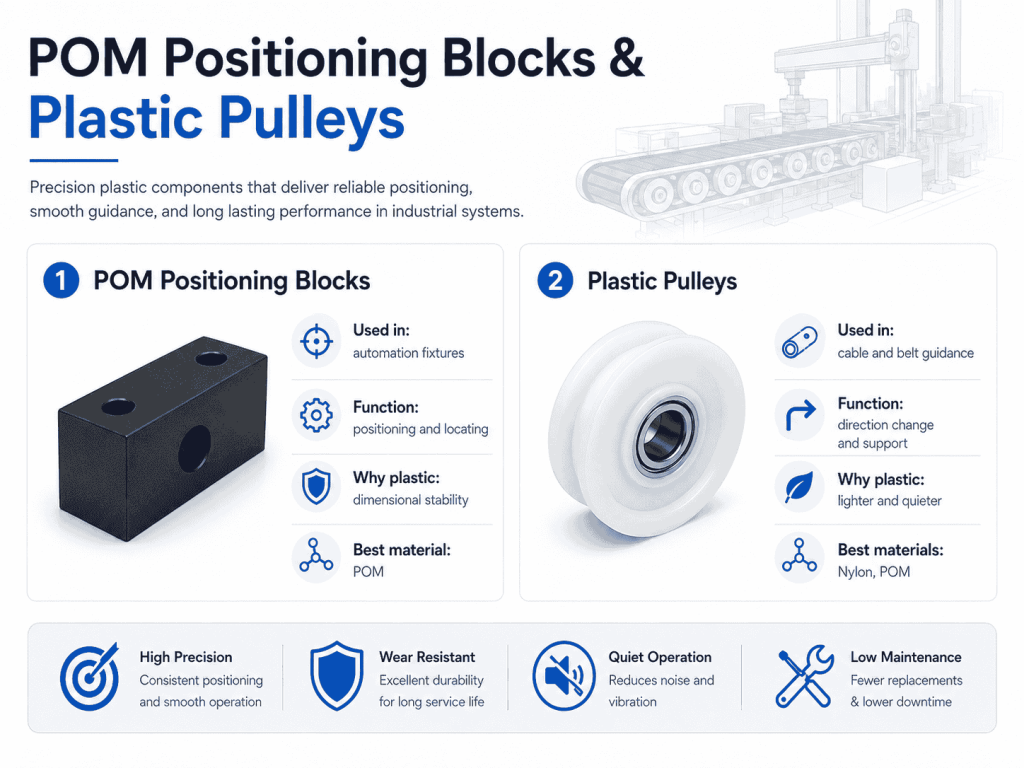
6. POM Positioning Blocks
POM positioning blocks are frequently used in automation fixtures, inspection machines, assembly lines, packaging equipment, electronic production systems, and precision conveyor mechanisms. They locate products, control spacing, limit movement, and support workpieces during processing.
Positioning components often require stable holes, grooves, locating surfaces, and mounting dimensions. Standard nylon may change dimensions after absorbing moisture, while POM has relatively low moisture absorption and good dimensional stability.
POM also offers high rigidity, good machinability, and wear resistance. Its surface is less likely than bare metal to scratch sensitive workpieces, which makes it useful for tooling, inspection fixtures, and product-contact applications.
Recommended Materials
- Natural POM: Suitable for general industrial positioning components.
- Black POM: Suitable for industrial parts requiring a dark appearance.
- Antistatic POM: Suitable for electronic components and static-sensitive production areas.
- Conductive POM: Suitable for fixtures requiring more consistent static discharge performance.
7. Plastic Pulleys
Plastic pulleys are used in lifting guides, cable-routing systems, packaging machines, sliding mechanisms, fitness equipment, wire-handling systems, and small material-lifting devices. Their primary functions are to support cables, belts, ropes, or wires and change their direction of movement.
Metal pulleys can be heavy and may cause excessive noise or surface damage to cables and ropes. Nylon and POM pulleys provide a less aggressive contact surface while reducing component weight.
Plastic pulleys can be machined with U-shaped, V-shaped, semicircular, or custom grooves. They can also include bearing seats, bushings, flanges, and mounting holes according to the equipment structure.
The groove profile, shaft fit, operating speed, rope diameter, and applied load should all be considered when designing a plastic pulley.
Recommended Materials
- MC Nylon: Suitable for larger pulleys and medium-to-high mechanical loads.
- PA6 Nylon: Suitable for general industrial rope and cable guidance.
- POM: Suitable for smaller pulleys requiring accurate dimensions and smooth rotation.
- UHMWPE: Suitable for low-speed, wear-resistant, and corrosion-resistant applications.
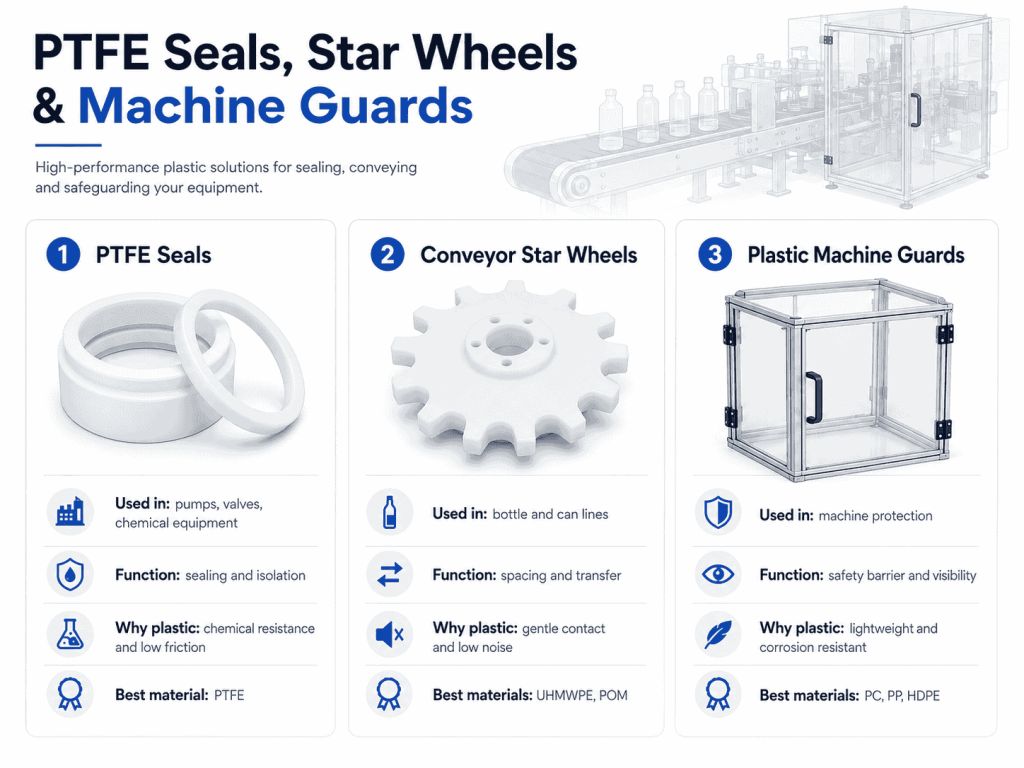
8. PTFE Seals
PTFE seals are commonly used in chemical-processing equipment, pumps, valves, hydraulic systems, pipeline connections, food equipment, and high- or low-temperature machinery. Their purpose is to isolate fluids, control leakage, and maintain sealing performance around moving or stationary parts.
Some elastomer seals may swell, harden, degrade, or lose performance when exposed to aggressive chemicals, friction, or temperature extremes. PTFE provides excellent chemical resistance, low friction, and a broad useful temperature range.
Because PTFE has limited elastic recovery compared with rubber, PTFE sealing components are often combined with springs, O-rings, or other energizing elements to maintain contact pressure.
Filled PTFE materials can improve wear resistance, creep resistance, load capacity, or thermal conductivity, depending on the selected filler.
Recommended Materials
- Virgin PTFE: Suitable for general chemical resistance and low-friction sealing.
- Glass-Filled PTFE: Provides improved wear resistance and reduced deformation.
- Carbon-Filled PTFE: Suitable for friction applications requiring improved wear and thermal performance.
- Bronze-Filled PTFE: Suitable for higher-load sliding and sealing components.
For additional information about PTFE and fluoropolymer performance, visit the official Chemours Advanced Performance Materials resource.
9. Conveyor Star Wheels
Conveyor star wheels are widely used in beverage filling lines, food-packaging systems, pharmaceutical equipment, bottle-handling machines, and automated container-transfer systems. They separate, position, rotate, and transfer bottles, cans, jars, or other containers.
A metal star wheel can scratch a container or create excessive noise during high-speed operation. Engineering plastic star wheels offer gentler contact and can reduce impact between the machine and the product.
The pocket profile of a star wheel is normally machined according to the container diameter, shape, spacing, and transfer speed. Accurate machining is essential because the profile affects how smoothly containers enter, rotate, and leave the transfer station.
Recommended Materials
- UHMWPE: Suitable for low-friction, wear-resistant, and high-speed container handling.
- POM: Suitable for star wheels requiring higher dimensional precision.
- Nylon: Suitable for components requiring strength and impact resistance.
- Food-Contact-Compliant Plastics: Suitable for food, beverage, and pharmaceutical packaging equipment.
10. Plastic Machine Guards
Plastic machine guards include safety covers, protective panels, inspection windows, isolation barriers, and equipment enclosures. They are commonly installed around machine tools, conveyors, packaging equipment, robotic cells, and automated production lines.
A machine guard prevents operators from reaching moving parts and helps contain chips, fragments, or splashing liquids. Transparent plastic panels also allow operators to observe the equipment without opening the enclosure.
Compared with sheet-metal covers, plastic machine guards can be lighter, easier to remove, and resistant to corrosion. In wet or chemically aggressive environments, PP and HDPE panels may provide a practical alternative to painted metal.
For transparent impact-resistant protection, polycarbonate is generally preferred over ordinary acrylic when the guard may be exposed to mechanical impact.
Recommended Materials
- Polycarbonate: Suitable for transparent guards requiring visibility and impact resistance.
- PP: Suitable for chemically resistant machine panels and enclosures.
- HDPE: Suitable for moisture-resistant covers and general industrial panels.
- UHMWPE: Suitable for guards that also experience repeated friction, impact, or abrasion.
Why Are Engineering Plastics Increasingly Used in Industrial Machinery?
The value of an engineering plastic component is not limited to its material price. The correct plastic can improve equipment performance, protect mating components, and reduce long-term maintenance requirements.
In appropriate applications, engineering plastics can reduce direct metal-to-metal friction, lower operating noise, and decrease sliding resistance. Self-lubricating or low-friction grades may also reduce the need for oil or grease.
Because engineering plastics do not rust, they can perform well in wet, humid, or frequently washed production environments. Their lower density can also reduce the weight of rotating and reciprocating components, helping decrease inertia and drive load.
Guide rails, wear strips, bushings, and positioning blocks can be designed as replaceable wear components. This allows maintenance teams to replace the worn plastic part instead of repairing the machine frame, shaft, or guide assembly.
Factors to Consider When Selecting an Engineering Plastic
Material selection should not be based on wear resistance alone. The following factors should be evaluated before confirming the plastic grade and component design:
- Static and dynamic mechanical loads
- Impact and vibration levels
- Sliding speed and operating frequency
- Continuous and peak operating temperatures
- Moisture, cleaning, and water exposure
- Contact with acids, alkalis, oils, solvents, or cleaning agents
- Required machining tolerances and dimensional stability
- Food-contact, antistatic, conductive, or flame-retardant requirements
- Contact with chains, belts, cables, metal parts, or finished products
- Expected service life and maintenance frequency
For example, UHMWPE is often selected for guide rails and wear strips because of its low-friction and wear-resistant surface. POM is frequently used for precision positioning blocks and small mechanical components. Nylon is suitable for rollers, pulleys, and parts requiring toughness, while PTFE is commonly considered for low-friction and chemically resistant sealing applications.
Quick Material Selection Guide
| Application Requirement | Commonly Considered Material | Typical Components |
|---|---|---|
| Low friction and high wear resistance | UHMWPE | Guide rails, wear strips, star wheels |
| Dimensional stability and precision machining | POM | Gears, positioning blocks, small pulleys |
| Toughness and impact resistance | Nylon | Rollers, bushings, pulleys, gears |
| Chemical resistance and low friction | PTFE | Seals, bushings, sliding components |
| Transparent impact protection | Polycarbonate | Machine guards and observation windows |
| Corrosion-resistant panels | PP or HDPE | Machine covers, guards, and enclosures |
Conclusion
Plastic gears, nylon rollers, plastic bushings, UHMWPE guide rails, wear strips, POM positioning blocks, plastic pulleys, PTFE seals, conveyor star wheels, and plastic machine guards are widely used throughout industrial machinery and automation equipment.
No single engineering plastic is suitable for every machine or operating condition. The material should be selected according to load, speed, temperature, friction, chemical exposure, moisture, dimensional accuracy, and maintenance requirements.
When the material and component structure are properly matched to the application, engineering plastics can deliver reliable wear resistance, low-friction movement, corrosion resistance, reduced noise, and longer equipment service life.