
However, industrial equipment is increasingly expected to operate with lower weight, less noise, reduced lubrication, and improved corrosion resistance.
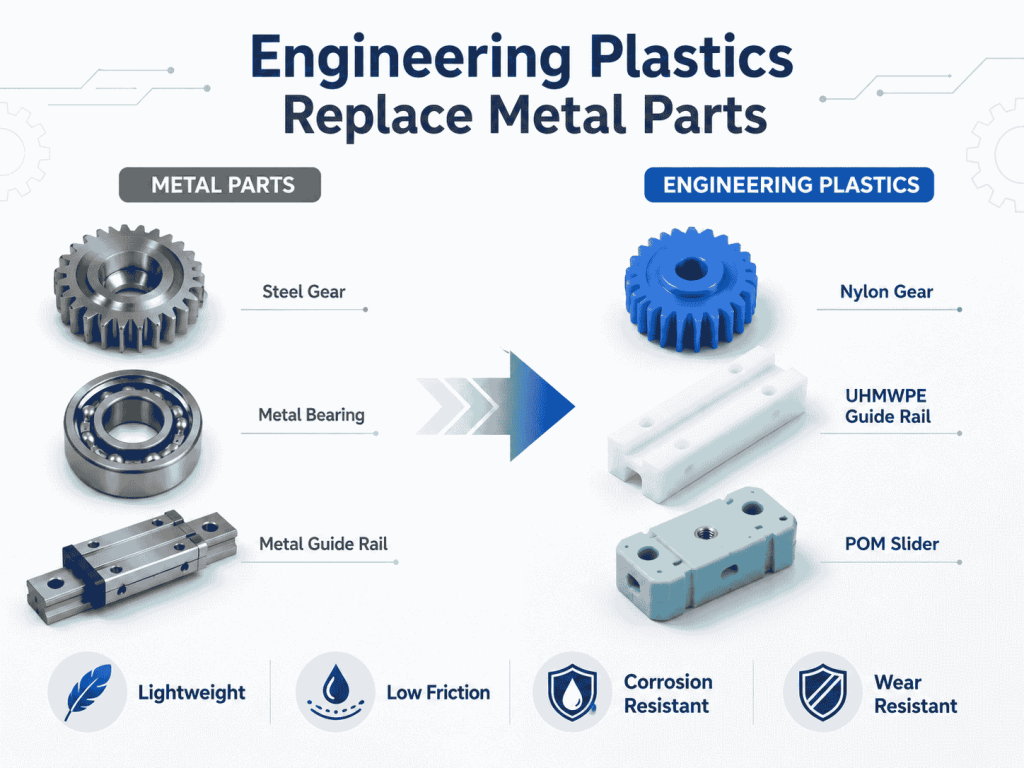
For these reasons, engineering plastics such as nylon, UHMWPE, POM, PTFE, and PP are being used to replace selected metal components in conveying systems, packaging machinery, mining equipment, food-processing lines, electrical equipment, and automated production systems.
This does not mean that engineering plastics can replace metal in every application. The most effective approach is to identify components where friction, wear, corrosion, weight, noise, or product-surface protection is more important than extreme structural strength.
Why Are Engineering Plastics Replacing Metal Parts?
Engineering plastics offer a combination of mechanical performance, low density, chemical resistance, machinability, and sliding properties. According to Piedmont Plastics’ industrial material overview, performance plastics are increasingly used in industrial applications where reduced lubrication, lower weight, and improved corrosion resistance are required.
When the correct material is selected, a plastic component may reduce equipment weight, protect adjacent parts, lower mechanical noise, and simplify routine maintenance.
Common Problems with Traditional Metal Parts
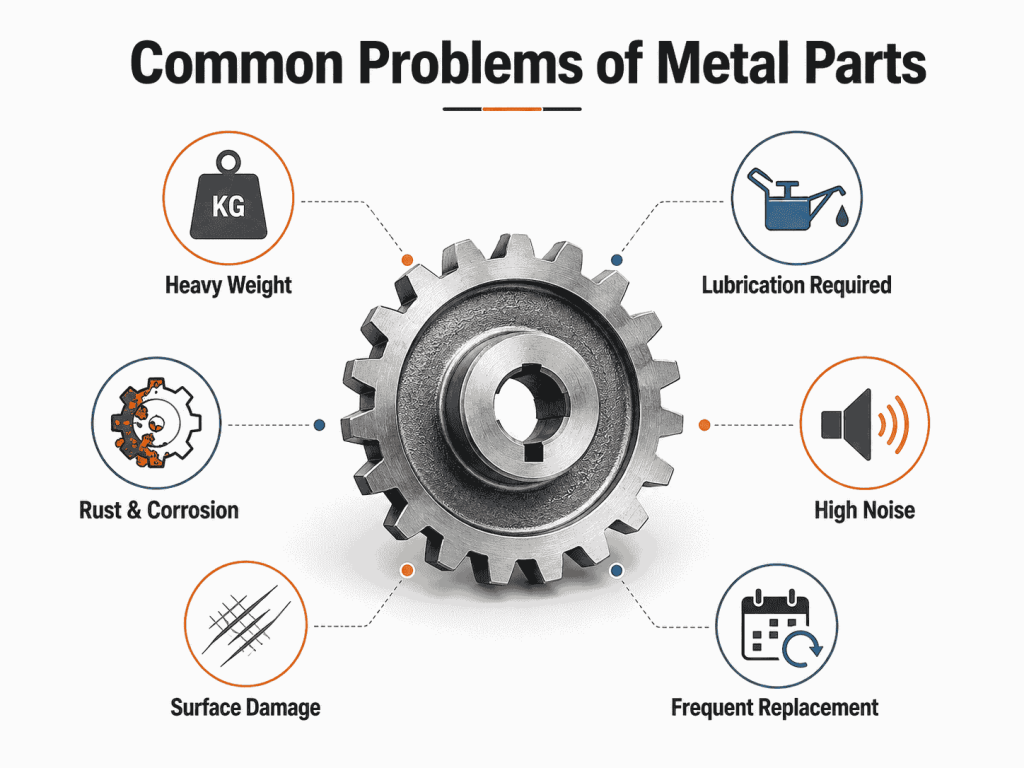
Metal Parts Can Be Too Heavy
Steel guide rails, rollers, liners, and support components can add considerable weight to a machine. Heavy moving parts may increase the load on motors, bearings, frames, and drive systems.
Engineering plastics have a lower density than most metals. Replacing suitable metal components with machined plastic parts can make installation, handling, and maintenance easier while reducing the weight of moving assemblies.
Metal-to-Metal Contact Requires Lubrication
Metal bearings, bushings, slide plates, and guide components normally require regular lubrication. Without sufficient grease or oil, friction can cause heat, noise, surface scoring, and premature wear.
Nylon, UHMWPE, POM, and PTFE can provide useful sliding and wear properties. In appropriate applications, these materials may reduce external lubrication requirements and help keep equipment cleaner.
Metal Can Corrode in Wet Environments
Industrial components are often exposed to water, cleaning agents, salt, chemicals, and humid operating conditions. Standard steel parts may rust, affecting their surface condition, dimensions, and movement.
Engineering plastics do not rust like ordinary steel. They are frequently used for wear strips, liners, scrapers, guide rails, separators, and support blocks in wet or chemically aggressive environments.
Metal Components Can Increase Equipment Noise
Metal gears, rollers, chains, and guides can generate significant noise during continuous operation. Vibration and direct metal-to-metal impact may make the equipment louder and less stable.
Plastic components can absorb part of the impact and vibration. Nylon gears, UHMWPE chain guides, and plastic rollers are commonly considered when quieter movement is required.
Metal Contact Can Damage Product Surfaces
Glass, painted components, electronic products, packaging materials, and finished panels can be scratched when they contact hard metal guides or positioning blocks.
POM, nylon, and UHMWPE components provide a comparatively gentle contact surface. They are suitable for fixtures, guides, supports, star wheels, and positioning components that directly contact finished products.
Wear Parts May Require Frequent Replacement
Metal wear parts operating without sufficient lubrication can develop scoring, increased friction, and dimensional changes. This may result in unplanned downtime and repeated maintenance.
Using a suitable wear-resistant plastic can improve sliding performance and protect more expensive metal structures. Plastic wear strips and liners can also be designed as replaceable components.
Common Engineering Plastics Used as Metal Alternatives
Nylon: Gears, Rollers, Pulleys, and Bushings
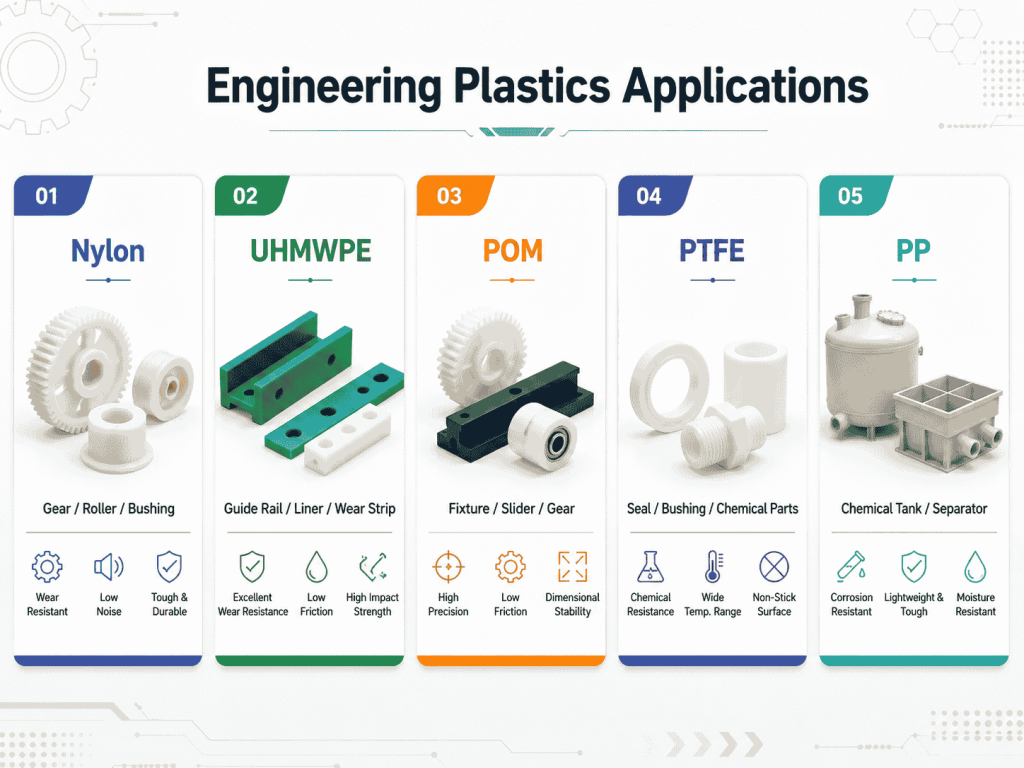
Nylon combines mechanical strength, impact resistance, wear resistance, and good machining performance. It is widely used for industrial components that must carry moderate loads while reducing noise and friction.
Common nylon components include:
- Gears and sprockets
- Rollers and pulleys
- Bushings and bearing sleeves
- Guide blocks and sliders
- Wear pads and support blocks
Nylon parts are frequently installed in conveying systems, packaging machinery, lifting equipment, agricultural machinery, and automated production lines.
However, standard nylon can absorb moisture. Material grade, dimensional tolerance, humidity, and operating temperature should therefore be evaluated before replacing a precision metal component.
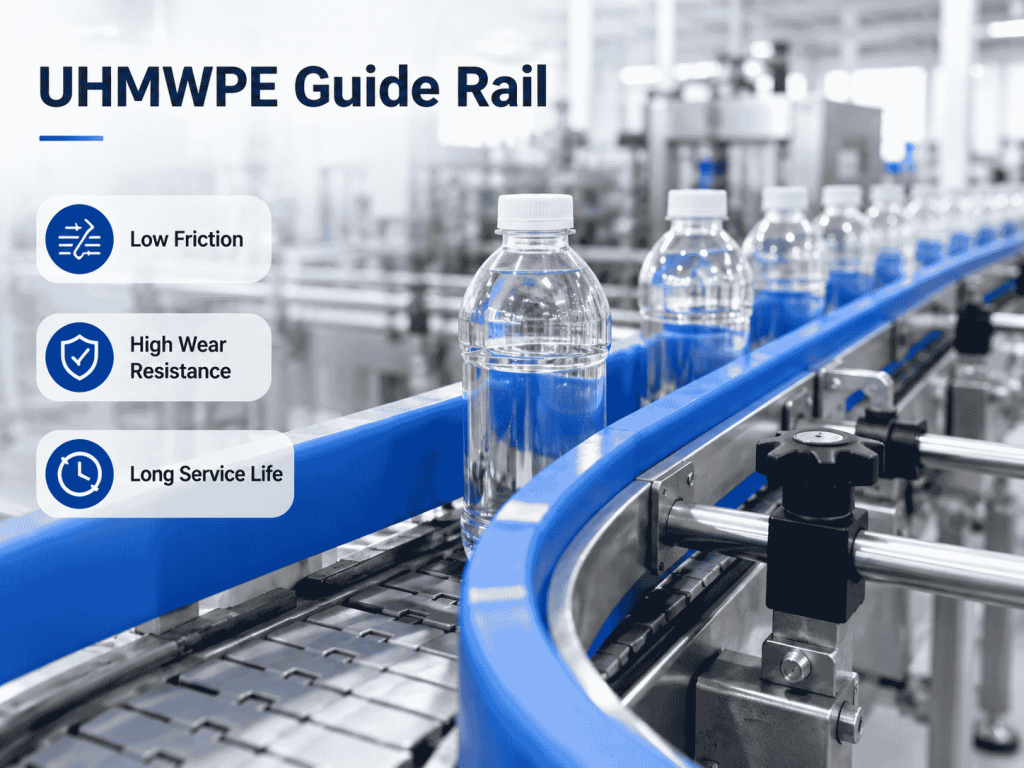
UHMWPE: Guide Rails, Liners, and Wear Strips
UHMWPE, or ultra-high-molecular-weight polyethylene, is known for its impact strength, abrasion resistance, chemical resistance, and low-friction surface. These properties make it particularly suitable for sliding, guiding, and bulk-material-handling applications.
Typical UHMWPE components include:
- Chain guides and conveyor rails
- Wear strips and slide plates
- Hopper and chute liners
- Curved guide components
- Bottle conveyor guide rails
- Outrigger pads and support pads
UHMWPE material data published by Ensinger highlights properties including impact strength, abrasion resistance, chemical resistance, and low-temperature performance.
UHMWPE is not normally selected for applications requiring high rigidity, tight dimensional stability under load, or continuous exposure to high temperatures.
POM: Precision Fixtures, Sliders, and Gears
POM, also known as acetal, offers high stiffness, good dimensional stability, low moisture absorption, and a relatively low coefficient of friction. It is commonly machined into precise mechanical components.
Typical POM applications include:
- Precision gears
- Positioning and limit blocks
- Fixtures and tooling plates
- Sliders and guide components
- Conveyor star wheels
- Bushings and washers
POM is commonly found in automation equipment, inspection systems, electronic assembly equipment, packaging machinery, and precision conveying systems.
For static-sensitive production environments, antistatic or electrically conductive POM grades may be considered after confirming the required surface-resistance range.
PTFE: Seals, Bushings, and Chemical Components
PTFE provides very low friction, broad chemical resistance, electrical insulation, and useful high- and low-temperature performance. It is often used in chemical equipment and sealing systems.
Common PTFE components include:
- Sealing rings and gaskets
- Flanged bushings
- Scraper blades
- Guide strips
- Insulating components
- Chemical-resistant sleeves
Unfilled PTFE is relatively soft and can deform under sustained loads. Filled or modified PTFE grades may be required when improved wear resistance, strength, or dimensional stability is needed.
PP: Chemical Tanks and Electrical Separators
PP, or polypropylene, is lightweight and resistant to many chemicals. It also provides electrical insulation and low moisture absorption, making it suitable for chemical-processing and electrical applications.
Common PP products include:
- Chemical tanks and fabricated vessels
- Electrical separator plates
- Busbar support components
- Machine guards and protective panels
- Pipe fittings and connection parts
- Components exposed to acids or alkalis
PP normally has lower stiffness and wear resistance than nylon or POM. It is therefore better suited to corrosion-resistant, insulating, and moderate-load applications than heavily loaded mechanical components.
Benefits of Replacing Metal with Engineering Plastics
Lower Component Weight
Replacing suitable steel, aluminum, or bronze components with engineering plastics can reduce the weight of moving assemblies and simplify installation or replacement.
Reduced Lubrication Requirements
Some engineering plastics provide naturally low friction or can be supplied in internally lubricated grades. This may reduce the amount of grease required in sliding applications.
Improved Corrosion Resistance
Plastic components do not rust and can provide longer service in wet, humid, or chemically exposed operating conditions when the material is compatible with the specific medium.
Lower Mechanical Noise
Plastic gears, guides, rollers, and bushings can reduce hard metal-to-metal contact, helping equipment operate more quietly.
Protection for Finished Products
Plastic contact surfaces can reduce scratching, denting, and marking during conveying, positioning, assembly, and inspection processes.
Greater Design Flexibility
Engineering plastics can be CNC machined, molded, welded, or thermoformed into complex components. Holes, slots, grooves, counterbores, curved profiles, and special mounting structures can be incorporated into the design.
More examples of plastic replacing conventional materials can be found in this engineering plastics and metal replacement article.
When Should Engineering Plastics Not Replace Metal?
Engineering plastics have performance limits and should not automatically replace every metal component. Metal may remain the better choice for:
- Main load-bearing structures exposed to extreme loads
- Components operating continuously at very high temperatures
- Parts requiring exceptionally high stiffness
- High-speed rotating components requiring strict dynamic balance
- Safety-critical parts exposed to severe fatigue loading
- Components requiring electrical conductivity or heat dissipation
- Applications with extremely tight dimensional tolerances
In many machines, a hybrid structure is more practical. A metal frame can provide structural strength, while a replaceable UHMWPE wear strip, nylon bushing, POM slider, or PTFE liner provides the contact surface.
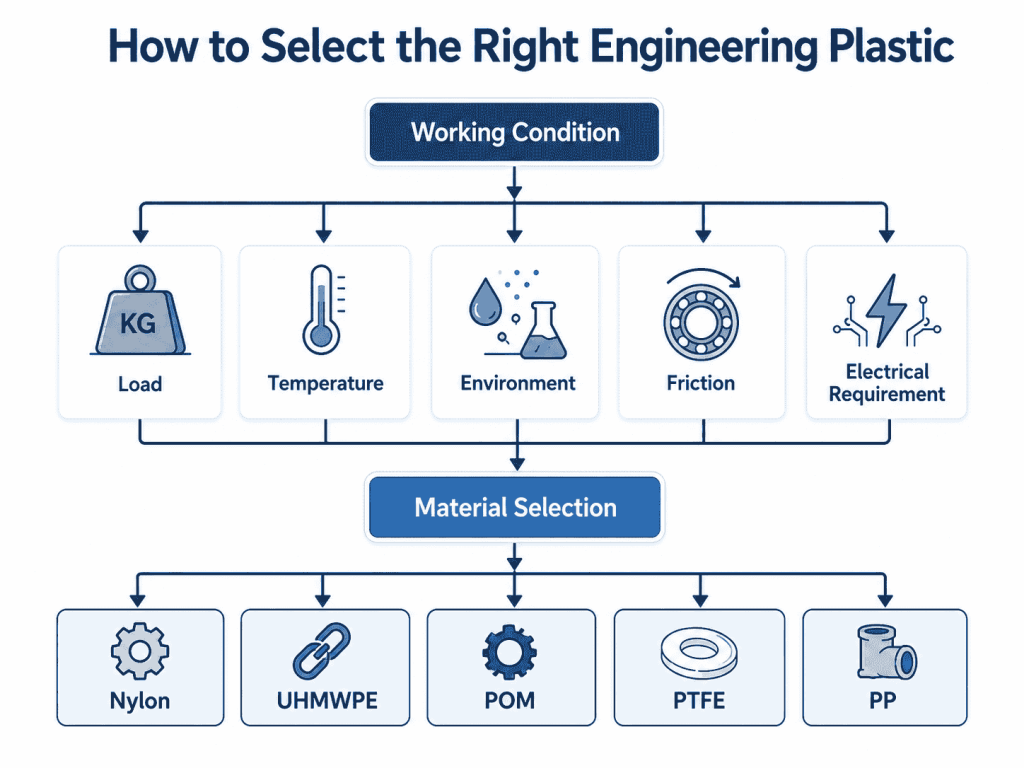
How to Select the Right Engineering Plastic
Material selection should begin with the actual operating conditions rather than the appearance or price of the raw material.
1. Determine the Mechanical Load
Identify static load, dynamic load, impact, vibration, pressure, and possible deformation. A material that performs well as a guide strip may not be suitable as a structural support.
2. Confirm the Operating Temperature
Consider both normal and maximum temperatures. Frictional heat and nearby motors, heaters, or processing equipment can raise the actual component temperature.
3. Evaluate the Working Environment
Confirm whether the component will contact water, oil, cleaning agents, acids, alkalis, solvents, dust, or abrasive particles.
4. Identify the Type of Movement
Determine whether the part is sliding, rotating, rolling, oscillating, or stationary. Also consider speed, contact pressure, and lubrication conditions.
5. Check Dimensional Requirements
Moisture absorption, thermal expansion, long-term loading, and machining tolerance can affect the final dimensions of a plastic component.
6. Confirm Electrical Requirements
The component may need to be insulating, antistatic, electrostatic-dissipative, or conductive. These requirements should be defined before selecting the material grade.
7. Review Industry Compliance
Food-processing, medical, electrical, and semiconductor applications may require specific material certifications or regulatory compliance.
Engineering Plastic Selection Overview
| Material | Main Advantages | Typical Components | Important Limitation |
|---|---|---|---|
| Nylon | Strength, wear resistance, impact resistance | Gears, rollers, pulleys, bushings | Moisture absorption |
| UHMWPE | Low friction, abrasion resistance, impact resistance | Guide rails, liners, wear strips | Limited rigidity and heat resistance |
| POM | Dimensional stability, stiffness, machinability | Fixtures, sliders, gears, star wheels | Material compatibility must be checked |
| PTFE | Low friction, chemical resistance, temperature range | Seals, bushings, gaskets, scrapers | Relatively soft under sustained load |
| PP | Low weight, chemical resistance, insulation | Tanks, separators, electrical components | Lower stiffness and wear resistance |
Frequently Asked Questions
Can engineering plastics completely replace metal?
No. Engineering plastics are most effective when replacing metal components affected by friction, corrosion, noise, weight, or frequent maintenance. Highly loaded structural and safety-critical parts may still require metal.
Which engineering plastic is best for wear resistance?
UHMWPE and nylon are commonly used for wear applications, but the best choice depends on load, speed, temperature, surface pressure, and environmental conditions.
Which plastic is suitable for precision-machined parts?
POM is frequently used for precision fixtures, gears, sliders, and positioning components because of its stiffness, machinability, and dimensional stability.
Which plastic is suitable for chemical equipment?
PTFE and PP are frequently considered for chemical applications. The exact material must be checked against the operating temperature, chemical concentration, exposure time, and mechanical load.
Can plastic gears operate without lubrication?
Some nylon and POM gears can operate with limited or no external lubrication under suitable loads and speeds. The complete gear design, temperature, mating material, and operating cycle must still be evaluated.
Conclusion
Replacing metal with engineering plastics is not simply a material substitution. It is an engineering decision based on load, movement, temperature, chemical exposure, dimensional requirements, and maintenance objectives.
Nylon is suitable for gears, rollers, pulleys, and bushings. UHMWPE is commonly used for guide rails, liners, and wear strips. POM is effective for precision fixtures and moving components. PTFE is suitable for seals and chemical-resistant sliding parts, while PP is widely used for corrosion-resistant and electrically insulating components.
When the material and component structure are properly matched to the operating conditions, engineering plastics can reduce equipment weight, lower friction, protect product surfaces, improve corrosion resistance, and simplify maintenance.