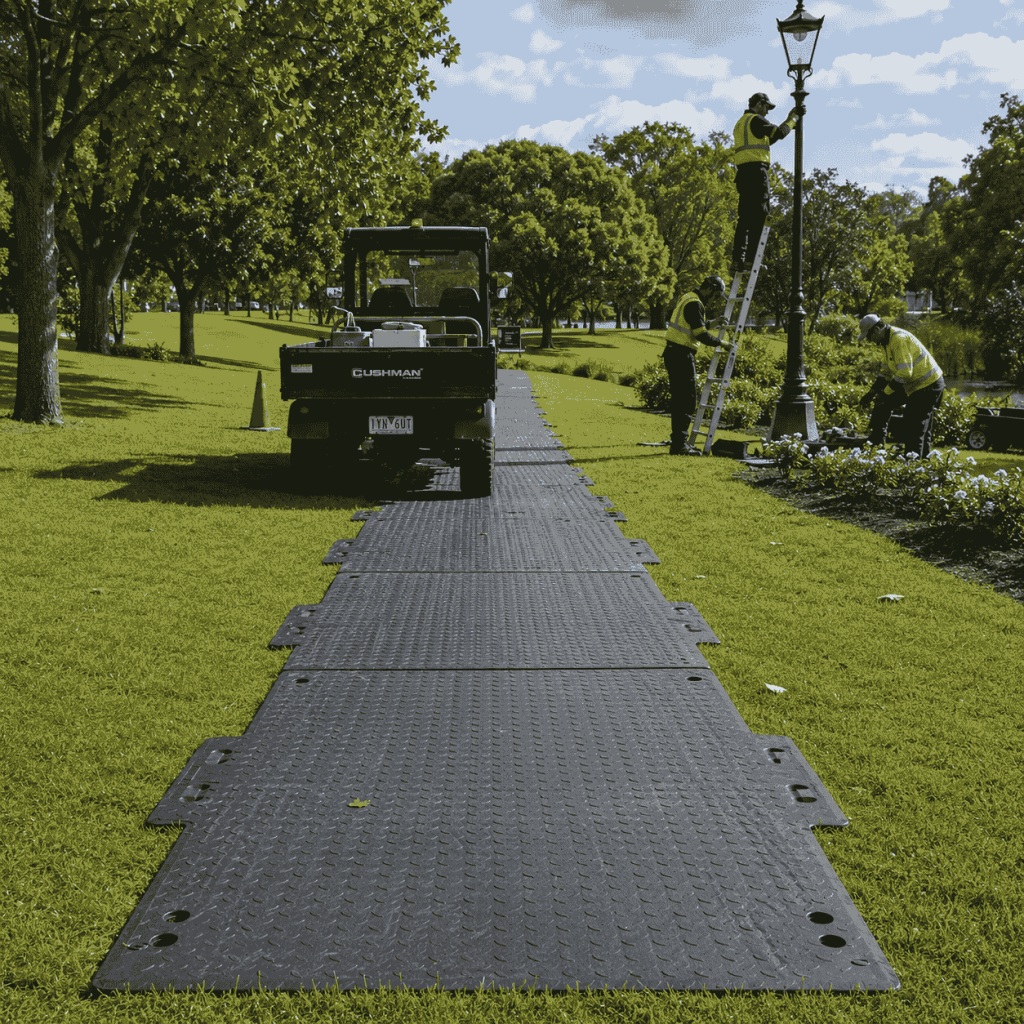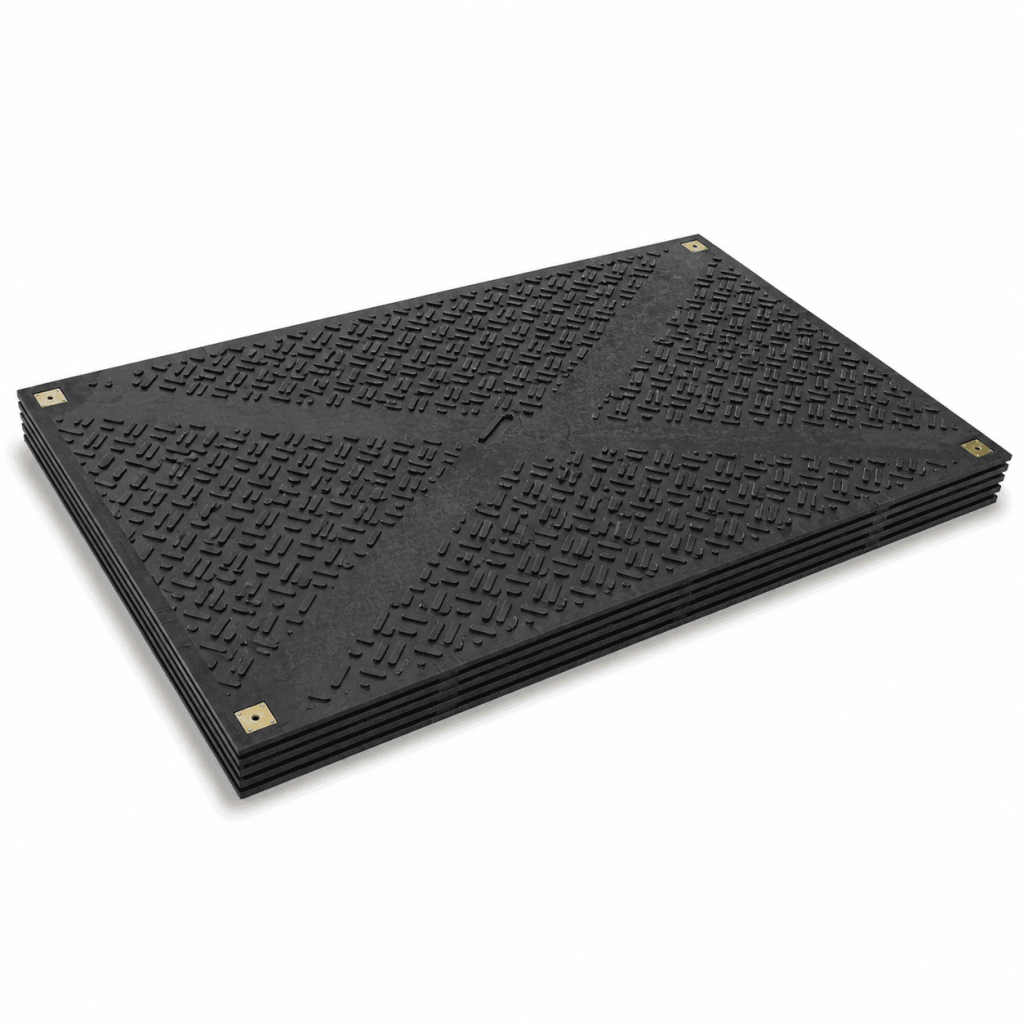

Ground Protection Mats Case Study examines how black polyethylene mats were used to create a temporary vehicle route across a public park lawn. The solution allowed maintenance vehicles to reach the work area while reducing wheel ruts, soil settlement, and damage to the grass.
Project Background
The project involved lighting, drainage, and landscape equipment maintenance inside an urban park. Because the work area was located away from the main paved road, transport vehicles and small machinery had to cross a section of grass.
After rainfall, the soil became soft and unsuitable for repeated vehicle traffic. Direct access caused several problems:
- Vehicle tyres slipped or sank into soft soil.
- Repeated traffic created visible wheel ruts.
- Grass and topsoil were damaged.
- Steel plates were difficult to move and reposition.
- Temporary gravel roads required additional removal work.
The project team therefore needed a removable, reusable, and easy-to-install ground protection solution.
Application on Park Lawns
Park lawns are easily damaged by maintenance vehicles, especially after rainfall or irrigation. Repeated tyre pressure can compact the soil, tear the grass surface, and leave visible wheel ruts. In this project, the ground protection mats created a stable temporary route across the lawn, allowing vehicles and equipment to reach the maintenance area while reducing direct contact with the grass. After the work was completed, the mats were removed, leaving the lawn with only minimal restoration required.

Product Design Features
Raised Anti-Slip Surface
The raised surface pattern increased friction between the vehicle tyres and the mats. This helped reduce slipping on wet grass, mud, and other damp surfaces.
Integrated Hand Holes
The mats featured hand holes that made lifting, dragging, unloading, and repositioning more convenient. This was important because the access route needed to change as the maintenance work progressed.
Durable Polyethylene Material
Polyethylene has low water absorption and does not rust when exposed to rain, soil, or mud. Its toughness also makes it suitable for repeated temporary use under appropriate operating conditions.
Reusable Structure
The mats did not require permanent fixing. After one section of the project was completed, they could be removed and installed in another area.
Installation Process
1. Plan the Vehicle Route
The route was selected according to vehicle width, turning radius, ground condition, and the location of the maintenance work.
2. Prepare the Surface
Sharp objects and major surface irregularities were removed to reduce concentrated pressure beneath the mats.
3. Install the Mats
The mats were positioned along the access route, with sufficient coverage provided for the vehicle tyres.
4. Reinforce Turning Areas
Additional coverage was installed where vehicles needed to turn, reverse, stop, or unload equipment.
5. Inspect During Use
The mat positions and underlying ground were checked regularly. Any displaced or uneven mats were adjusted promptly.
Project Results
After installation, maintenance vehicles were able to travel across the lawn with greater stability. The tyres no longer contacted the grass directly, and the mats distributed the wheel loads across a wider surface area.
This reduced deep wheel ruts, local soil settlement, and visible damage to the grass. The raised surface pattern also improved tyre traction in damp conditions.
As the work location changed, the mats were moved to the next section and reused. After the project was completed, they were removed and cleaned without requiring the demolition of a permanent road.
Advantages of Polyethylene Ground Protection Mats
- Ground protection: Reduces direct tyre contact with grass and soil.
- Load distribution: Spreads wheel pressure across a larger area.
- Anti-slip surface: Improves traction on wet or muddy ground.
- Easy handling: Integrated holes simplify lifting and repositioning.
- Weather resistance: Suitable for rain, mud, and humid conditions.
- Reusable: Can be removed and installed at another location.
- Less restoration work: Reduces the need for gravel removal or road demolition.

Typical Applications
Polyethylene ground protection mats can also be used for:
- Park and landscape maintenance
- Tree trimming and transplanting work
- Outdoor exhibitions and temporary events
- Golf course and sports field maintenance
- Utility and telecommunications repairs
- Agricultural and forestry vehicle routes
- Temporary parking and equipment storage
Project Conclusion
This Ground Protection Mats Case Study demonstrates how polyethylene mats can provide temporary vehicle access while protecting grass and soft soil.
The mats reduced slipping, wheel sinkage, rutting, and surface damage. Their portable and reusable design also allowed the project team to adjust the access route without constructing a permanent roadway.
For additional background on portable mat systems used to create temporary roads and working surfaces, read this overview of access mats.
Mat size, thickness, surface pattern, hand-hole design, colour, and connection method can be selected according to vehicle type, ground conditions, and project requirements.