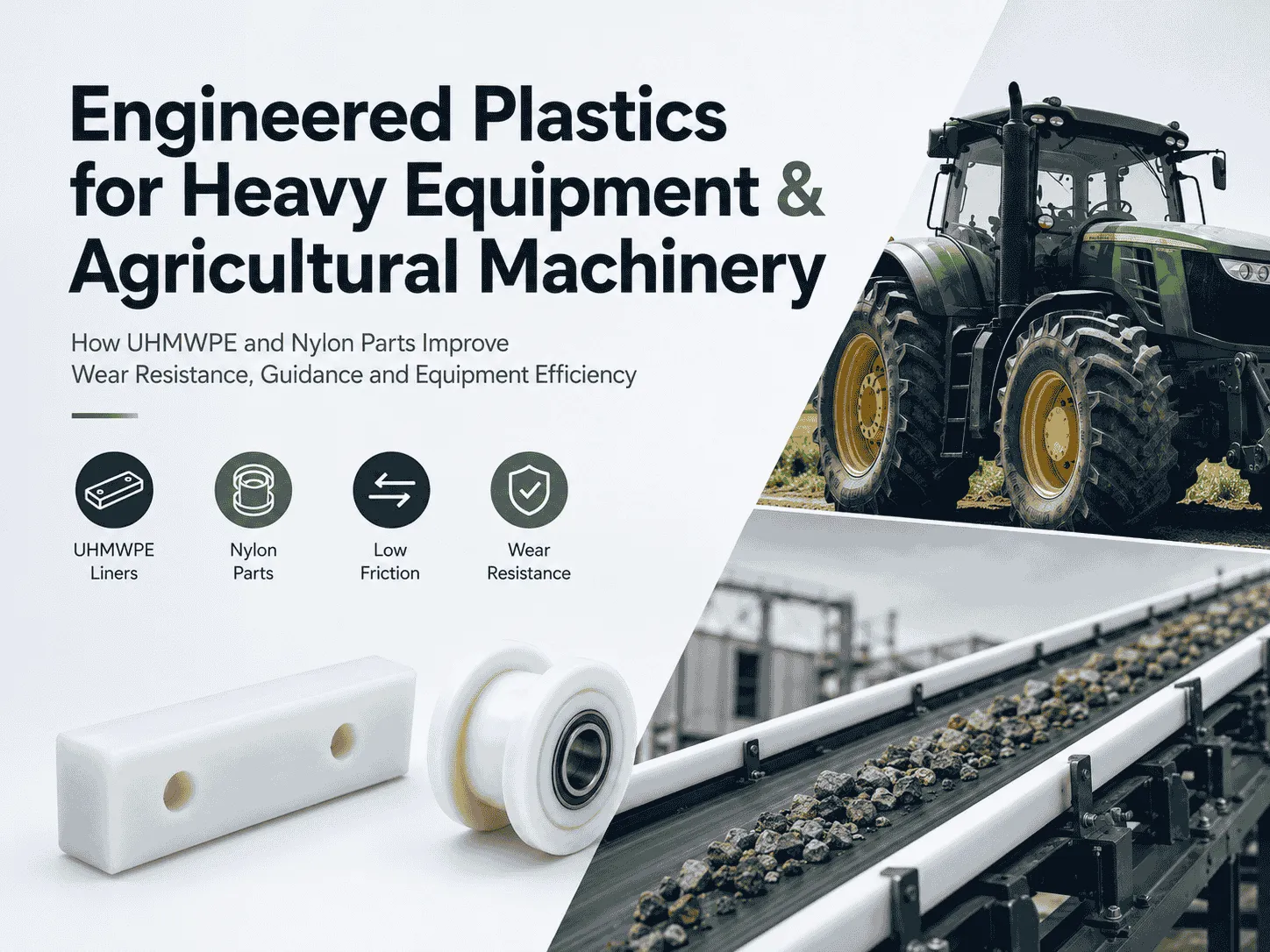

Heavy equipment and agricultural machinery often operate under demanding conditions involving high loads, strong impacts, mud, water, dust and continuous vibration. When sliding, guiding, supporting or transmission components begin to wear, maintenance costs can increase significantly. Excessive wear may also cause abnormal noise, higher operating resistance and reduced equipment stability.
Although traditional metal components provide high structural strength, they may create problems in certain friction and guiding positions, including corrosion, insufficient lubrication, high noise and excessive wear on mating components. For this reason, an increasing number of equipment manufacturers are using UHMWPE and nylon parts to replace metal components in selected applications.
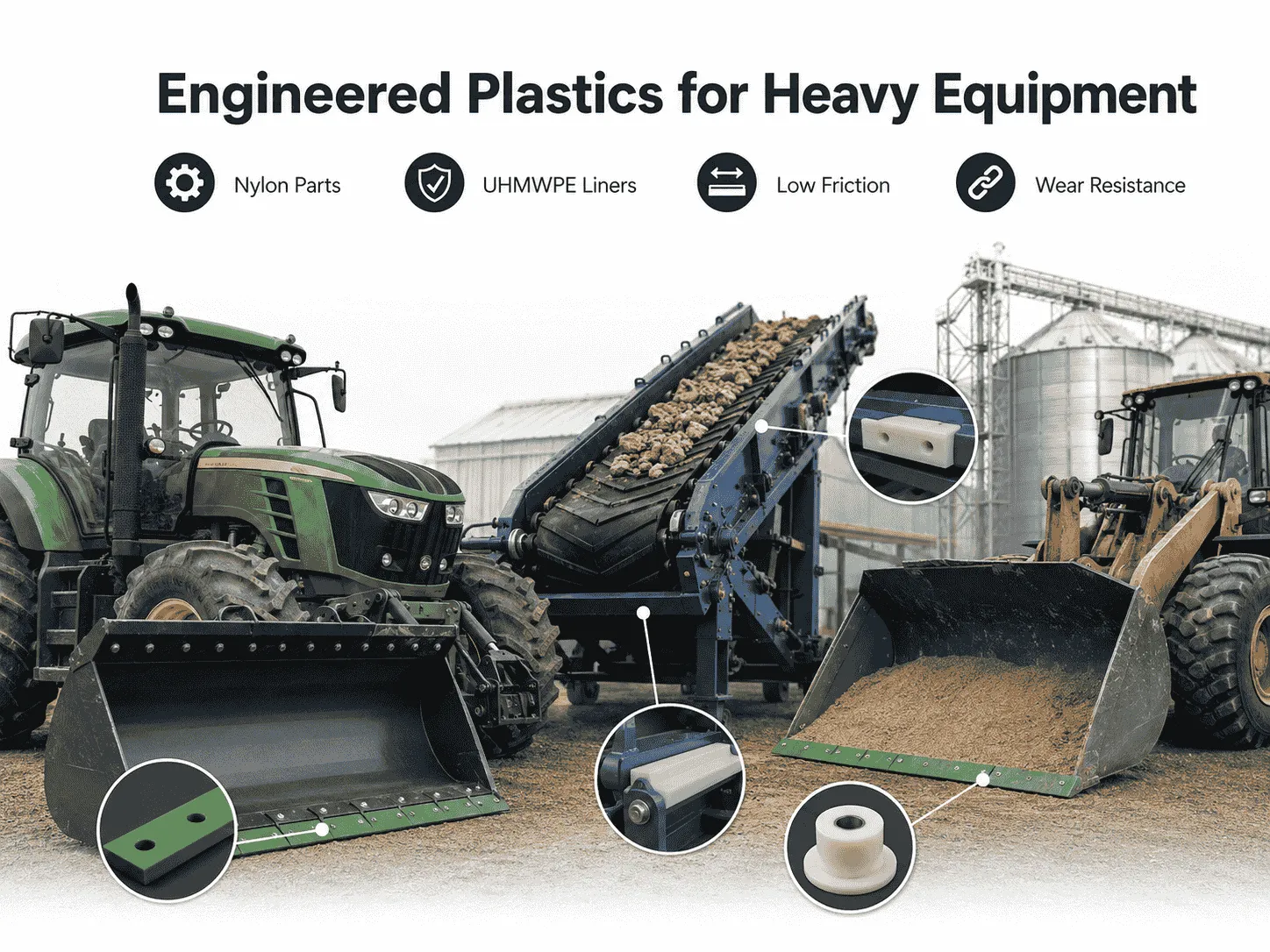
These engineering plastics are lightweight, wear-resistant and suitable for CNC machining into pulleys, bushings, guide rails, liners, chain guides and outrigger pads. They are widely used in agricultural machinery, conveyor systems, construction vehicles and heavy industrial equipment.
1. Common Challenges in Heavy Equipment and Agricultural Machinery
Agricultural machinery and heavy equipment usually work in complex environments. Their components may be affected by several operating factors at the same time.
Common working conditions include:
- Long periods of continuous operation;
- Heavy loads, impacts and repeated vibration;
- Exposure to mud, sand, dust and fertilizer corrosion;
- Outdoor temperature fluctuations;
- Frequent sliding, rotating or reciprocating movement;
- Limited maintenance space;
- Requirements for reduced noise and minimal lubrication.
For example, guiding components in harvesters, seeders, tractors and conveyor systems are frequently exposed to dust, crop residue and abrasive soil particles. When the material does not provide sufficient wear resistance, guide rails and liners may quickly develop grooves, deformation and excessive operating clearance.
2. Limitations of Traditional Metal Components
Metal remains the primary structural material used in heavy machinery. However, metal is not always the most suitable choice for every sliding, guiding or protective position.
2.1 Corrosion and Rust
Agricultural machinery is frequently exposed to rainwater, mud, fertilizers and cleaning fluids. If the protective coating on an ordinary steel component becomes damaged, corrosion can occur and affect the component’s dimensions and installation accuracy.
2.2 High Lubrication Requirements
Metal sliding components usually require regular lubrication. If lubrication is insufficient, friction may increase significantly and cause sticking, scoring or abnormal wear.
2.3 Excessive Operating Noise
Direct metal-to-metal contact can generate considerable impact and friction noise. Continuous equipment vibration may further amplify this noise.
2.4 Damage to Mating Components
When sand, stones or other contaminants enter a metal contact surface, the harder metal component may scratch shafts, guide rails and equipment frames. Repairs may then require several components to be replaced rather than only one wear part.
2.5 Higher Component Weight
Metal components increase equipment weight and moving inertia. This can be a disadvantage for parts that move frequently or rotate at higher speeds.
3. Engineering Plastics for Heavy-Duty Equipment
UHMWPE and nylon engineering plastics are commonly used in heavy machinery and agricultural equipment. The two materials have different performance characteristics and are suitable for different component functions.
UHMWPE — Ultra-High Molecular Weight Polyethylene
UHMWPE has a low coefficient of friction and excellent wear resistance, making it particularly suitable for sliding, guiding, lining and protective components.
Its main characteristics include:
- Excellent wear resistance;
- Low coefficient of friction;
- High impact resistance;
- Low moisture absorption;
- Resistance to many acids, alkalis and corrosive substances;
- Low material weight;
- Reduced operating noise;
- Low adhesion to mud and bulk materials.
UHMWPE is commonly machined into wear liners, guide rails, sliding blocks, outrigger pads, chain guides and equipment protection panels.
Nylon Engineering Plastic
Nylon provides good mechanical strength, toughness and load-bearing capacity. It is commonly used for components that rotate, support shafts or transfer mechanical loads.
Its main characteristics include:
- High mechanical strength;
- Good impact resistance;
- Good wear resistance;
- Self-lubricating properties under suitable conditions;
- Good machinability;
- Lower weight than metal;
- Reduced operating noise;
- Reduced risk of damaging mating metal components.
Nylon is suitable for machining pulleys, bushings, rollers, gears, support blocks and guide wheels.
4. Typical Machined Plastic Parts in Heavy Equipment and Agricultural Machinery
4.1 Nylon Pulleys
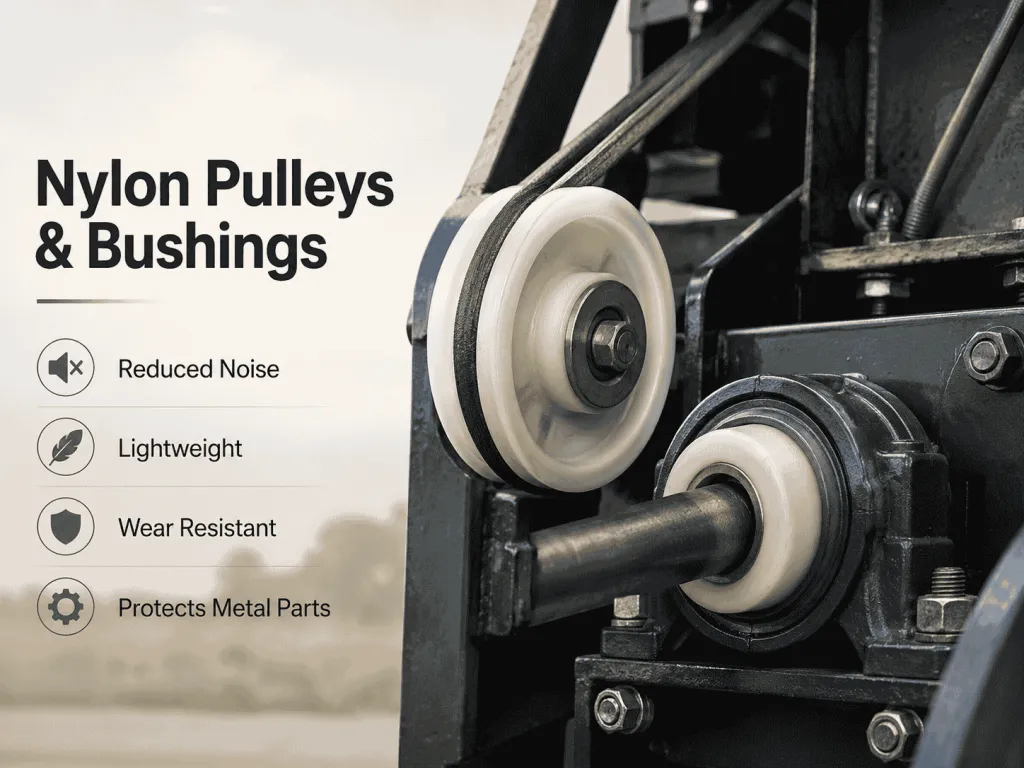
Nylon pulleys are used in agricultural machinery, lifting equipment, conveyor systems and wire-rope guiding mechanisms.
Compared with metal pulleys, nylon pulleys are lighter, quieter during operation and less likely to cause aggressive wear on wire ropes or mating guide rails.
Common applications include:
- Harvester guiding mechanisms;
- Conveyor lifting systems;
- Wire-rope guiding systems;
- Agricultural machinery tensioning mechanisms;
- Sliding doors and protective covers on construction equipment.
For applications involving higher loads, the pulley can be designed with a thicker wheel body, reinforced sections or an integrated metal bearing to improve overall load capacity.
4.2 Nylon Bushings
Nylon bushings are commonly installed around shafts, connecting rods, pivot pins and oscillating mechanisms. They provide support, reduce friction and protect metal shafts from direct wear.
In agricultural machinery, bushings may be exposed to dust, mud, water and repeated impacts. Nylon bushings reduce direct metal-to-metal contact and may decrease the equipment’s dependence on frequent lubrication.
When the bushing eventually wears, only the replaceable plastic component normally needs to be changed. This can help protect more expensive shafts and mounting housings.

4.3 UHMWPE Wear Liners
UHMWPE wear liners can be installed inside hoppers, truck bodies, conveying chutes and material-handling channels to protect the original equipment structure from abrasion.
The material’s low-friction surface can reduce the adhesion of soil, grain, animal feed, fertilizer and granular materials, helping materials discharge and move more smoothly.
Common installation areas include:
- Agricultural transport vehicle bodies;
- Grain hoppers;
- Fertilizer conveying chutes;
- Ore and aggregate storage hoppers;
- Harvester material channels;
- Wear-resistant liners for construction vehicles.
4.4 UHMWPE Guide Rails
UHMWPE guide rails support and guide chains, workpieces, conveyor belts and other moving components.
During operation, the plastic guide rail separates the chain or moving component from the metal equipment frame. This helps reduce friction, operating noise and chain wear.
According to the equipment structure, UHMWPE guide rails can be machined into straight, curved, U-shaped, T-shaped or custom-profile designs with mounting holes.

4.5 UHMWPE Outrigger Pads
Large agricultural machinery, lifting equipment and construction vehicles transfer their loads to the ground through stabilizers or outriggers.
When the ground is soft or uneven, the stabilizer may sink or tilt. A UHMWPE outrigger pad increases the contact area beneath the stabilizer, distributes the load and improves equipment stability on mud, sand and temporary operating surfaces.
Ground firmness, drainage, grading and supporting materials are important considerations when stabilizing heavy equipment, as explained in the OSHA ground-condition requirements for cranes and derricks.
Compared with steel plates, UHMWPE outrigger pads are lighter, easier to move and resistant to rust.
4.6 UHMWPE Chain Guides
Chain guides are commonly installed in conveyor machinery, agricultural processing equipment and automated production lines. They support the chain and control its operating direction.
UHMWPE chain guides provide low friction and good wear resistance, reducing chain resistance, vibration and operating noise.
A properly designed chain-guide profile can also limit lateral chain movement and prevent the chain from striking the equipment frame.

4.7 Equipment Liners and Protective Panels
Engineering plastic liners can be installed in areas exposed to repeated impacts, friction and material abrasion.
For example, UHMWPE protective panels used in harvesters, loading equipment and agricultural transport machinery can reduce wear caused by crops, soil, sand and granular materials.
Because UHMWPE has good toughness, it can absorb impacts without breaking as easily as some rigid or brittle materials.
5. Benefits of Replacing Selected Metal Parts with Engineering Plastics
When UHMWPE or nylon is used under suitable operating conditions, replacing selected metal components can improve equipment performance in several ways.
5.1 Reduced Operating Noise
Plastic-to-metal contact generally produces less impact and friction noise than direct metal-to-metal contact, helping improve the equipment’s operating environment.
5.2 Reduced Lubrication and Maintenance
UHMWPE has low-friction characteristics, while nylon can provide self-lubricating performance in suitable applications. Some low-speed and moderate-load components may therefore require less frequent lubrication.
5.3 Longer Service Life for Mating Components
Engineering plastics are generally softer than steel and can be used as replaceable wear components. The plastic part wears first and helps protect chains, shafts, guide rails and the main equipment frame.
5.4 Reduced Equipment Weight
Engineering plastics have a significantly lower density than steel. Replacing selected metal pulleys, bushings, liners and support blocks with plastic parts can reduce the overall equipment weight.
5.5 Improved Corrosion Resistance
UHMWPE and nylon do not rust like ordinary steel, making them suitable for outdoor, humid and frequently washed environments.
5.6 Lower Long-Term Repair Costs
Engineering plastic components can be machined according to equipment drawings. When a wear component reaches the end of its service life, the individual plastic part can usually be replaced without repairing or replacing the main equipment structure.
6. How to Choose Between UHMWPE and Nylon
Neither UHMWPE nor nylon is universally better. The correct choice depends on how the component operates and the loads it must withstand.
| Application Requirement | Recommended Material |
|---|---|
| Low-friction sliding and guidance | UHMWPE |
| Non-stick and wear-resistant liners | UHMWPE |
| Wet, muddy or corrosive environments | UHMWPE |
| Impact-resistant protection | UHMWPE |
| Pulleys, rollers and bushings | Nylon |
| Higher mechanical strength | Nylon |
| Supporting and transferring mechanical loads | Nylon |
| Gears, guide wheels and rotating components | Nylon |
Material selection should also consider the following parameters:
- Applied Material selection should also consider the load;
- Operating speed;
- Working temperature;
- Exposure to water, oil or chemical substances;
- Impact and vibration conditions;
- Installation dimensions and tolerances;
- Continuous operating time;
- Food-grade, antistatic or flame-retardant requirements.

For applications involving high temperatures, high speeds or especially demanding loads, material selection should not be based on wear resistance alone. Mechanical strength, thermal deformation and dimensional stability must also be evaluated.
7. Machining Considerations for Engineering Plastic Components
Plastic components used in heavy equipment are often large or structurally complex. Their machining process must account for internal material stress, heat generation and dimensional changes.
Production procedures should be arranged according to the component’s function and geometry. Typical steps may include material cutting, rough machining, stress-relief resting and final precision machining.
Components with deep grooves, thin walls, large holes or asymmetrical structures require careful fixture design and machining sequences to reduce the risk of deformation.
Mounting holes, tolerances, chamfers and surface finish should be determined according to the installation position and operating requirements. Proper machining ensures that the component can be installed correctly and remain stable during operation.
Conclusion
UHMWPE and nylon machined parts are widely used in heavy equipment, agricultural machinery, conveyor systems and construction vehicles.
UHMWPE is generally more suitable for wear liners, low-friction guide rails, chain guides, outrigger pads and protective components. Nylon is commonly selected for pulleys, bushings, rollers, gears and load-bearing mechanical parts.
By selecting the correct material and component structure, equipment manufacturers can reduce direct metal friction, lower operating noise, decrease component weight and extend the service life of critical equipment parts.
Engineering plastics are not simply direct replacements for metal. They should be selected according to the actual load, temperature, speed, installation method and operating environment to provide an effective wear-resistant, guiding and supporting solution.