
UHMWPE and nylon are two of the most widely used engineering plastics for wear parts.

Both materials offer good wear resistance, low friction, corrosion resistance, reduced operating noise, and lower weight than metal components.

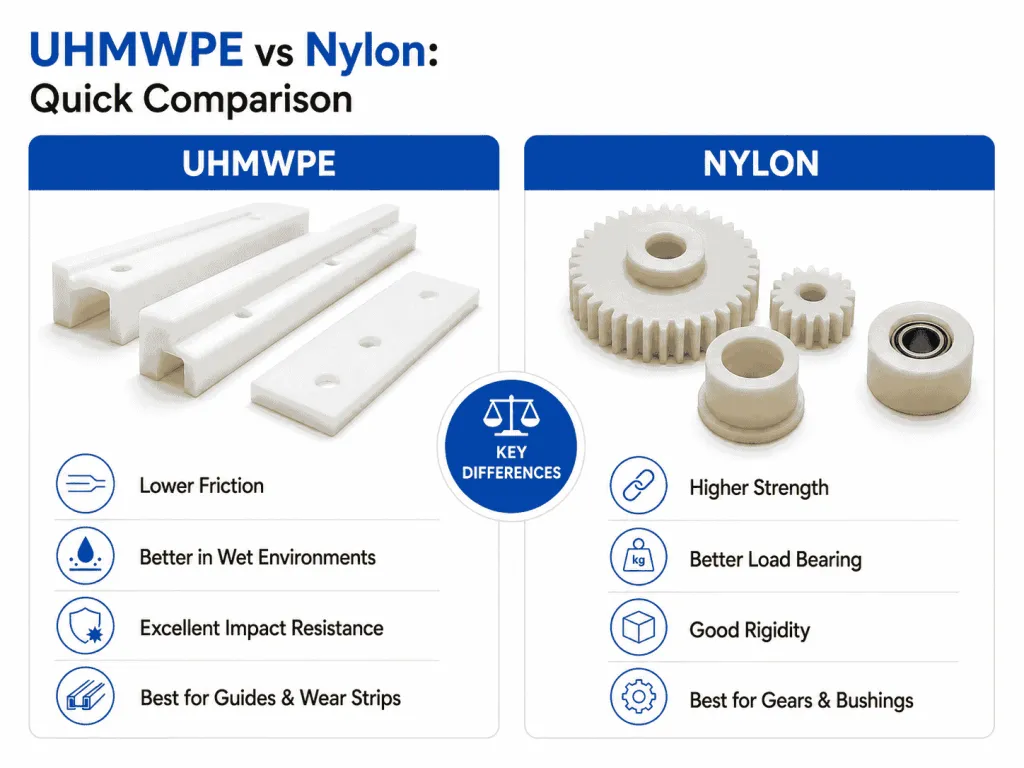
However, they do not perform in exactly the same way. UHMWPE is generally preferred for sliding wear, impact resistance, wet environments, and low-friction conveying components. Nylon usually provides greater strength, rigidity, and load-bearing capacity, making it more suitable for gears, bushings, rollers, and pulleys.

Therefore, the UHMWPE vs Nylon comparison is not simply about deciding which material is better. The correct choice depends on load, motion type, operating temperature, moisture, dimensional accuracy, and component design.

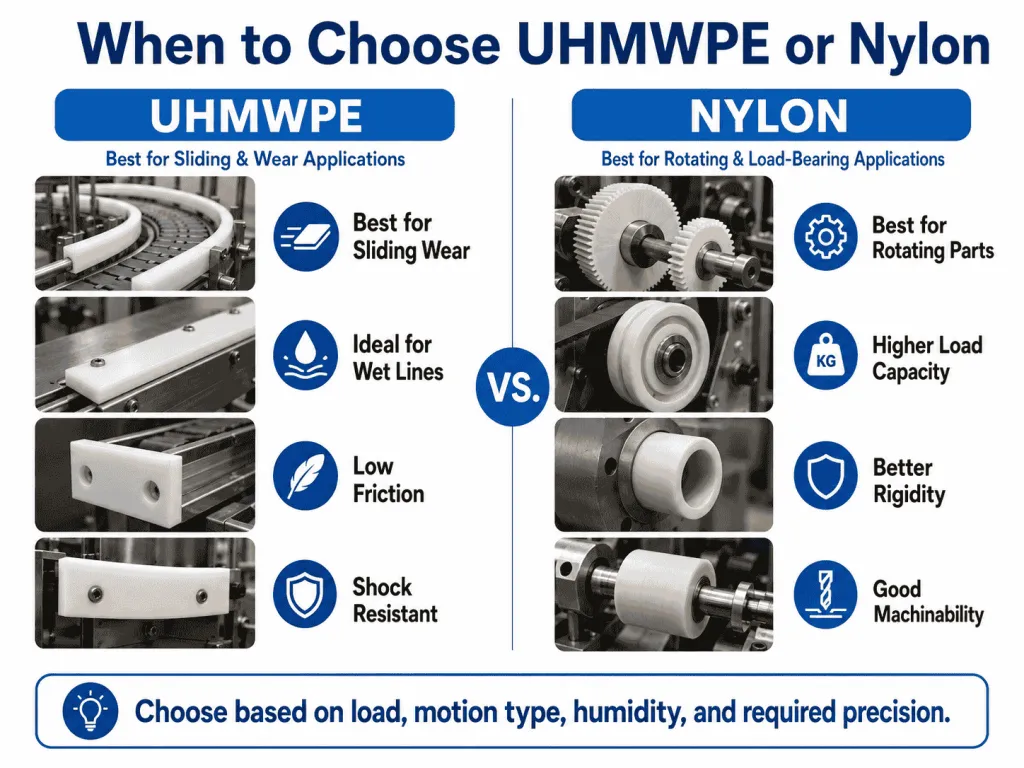
When to choose UHMWPE or Nylon for sliding, rotating, wet, and load-bearing applications
Material selection depends on load, movement type, humidity, friction, and dimensional requirements.

1. What Is the Difference Between UHMWPE and Nylon?

UHMWPE stands for ultra-high molecular weight polyethylene. It is an extremely tough thermoplastic with excellent abrasion resistance, high impact strength, low moisture absorption, and a very low coefficient of friction.

UHMWPE is commonly machined into components such as:

  • Chain guides
  • Conveyor wear strips
  • Sliding blocks
  • Guide rails
  • Chute and hopper liners
  • Conveyor star wheels

Nylon is a polyamide engineering plastic available in several grades, including PA6, PA66, cast nylon, oil-filled nylon, and MoS₂-filled nylon. Compared with standard UHMWPE, nylon generally offers higher tensile strength, compressive strength, hardness, and structural rigidity.

Nylon is commonly used for:

  • Gears and sprockets
  • Bushings and sleeves
  • Rollers and pulleys
  • Bearing pads
  • Support blocks
  • Mechanical wear components

According to the technical comparison published by Curbell Plastics , nylon typically provides greater mechanical strength and stiffness, while UHMWPE provides excellent impact resistance and very low friction.

2. UHMWPE vs Nylon Property Comparison

PropertyUHMWPENylon
Wear resistanceExcellent for sliding and abrasive wearGood, especially in modified grades
Coefficient of frictionVery lowLow to moderate
Load-bearing capacityModerateHigher
Impact resistanceExcellentGood
RigidityRelatively lowHigher
Water absorptionExtremely lowHigher and grade-dependent
Dimensional stabilityCan be affected by heat and long-term loadingGood, but moisture absorption must be considered
Typical applicationsGuides, wear strips, liners, and sliding partsGears, bushings, rollers, and pulleys

These are general comparisons rather than fixed design values. The performance of each material can vary depending on the grade, manufacturer, operating environment, speed, pressure, lubrication, and mating surface.

3. Which Material Has Better Wear Resistance?

For continuous sliding under low or moderate loads, UHMWPE is often the preferred material. Its low coefficient of friction allows chains, packages, profiles, and metal components to move smoothly across its surface.

UHMWPE can help reduce:

  • Sliding resistance
  • Noise and vibration
  • Wear on chains and metal surfaces
  • External lubrication requirements
  • Surface damage to conveyed products

This makes UHMWPE particularly suitable for conveyor guides, chain tracks, sliding rails, wear strips, and chute liners.

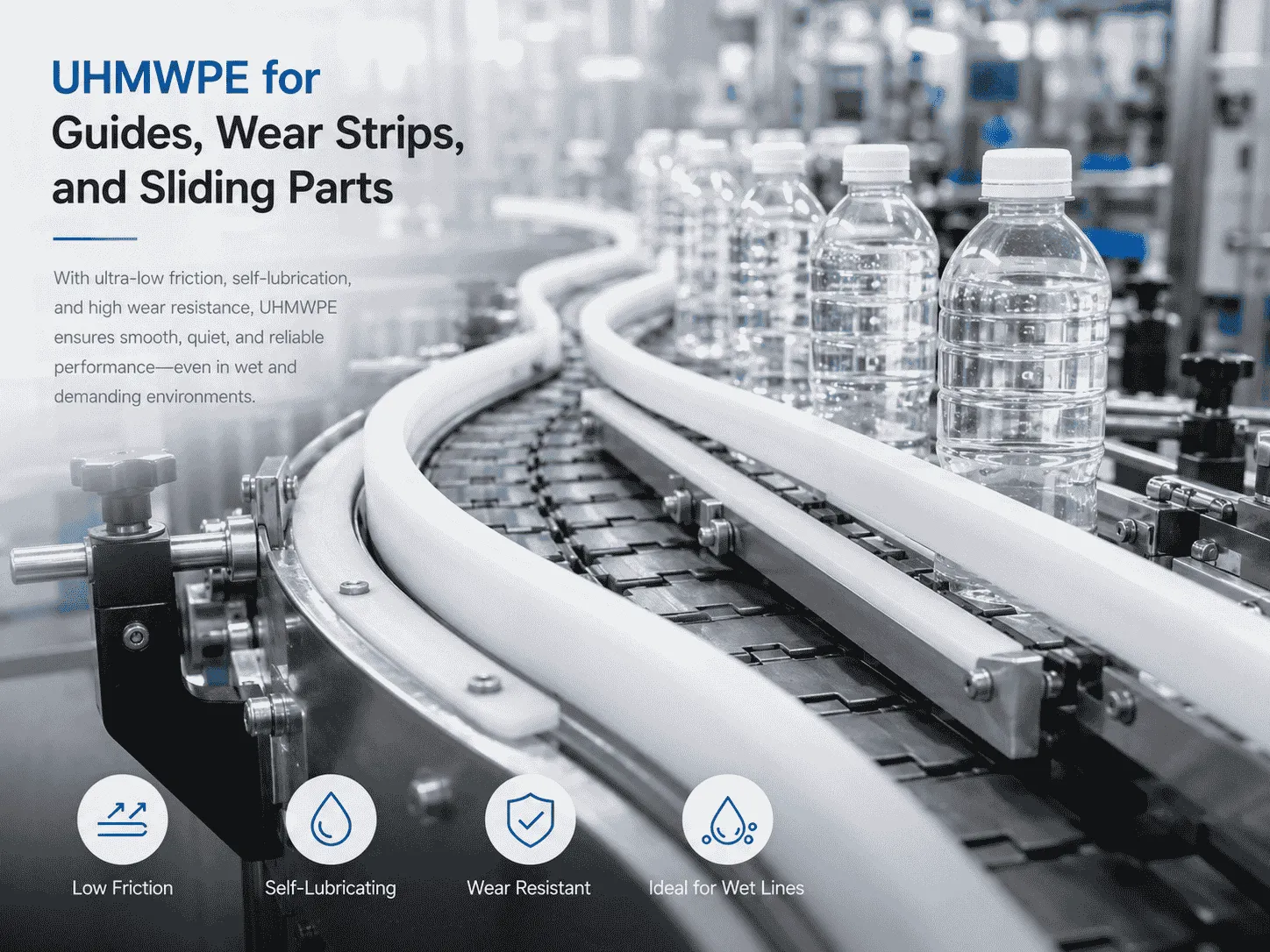
UHMWPE conveyor guides and wear strips installed on a plastic bottle production line
UHMWPE guides provide low friction, self-lubrication, and reliable wear resistance on wet conveyor lines.

However, nylon can also provide excellent wear performance. Oil-filled nylon, MoS₂-filled nylon, and other bearing grades can offer improved friction and wear properties under higher mechanical loads.

Wear performance is highly application-specific. Curbell Plastics notes that engineers should evaluate pressure, speed, temperature, surface finish, mating material, and lubrication when selecting a plastic for a friction and wear application .

General Selection Guidance

  • Choose UHMWPE for continuous sliding, low friction, abrasion, and impact.
  • Choose nylon for higher loads, rotating parts, and mechanically stressed components.
  • Choose modified nylon when both load capacity and improved sliding performance are required.

4. Which Material Has Better Load-Bearing Capacity?

Nylon generally has better load-bearing capacity than UHMWPE. Its higher tensile strength, compressive strength, hardness, and modulus allow nylon parts to maintain their shape under mechanical pressure and torque.

This is why nylon is frequently selected for:

  • Drive gears
  • Transmission sprockets
  • Rollers and wheels
  • Mechanical bushings
  • Bearing sleeves
  • Structural support blocks

UHMWPE has exceptional impact resistance, but it is softer and less rigid. Under continuous static pressure, elevated temperature, or high mechanical loading, UHMWPE may experience creep or dimensional deformation.

For this reason, standard UHMWPE should not automatically replace nylon in high-load structural parts.

5. Which Material Is Better in Wet Environments?

UHMWPE is generally the better choice for wet, humid, washdown, and water-contact environments.

Its extremely low water absorption allows the material to maintain relatively stable dimensions and weight after exposure to moisture. This property is particularly useful in:

  • Food and beverage processing equipment
  • Bottling and packaging lines
  • Washing systems
  • Water treatment equipment
  • Marine structures
  • Outdoor conveyor systems

Ensinger lists a water absorption value of approximately 0.01% for its TECAFINE PE1000 UHMWPE grade.

Nylon absorbs more moisture than UHMWPE. Moisture absorption can cause dimensional expansion and changes in rigidity and mechanical performance. The exact level depends on the nylon grade and test method.

This does not mean that nylon cannot be used in wet environments. However, engineers should allow for moisture-related dimensional changes when designing precision gears, bushings, sleeves, or locating components.

6. Is UHMWPE or Nylon Better for Guides and Sliding Parts?

UHMWPE is usually the first choice for conveyor guides, chain tracks, sliding rails, and wear strips.

Its main advantages in sliding applications include:

  • Low sliding friction
  • Good self-lubricating performance
  • Excellent resistance to abrasive wear
  • High impact resistance
  • Low water absorption
  • Reduced operating noise

UHMWPE guides are commonly installed in food processing, beverage production, packaging machinery, logistics conveyors, and automated production lines.

Nylon may be a better choice when a guide block must withstand a concentrated mechanical load, retain threaded fasteners, or maintain greater structural rigidity.

7. Is UHMWPE or Nylon Better for Gears and Bushings?

Nylon Gears

Nylon is generally more suitable than standard UHMWPE for manufacturing gears. Gear teeth must withstand contact pressure, bending stress, and transmitted torque. Nylon provides the mechanical strength and rigidity needed to maintain a more stable tooth profile.

Nylon gears can also reduce noise and weight compared with metal gears. They are widely used in packaging equipment, food machinery, textile machines, conveyor systems, and automated equipment.

Nylon gears, bushings, rollers, and pulleys used in industrial machinery
Nylon provides higher strength and rigidity for rotating and load-bearing industrial components.

Nylon Bushings

Nylon has good bearing and wear properties and is frequently used to replace some bronze or metal bushings. Nylon bushings can reduce component weight, protect mating shafts, resist corrosion, and lower operating noise.

Standard UHMWPE can be used for simple, low-speed bushings. However, its relatively low rigidity and higher thermal expansion can limit its use in high-speed, high-load, or high-precision bearing positions.

Curbell describes nylon as a strong and stiff engineering plastic with good bearing and wear characteristics.

8. How Do Cost and Machining Compare?

Standard UHMWPE is often cost-effective for long guides, wear strips, liners, and relatively simple sliding components. Its long wear life and low friction can also reduce maintenance and replacement frequency.

However, UHMWPE is relatively soft and has a higher thermal expansion rate than nylon. During machining, improper cutting parameters or clamping methods can cause:

  • Dimensional rebound
  • Part deformation
  • Raised burrs
  • Poor surface finish
  • Difficulty maintaining tight tolerances

Nylon generally machines well and is suitable for complex gears, rollers, bushings, holes, grooves, and threaded features. However, internal stress and moisture absorption must be considered when producing precision nylon parts.

For components with tight tolerances, the machining process may include material conditioning, rough machining, stress-relief periods, and final finishing.

The total component cost depends on more than the price per kilogram. Other factors include:

  • Material grade
  • Sheet or rod dimensions
  • Additives and color
  • Machining complexity
  • Required tolerances
  • Production quantity
  • Maintenance frequency
  • Expected service life

9. When Should You Choose UHMWPE?

UHMWPE is generally the better option when:

  • The component is exposed to continuous sliding wear.
  • Low friction is a major requirement.
  • The equipment operates in a wet or humid environment.
  • The component is exposed to impact or vibration.
  • The application requires a guide, wear strip, liner, or sliding block.
  • Low noise and protection of mating parts are important.
  • External lubrication should be reduced or avoided.

10. When Should You Choose Nylon?

Nylon is generally the better option when:

  • The component must withstand higher mechanical loads.
  • Greater strength and rigidity are required.
  • The component is a gear, bushing, pulley, sprocket, or roller.
  • The part must retain a stable mechanical shape.
  • Complex holes, threads, or precision features are required.
  • The operating temperature exceeds the practical range of standard UHMWPE.

11. UHMWPE vs Nylon: Quick Selection Guide

Application RequirementRecommended Material
Continuous sliding wearUHMWPE
Wet or washdown environmentUHMWPE
High impact or shock loadingUHMWPE
Higher structural loadNylon
Gear or sprocketNylon
Bushing, roller, or pulleyNylon or modified nylon
Long conveyor guideUHMWPE
High-load sliding componentModified nylon, subject to operating conditions

12. Frequently Asked Questions

Is UHMWPE always more wear resistant than nylon?

No. UHMWPE often performs well in sliding and abrasive wear applications, but wear is affected by load, speed, temperature, surface finish, lubrication, and the mating material. Modified nylon grades may provide longer service life under higher loads.

Can nylon be used for conveyor guides?

Yes. Nylon can be used for guide blocks and support components, particularly when higher rigidity is required. UHMWPE is usually more common for long conveyor guides, wet production lines, and applications requiring very low friction.

Can UHMWPE be used to manufacture gears?

UHMWPE can be machined into simple gears for low-speed and low-load applications. However, standard UHMWPE has lower rigidity and dimensional stability than nylon. Nylon is generally preferred for gears that transmit significant torque.

Can nylon be used in wet environments?

Yes, but moisture absorption must be considered. Designers should allow suitable clearance and dimensional tolerance, especially for precision gears, bushings, and locating parts.

Which material is easier to machine?

Both materials can be machined using CNC equipment. Nylon is generally better for complex and high-strength mechanical parts, while UHMWPE requires careful clamping and cutting parameters to control deformation and dimensional rebound.

Conclusion

UHMWPE and nylon are both suitable for industrial wear components, but each material has a different performance advantage.

UHMWPE is generally better for low-friction sliding, abrasive wear, impact resistance, wet environments, conveyor guides, wear strips, liners, and sliding blocks.

Nylon is generally better for higher loads, structural rigidity, gears, bushings, rollers, pulleys, sprockets, and rotating mechanical components.

UHMWPE vs Nylon comparison infographic showing wear resistance, load capacity, moisture absorption, and typical industrial applications
A detailed comparison of UHMWPE and nylon for wear resistance, load-bearing capacity, and wet operating environments.

The final material selection should be based on load, motion type, speed, temperature, humidity, dimensional tolerance, and expected service life. For complex applications, the component drawing, installation position, and actual operating conditions should be evaluated before the material grade and machining method are confirmed.

Picture of Author : Hone xi
Author : Hone xi

Wear-resistant UHMWPE sheets, liners, wear strips, guide rails and CNC machined plastic components for industrial equipment.

Facebook
Twitter
LinkedIn
Pinterest
Products
We Love to Hear From You

Need UHMWPE sheets & custom plastic machined/OEM parts?Send specs & material needs, free quote within 24h.