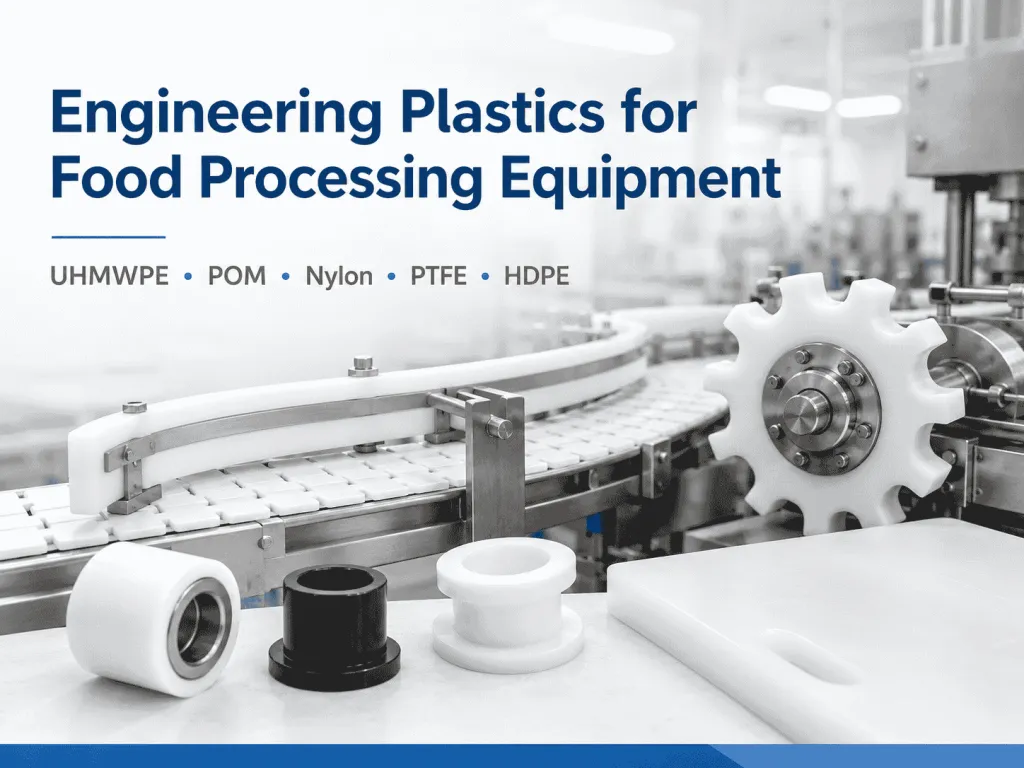

Food processing machinery operates in demanding environments involving moisture, oils, cleaning chemicals, continuous friction, impact, and frequent washdowns.

Although metal components provide high strength, they may create problems such as corrosion, excessive noise, high friction, and damage to bottles, packages, or food products.

Engineering plastics such as UHMWPE, POM, nylon, PTFE, and HDPE provide practical alternatives for selected conveying, guiding, positioning, sealing, and food preparation applications. Each material offers different mechanical, thermal, and chemical properties, so the correct choice depends on the equipment design and operating conditions.

This guide explains the most common engineering plastics for food processing equipment and how they are used in conveyor systems, filling machines, packaging lines, preparation areas, and other food production machinery.

Why Are Engineering Plastics Used in Food Processing Equipment?

Engineering plastics are widely used because they are lightweight, corrosion-resistant, easy to machine, and suitable for manufacturing complex components. They can be CNC machined into conveyor guides, star wheels, rollers, bushings, wear strips, scrapers, cutting boards, and equipment support parts.

Compared with conventional metal components, selected engineering plastics can provide several advantages:

  • Lower friction between moving components
  • Improved wear resistance in continuous operation
  • Resistance to rust in wet processing environments
  • Reduced operating noise and metal-to-metal contact
  • Lower component weight
  • Reduced risk of scratching bottles and packaging materials
  • Flexible CNC machining of holes, grooves, slots, and profiles

However, not every grade of plastic is suitable for direct food contact. Manufacturers should verify the exact resin grade, colorant, additives, processing conditions, and supporting compliance documentation before using a component in a food-contact application.

For current regulatory information, consult the U.S. Food and Drug Administration food-contact substances guidance and the European Commission food-contact materials guidance.

1. UHMWPE Conveyor Guides and Wear Strips

Ultra-high-molecular-weight polyethylene, commonly known as UHMWPE, is one of the most widely used wear-resistant plastics in food conveying and packaging equipment.

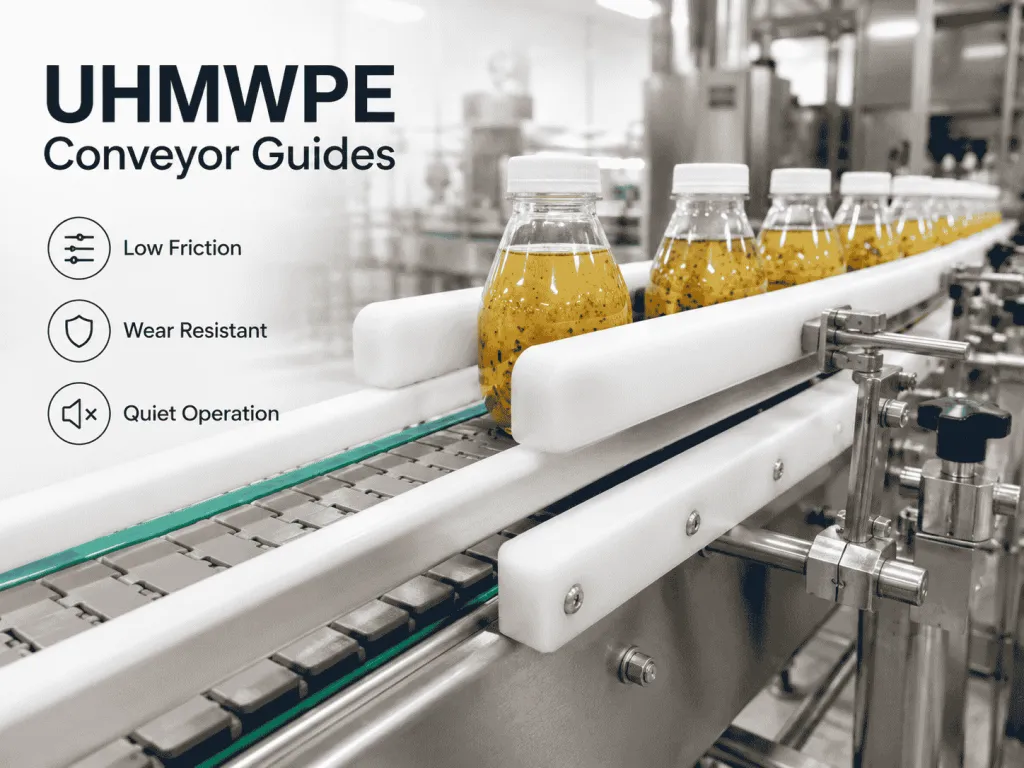
UHMWPE offers low friction, good impact resistance, and excellent wear performance. These properties make it suitable for components that continuously contact conveyor chains, bottles, containers, cartons, and packaged food products.

UHMWPE conveyor guides on a food and beverage processing line
UHMWPE conveyor guides provide low friction, wear resistance, and stable bottle handling on food processing lines.

Common UHMWPE Components

  • UHMWPE conveyor guides
  • Plastic wear strips
  • Chain guides
  • Curved conveyor rails
  • Bottle side guides
  • Conveyor guide blocks
  • Filling line guide rails

On beverage filling and food packaging lines, UHMWPE guide rails help maintain the position of bottles or packages as they move between different processing stations. The low-friction surface reduces conveying resistance and helps prevent products from becoming scratched or stuck.

UHMWPE wear strips can also be installed underneath conveyor chains to reduce direct contact between the chain and the stainless-steel machine frame. This can reduce wear, vibration, and operating noise.

When designing long UHMWPE conveyor guides, manufacturers should consider thermal expansion, mounting-hole design, operating speed, product weight, and the required clearance between the guide and the conveyed product.

2. POM Star Wheels and Precision Positioning Components

Polyoxymethylene, commonly known as POM or acetal, provides high mechanical strength, good dimensional stability, and excellent machinability. It is commonly selected for components that require accurate dimensions and repeatable positioning.

In food filling and packaging machinery, POM can be machined into star wheels, timing screws, gears, positioning blocks, guide plates, sliding blocks, and automation fixtures.

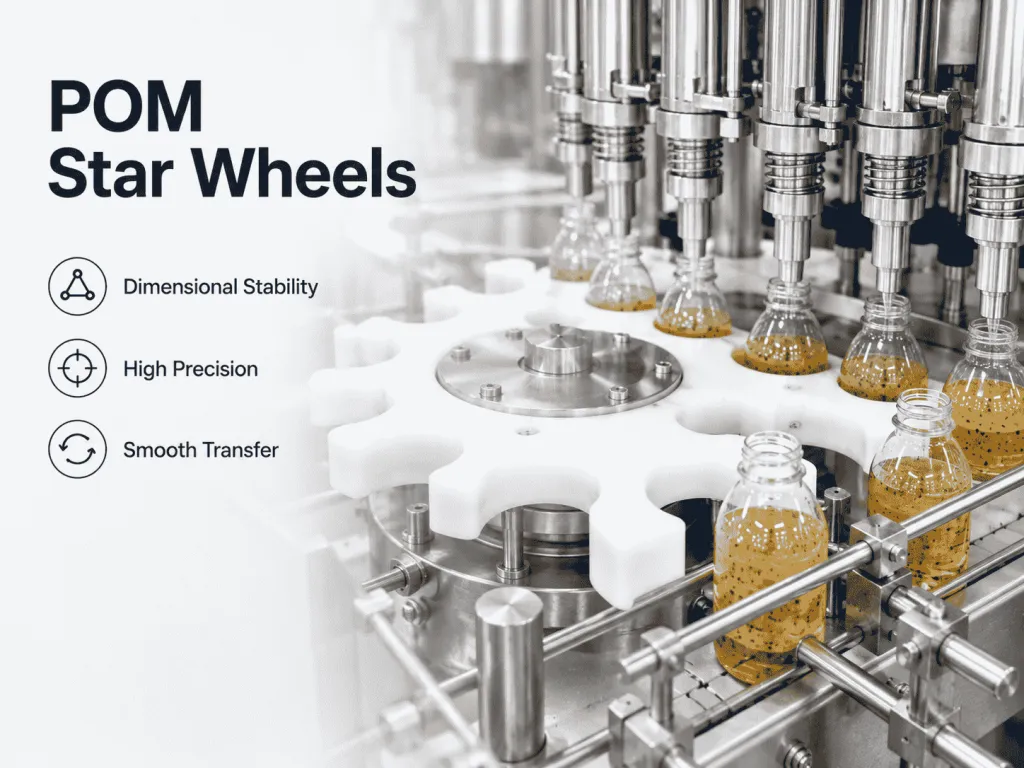
POM star wheel guiding bottles through a food filling machine
Precision-machined POM star wheels help position and transfer bottles smoothly during filling and packaging.

How POM Star Wheels Work

A star wheel is normally installed in a bottle filling, capping, labeling, inspection, or packaging machine. The shaped pockets around the wheel hold and guide containers as they move through different operating stations.

POM star wheels can perform several functions:

  • Control the spacing between bottles or containers
  • Guide products into the correct processing position
  • Reduce bottle movement and collision
  • Support smooth transfer between machine stations
  • Improve filling, capping, and labeling accuracy

Because POM can be machined to precise dimensions, it is suitable for star wheels with complex profiles, curved pockets, mounting holes, counterbores, and locating features.

However, operating temperature, cleaning chemicals, moisture exposure, and long-term mechanical load should still be evaluated. The material grade must be selected according to the actual production and sanitation requirements.

3. Nylon Rollers, Bushings, and Load-Bearing Components

Nylon combines mechanical strength, toughness, wear resistance, and load-bearing capacity. It is commonly used for rollers, bushings, pulleys, gears, spacers, guide wheels, and structural support components.

Nylon rollers and bushings installed on food packaging equipment
Nylon rollers and bushings offer reliable load support, wear resistance, and quieter operation in conveyor systems.

Common Nylon Applications

  • Nylon conveyor rollers
  • Nylon bushings
  • Guide wheels
  • Conveyor pulleys
  • Support blocks
  • Spacer rings
  • Transmission gears

Nylon rollers can support or guide conveyor belts, containers, trays, and packaging materials. Compared with metal rollers, they can reduce noise and help protect the surface of the transported product.

Nylon bushings are installed between shafts and housings to reduce direct metal-to-metal contact. They can provide a relatively lightweight and wear-resistant solution for moderate-load rotating or sliding positions.

One important consideration is moisture absorption. Standard nylon can absorb moisture from the surrounding environment, which may affect its dimensions and mechanical properties. This should be considered in humid production areas and equipment that is frequently washed.

For components requiring very tight dimensional tolerances in consistently wet conditions, POM or another low-moisture-absorption material may be more suitable. The final selection should be based on load, speed, dimensional tolerance, temperature, and cleaning procedures.

4. PTFE Bushings, Seals, and Scraper Components

Polytetrafluoroethylene, commonly known as PTFE, is valued for its low coefficient of friction, broad chemical resistance, and ability to perform across a relatively wide temperature range.

PTFE is frequently used in food processing equipment for seals, gaskets, bushings, scraper blades, isolation pads, valve components, and low-friction sliding parts.

PTFE bushings and seals in stainless-steel food processing machinery
PTFE bushings and seals provide low friction, chemical resistance, and reliable performance in demanding processing environments.

Where Is PTFE Commonly Used?

  • Equipment exposed to cleaning chemicals
  • Low-friction shaft and sliding positions
  • Scraping and product-release components
  • Pump and valve assemblies
  • Pipe connection seals
  • Temperature-sensitive sealing structures

A PTFE scraper can help remove sticky material from a roller, belt, mixing surface, or processing component. Its low surface adhesion makes it useful in selected applications involving oils, dough, sauces, and other materials that may stick to equipment surfaces.

PTFE bushings can reduce friction between a moving shaft and its housing. PTFE seals and gaskets may also be used where resistance to cleaning agents or processing chemicals is required.

However, standard PTFE is softer and has lower load-bearing capability than POM or nylon. Components exposed to high compressive loads require careful evaluation of wall thickness, pressure, speed, mating surfaces, and structural support.

5. HDPE Cutting Boards and Work Surfaces

High-density polyethylene, or HDPE, is commonly used for cutting boards, food preparation surfaces, workbench panels, protective liners, and equipment side panels.

HDPE offers good moisture resistance, impact resistance, and ease of cleaning. It does not rust and can be produced in different thicknesses, dimensions, and colors.

HDPE cutting board on a stainless-steel food preparation table
HDPE cutting boards provide a moisture-resistant, impact-resistant, and easy-to-clean food preparation surface.

Common HDPE Food Processing Applications

  • HDPE cutting boards
  • Food preparation surfaces
  • Processing worktops
  • Equipment protection panels
  • Tabletop liners
  • Impact and wear pads

Color-coded HDPE cutting boards may be used to separate different preparation areas or food categories. This can support internal hygiene management procedures and reduce the risk of using the same surface for incompatible materials.

Cutting surfaces should be inspected regularly. Deep knife marks, excessive wear, cracks, or deformation can create areas that are difficult to clean. Worn boards should be resurfaced or replaced according to the facility’s hygiene procedures.

Engineering Plastic Selection Table

ApplicationRecommended MaterialMain Reasons
Conveyor guides and wear stripsUHMWPELow friction, wear resistance, and impact resistance
Star wheels and positioning componentsPOMDimensional stability and precise machining
Rollers, bushings, and pulleysNylonLoad-bearing capacity, wear resistance, and noise reduction
Seals, scrapers, and low-friction bushingsPTFEChemical resistance, low friction, and temperature resistance
Cutting boards and preparation surfacesHDPEMoisture resistance, impact resistance, and easy cleaning

This table provides general selection guidance only. The final material should be confirmed according to the operating temperature, mechanical load, production speed, cleaning chemicals, food type, dimensional tolerance, and regulatory requirements.

Key Factors When Selecting Engineering Plastics

1. Direct or Indirect Food Contact

Determine whether the component will directly contact food, indirectly contact food, or remain outside the food-contact area. Direct-contact components generally require more detailed documentation and traceability.

Material names such as “nylon,” “POM,” or “UHMWPE” do not automatically confirm food-contact compliance. The exact resin grade, additives, pigments, manufacturing method, and intended use must be reviewed.

2. Food Type and Conditions of Use

The suitability of a food-contact material may depend on the food type, contact time, operating temperature, and whether the component is used for repeated or single use.

The FDA publishes reference information covering food types and conditions of use for food-contact substances.

3. Operating Temperature

Consider the normal processing temperature as well as temporary exposure during cleaning and sterilization. Hot water, steam, heated product, and rapid temperature changes may affect dimensional stability and service life.

4. Mechanical Load

Conveyor guides mainly experience sliding wear and impact, while bushings, rollers, gears, and support blocks may carry significant loads. A material with low friction is not automatically suitable for a heavily loaded component.

5. Cleaning Chemicals

Food processing equipment may be exposed to alkaline detergents, acidic cleaners, disinfectants, oils, fats, and other processing substances. Chemical compatibility should be confirmed for both the material and the expected concentration.

6. Dimensional Stability

Star wheels, timing components, positioning blocks, and automation fixtures may require tight tolerances. Moisture absorption, temperature changes, internal stress, and machining methods can all affect final dimensions.

7. Thermal Expansion

Long plastic conveyor guides and wear strips expand and contract as temperatures change. Mounting holes and fastening systems should allow controlled movement to prevent buckling, warping, or excessive internal stress.

8. Machine Speed and Friction

Higher operating speeds can increase frictional heat and wear. The contact pressure, surface finish, lubrication condition, and mating material should be considered during component design.

How to Improve the Service Life of Plastic Components

Material selection is only one part of achieving reliable performance. Component design, machining quality, installation, and maintenance also affect service life.

Important manufacturing and inspection points include:

  • Confirming that holes, grooves, and profiles match the drawing
  • Removing burrs and sharp machining edges
  • Controlling the surface finish of sliding areas
  • Providing expansion clearance for long guide rails
  • Preventing distortion in long or thin components
  • Matching star wheel pockets to bottle dimensions
  • Controlling the inner and outer diameter of bushings
  • Maintaining consistent dimensions across production batches

For replacement parts, manufacturers should also verify the original installation position, wear pattern, fastener design, mating surface, and product contact area. This information can help identify whether the previous component failed because of material selection, structural design, installation, or operating conditions.

Food-Contact Compliance Considerations

Food processing equipment manufacturers should not describe every component made from UHMWPE, POM, nylon, PTFE, or HDPE as “food grade” without reviewing the specific material documentation.

Depending on the destination market and application, relevant documentation may include:

  • Material technical data sheets
  • Supplier declarations
  • Food-contact compliance statements
  • Migration test reports
  • Material batch traceability
  • Information about pigments and additives
  • Defined temperature and contact limitations

For products intended for the European market, manufacturers should review the applicable EU food-contact material legislation. For products intended for the United States, manufacturers should review the relevant FDA authorizations and conditions of use.

Conclusion

UHMWPE, POM, nylon, PTFE, and HDPE perform different functions in food processing and packaging equipment.

UHMWPE is commonly used for conveyor guides and wear strips. POM is suitable for precision star wheels and positioning components. Nylon provides strength and wear resistance for rollers, bushings, and support parts. PTFE is selected for low-friction, chemical-resistant, and sealing applications. HDPE is widely used for cutting boards, preparation surfaces, and protective panels.

The best engineering plastic cannot be selected by material name alone. Operating temperature, mechanical load, cleaning chemicals, production speed, dimensional tolerances, installation structure, and food-contact requirements must all be considered.

By combining suitable material selection with accurate CNC machining and proper component design, food processing equipment manufacturers can reduce friction, control wear, lower operating noise, prevent corrosion, and improve the stability of production lines.

Picture of Author : Hone xi
Author : Hone xi

Wear-resistant UHMWPE sheets, liners, wear strips, guide rails and CNC machined plastic components for industrial equipment.

Facebook
Twitter
LinkedIn
Pinterest
Products
We Love to Hear From You

Need UHMWPE sheets & custom plastic machined/OEM parts?Send specs & material needs, free quote within 24h.