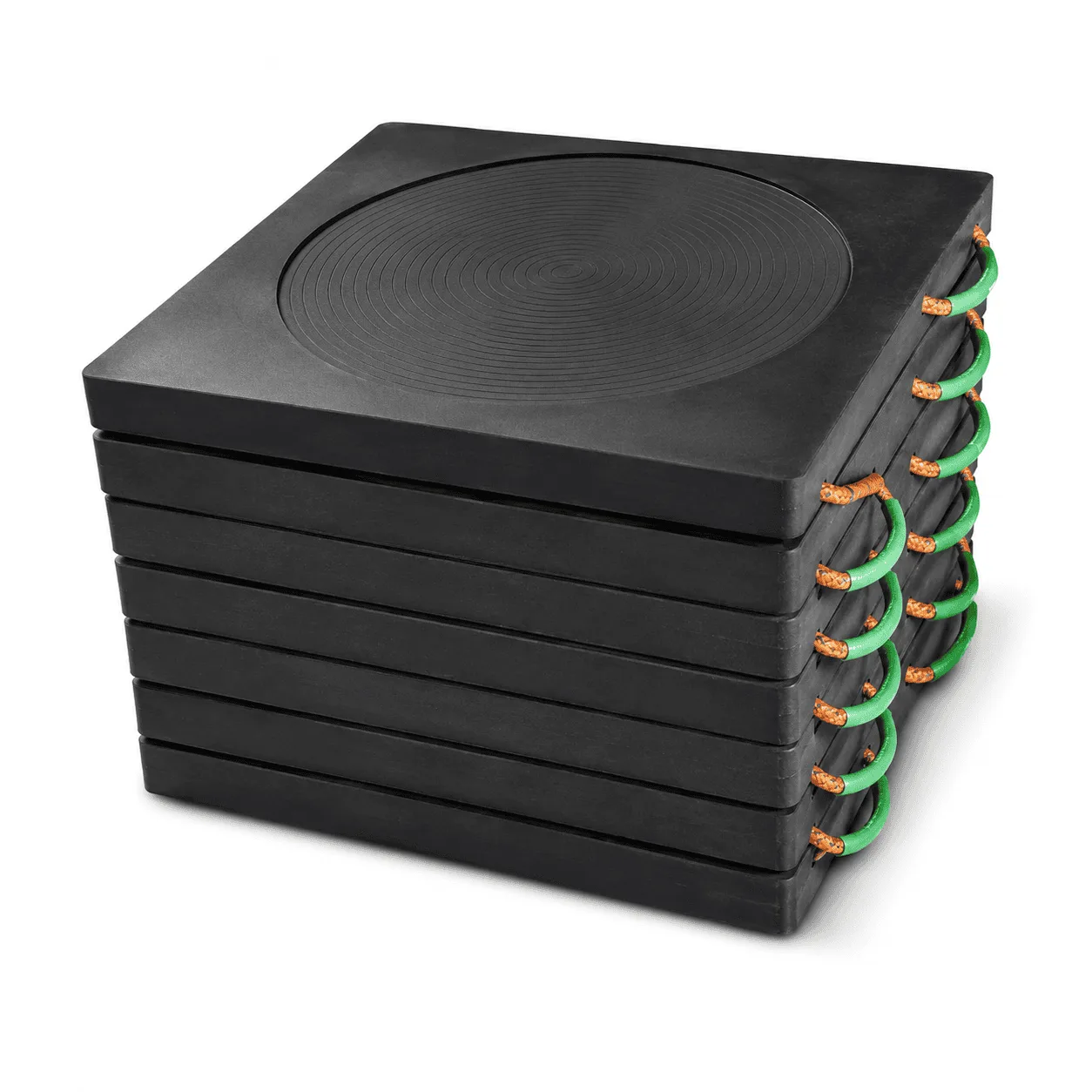
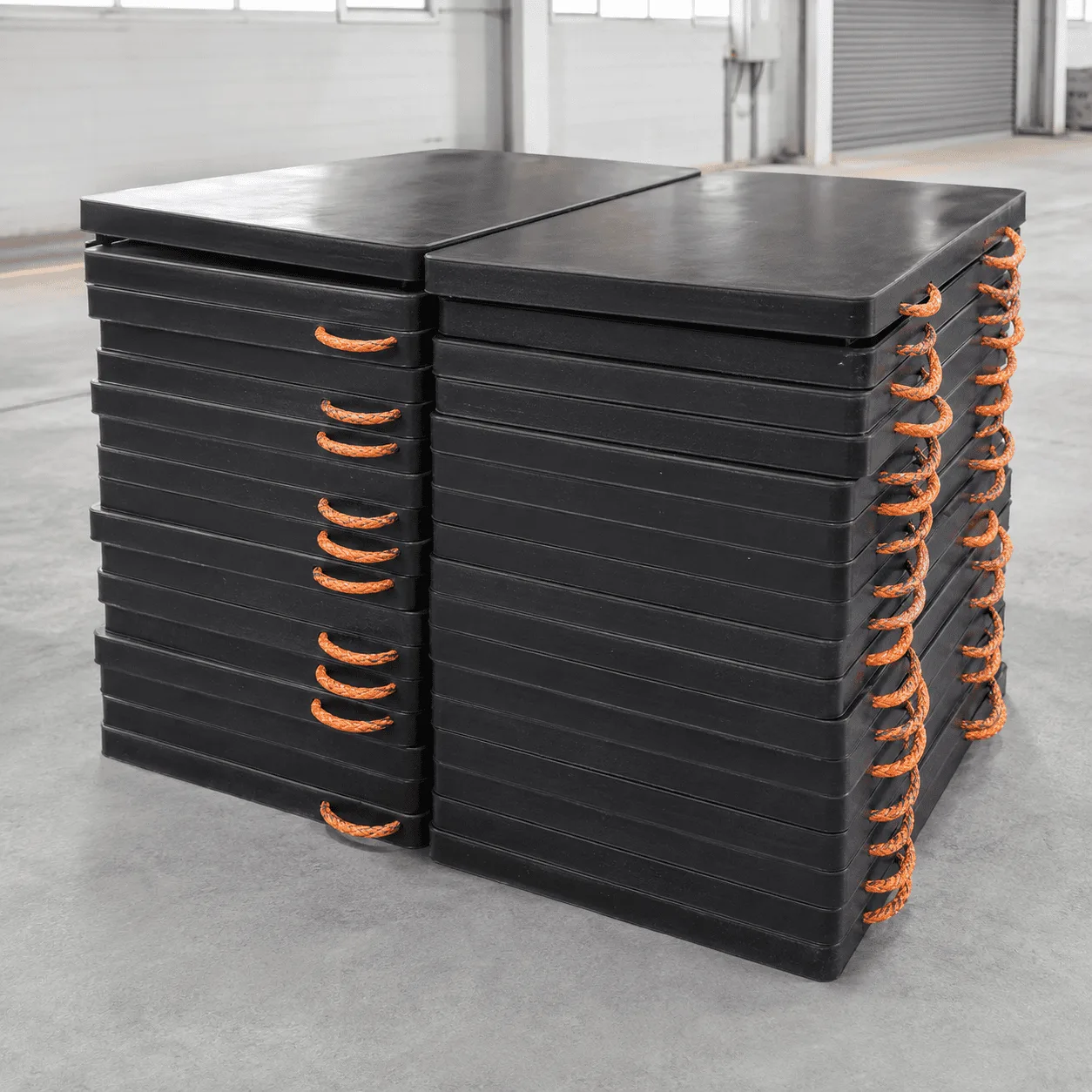
UHMWPE HDPE Crane Pads are reusable heavy-equipment support panels featuring solid square structures, raised diagonal working surfaces and multiple reinforced rope handles. Practical reference sizes include 500 × 500 × 40–50 mm, 600 × 600 × 40–60 mm, 800 × 800 × 60–80 mm and 1000 × 1000 × 80–100 mm for mobile cranes, concrete pumps, boom trucks and other stabilizer-equipped machinery.
UHMWPE HDPE Crane Pads are heavy-duty engineering-plastic support panels designed for mobile crane outriggers, concrete pump stabilizers, boom truck support legs, truck-mounted cranes, aerial work platforms and other machinery equipped with hydraulic stabilizers.
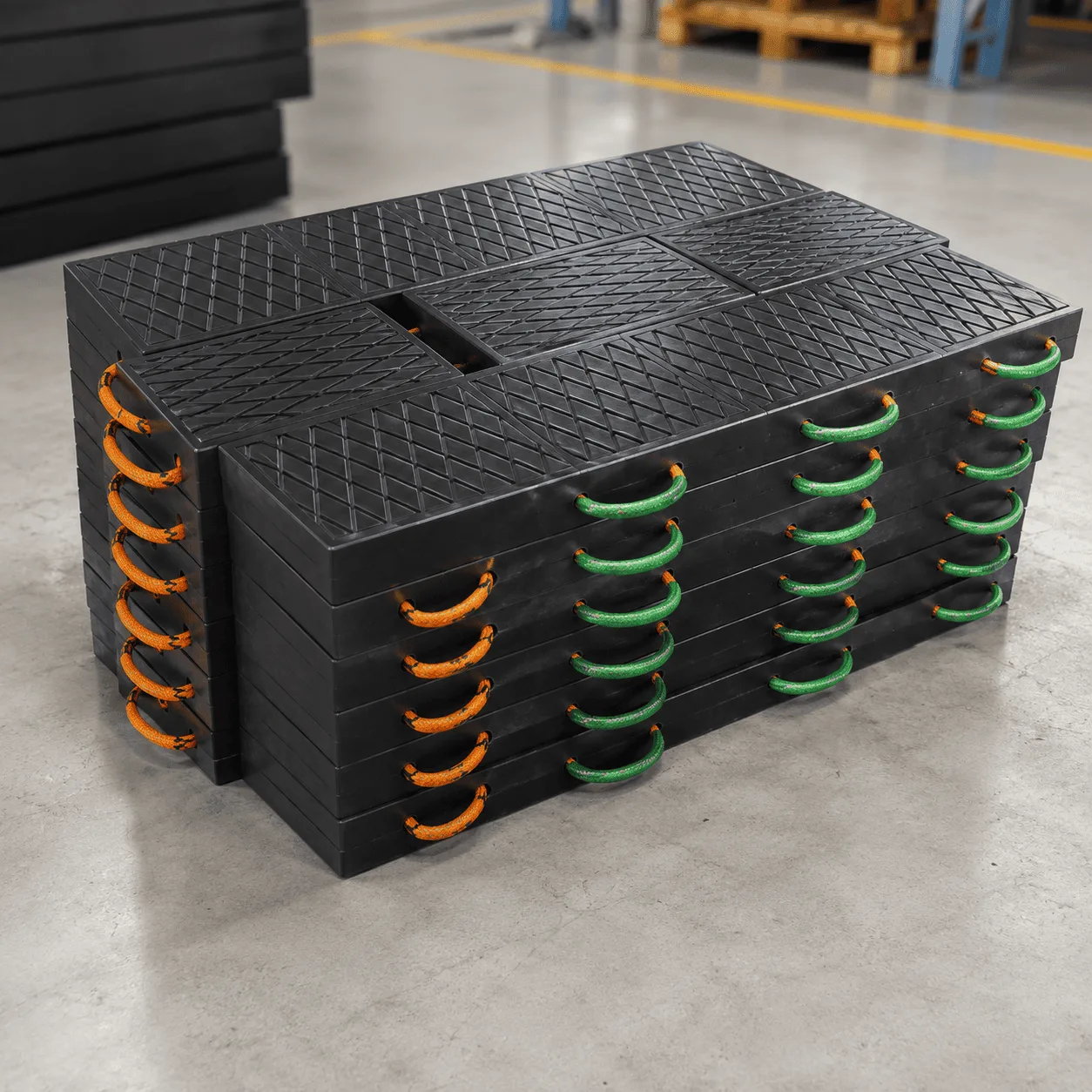
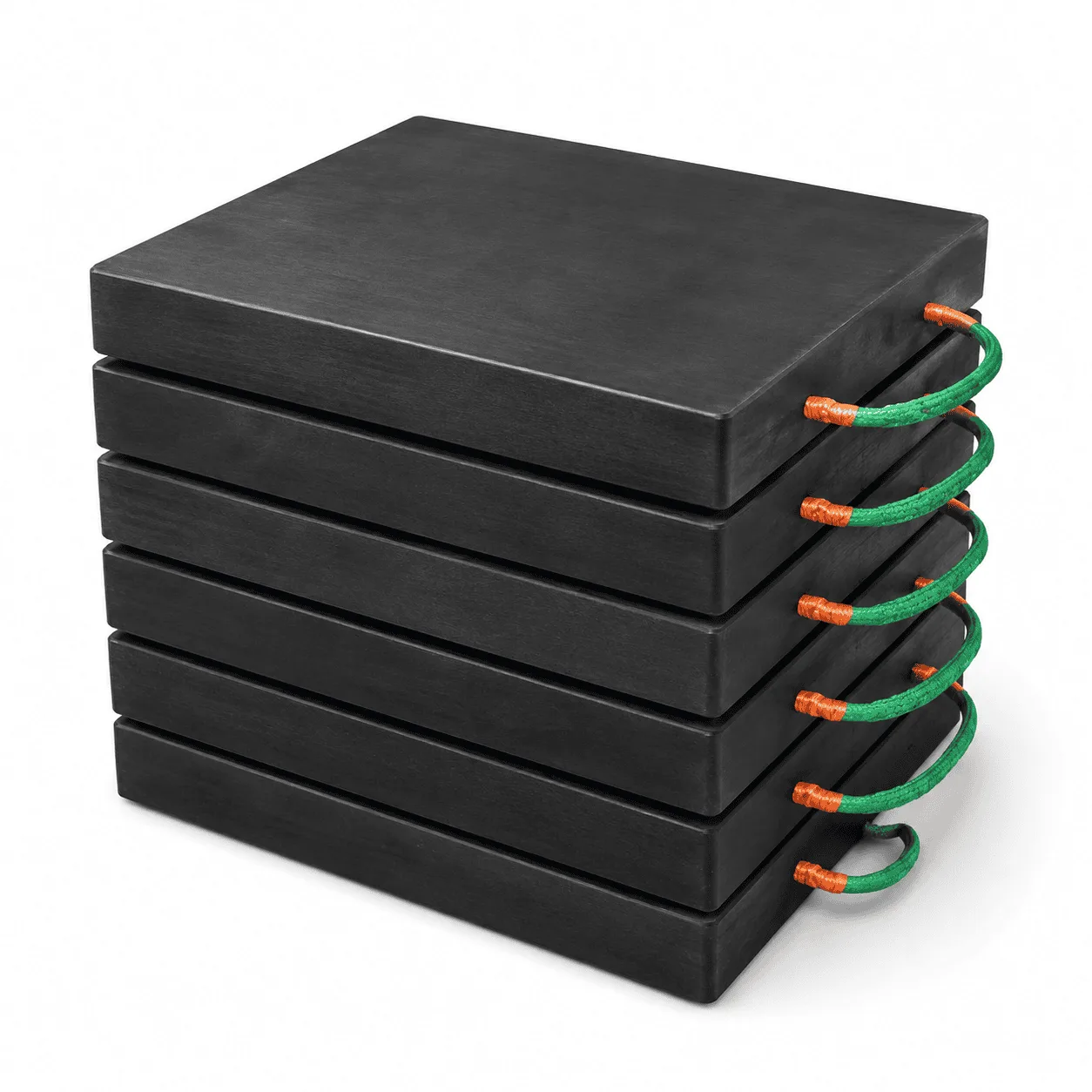
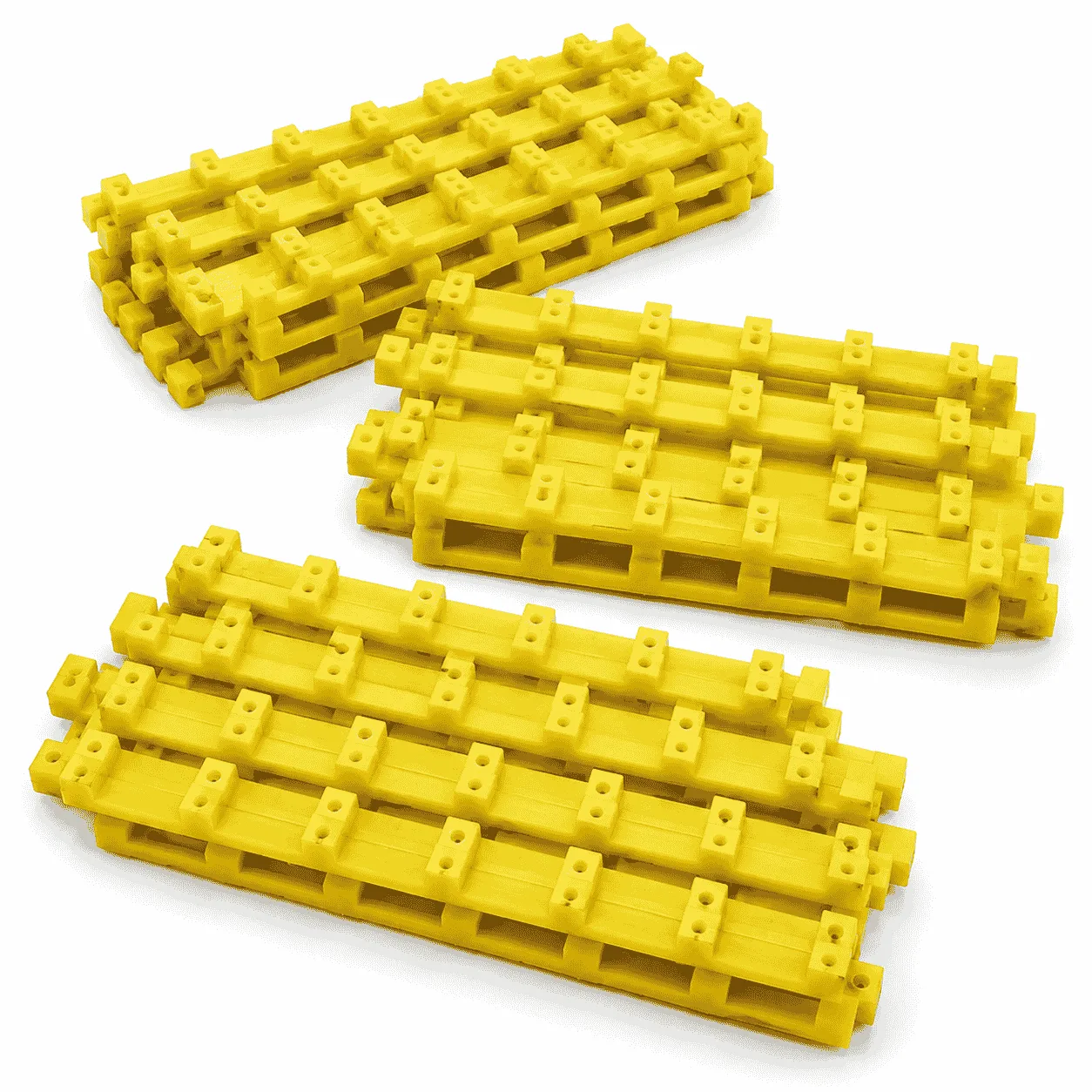
The product shown features solid square panels, raised diagonal-pattern working surfaces and multiple reinforced rope handles positioned around the outside edges. Matching pads can be stacked together as a complete equipment-support set for transportation, vehicle storage, warehouse organization and repeated equipment setup.
This product series can be manufactured from ultra-high-molecular-weight polyethylene or high-density polyethylene according to the required dimensions, thickness, equipment reaction, handling frequency and operating conditions. Although UHMWPE and HDPE both belong to the polyethylene family, their impact resistance, abrasion performance, stiffness and finished-product cost are not identical.
Unlike temporary roadway mats that are installed continuously to form a vehicle-access route, crane pads are positioned directly beneath individual stabilizer or outrigger feet. Their main purpose is to increase the geometric contact area between the original equipment foot and the supporting surface.
The exact dimensions of the products shown cannot be confirmed from the photograph alone. The following specifications are practical reference sizes for solid UHMWPE or HDPE crane and outrigger support pads.
| Reference Pad Size | Reference Thickness | Typical Application |
|---|---|---|
| 400 × 400 mm | 30–40 mm | Compact stabilizers and smaller service equipment |
| 500 × 500 mm | 40–50 mm | Utility vehicles and compact crane support |
| 600 × 600 mm | 40–60 mm | General mobile cranes and boom trucks |
| 700 × 700 mm | 50–60 mm | Medium stabilizer-support requirements |
| 800 × 800 mm | 60–80 mm | Concrete pumps and medium heavy equipment |
| 900 × 900 mm | 60–80 mm | Larger cranes and pump-truck stabilizers |
| 1000 × 1000 mm | 80–100 mm | Large mobile-equipment support |
| 1200 × 1200 mm | 80–100 mm | Large cranes and heavy-equipment stabilizers |
| 1500 × 1500 mm | 100–150 mm | Special large-format support applications |
The approximately 400 × 400 × 30–40 mm and 500 × 500 × 40–50 mm formats provide compact support options where equipment-storage space and repeated positioning are important.
The approximately 600 × 600 × 40–60 mm format provides a practical balance between geometric support area, panel thickness, finished product weight and vehicle-storage requirements.
Medium-size products such as approximately 700 × 700 × 50–60 mm and 800 × 800 × 60–80 mm provide broader support areas for mobile cranes, concrete pumps, boom trucks and utility equipment.
Larger panels such as approximately 900 × 900 × 60–80 mm, 1000 × 1000 × 80–100 mm and 1200 × 1200 × 80–100 mm require additional consideration for transportation, finished weight, vehicle storage and handling methods.
Large-format solid panels measuring approximately 1500 × 1500 × 100–150 mm can have substantial finished weights. Suitable mechanical handling equipment may therefore be required during transportation, storage and positioning.
These dimensions are reference product options rather than universal safe-working-load ratings. Final dimensions and thickness should be selected according to the maximum individual stabilizer reaction, original equipment-foot dimensions, required effective support area, selected polyethylene grade, panel stiffness and supporting surface condition.
| Specification | Typical Reference |
|---|---|
| Product type | Crane and heavy-equipment outrigger support pad |
| Material options | UHMWPE or HDPE |
| Main shape | Square |
| Alternative shapes | Rectangular, round and clipped-corner formats |
| Working surface | Raised diagonal or cross-pattern surface |
| Reference size range | Approximately 400 × 400 mm to 1500 × 1500 mm |
| Reference thickness | Approximately 30–150 mm |
| Handling structure | Multiple reinforced rope handles |
| Storage structure | Stackable matching support-pad sets |
| Main applications | Mobile cranes, concrete pumps, boom trucks and heavy machinery |
Final dimensions, thickness, polyethylene grade, surface-pattern depth, outside shape, edge design and handle arrangement should always be matched to the actual equipment and operating requirements.
A major handling feature of UHMWPE HDPE Crane Pads is the use of several reinforced rope handles positioned around the panel edges.
Multiple gripping positions can make it easier to:
The handle structure may include braided synthetic rope, protective grip sleeves and reinforced attachment points passing through the polyethylene panel.
Before moving a support pad, inspect:
The carrying handles are intended for transportation and positioning. They should not be treated as structural components carrying the crane, stabilizer or equipment reaction.
The presence of several handles does not mean every solid panel can safely be lifted by one person. Larger products may require coordinated team handling or suitable mechanical handling equipment.
The product shown uses a repeating diagonal or cross-pattern structure across the primary working surface.
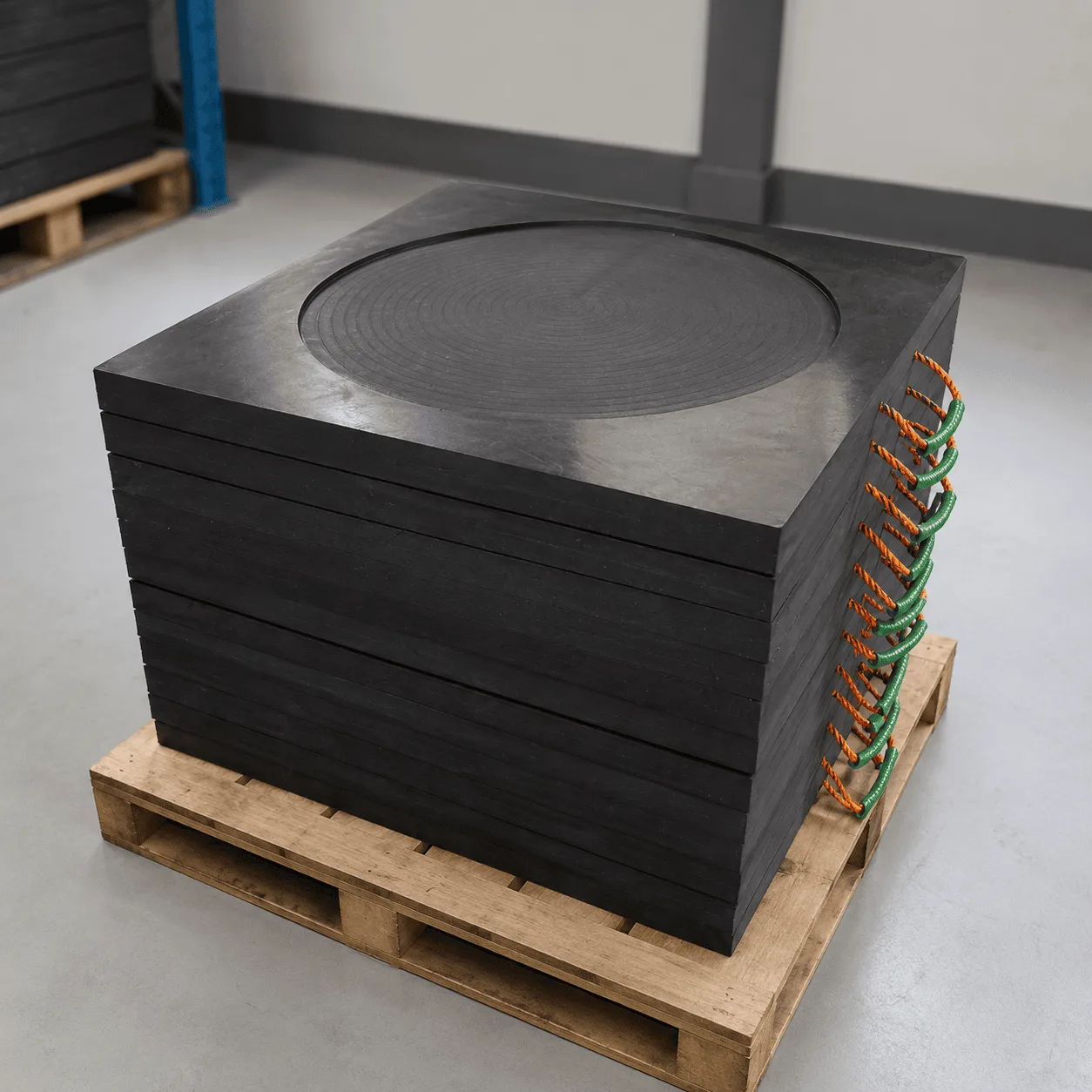
The intersecting raised lines create a clearly identifiable upper face and distinguish the product from completely smooth, circular-recessed, concentric-grooved and interlocking support products.
The textured working surface can provide:
The raised pattern should not be treated as a replacement for correct pad sizing, appropriate panel thickness, suitable supporting ground or correct equipment-foot positioning.
Mud, oil, gravel, stones, metal fragments and other hard debris should be removed from the textured working surface before equipment load is applied.
The reference image shows several matching square support panels stacked together as a complete equipment-support set.
A stackable structure can help with:
The products should normally be stacked for transportation and storage. Multiple flat crane pads should not automatically be placed on top of one another beneath an operating stabilizer unless the complete support arrangement has been properly evaluated.
The storage surface should be reasonably level and suitable for the combined weight of the complete stack.
Hard stones, gravel and metal fragments should be removed before stacking to reduce concentrated contact points and unnecessary surface damage.
The square panel structure provides a practical geometric support area beneath round, square or rectangular stabilizer feet.
A solid square support pad can provide:
The original stabilizer foot should remain within the intended working area of the support pad. A foot positioned close to an unsupported outside edge creates a different loading condition from one positioned within the main central area.
The support panel should not bridge a large unsupported void, deep depression, unstable edge or unsuitable opening.
UHMWPE stands for ultra-high-molecular-weight polyethylene. It is a thermoplastic polyethylene containing extremely long molecular chains and is associated with high toughness, strong impact performance, extremely low moisture absorption, low friction and good abrasion resistance.
For a general material explanation, see the Wikipedia article about ultra-high-molecular-weight polyethylene.
Practical UHMWPE characteristics for reusable crane-support products include:
UHMWPE can be considered where repeated handling, impact exposure, outdoor operation and abrasion resistance are important.
HDPE stands for high-density polyethylene. It is a thermoplastic polymer commonly associated with a relatively high strength-to-density ratio, low water absorption and resistance to many solvents.
For a general material explanation, see the Wikipedia article about high-density polyethylene.
Practical HDPE characteristics for crane-pad applications include:
Material properties can vary according to the selected grade, manufacturing process, product dimensions, operating temperature and service conditions.
Chemical resistance should not be interpreted as universal resistance to every substance. Actual compatibility depends on the exact chemical, concentration, exposure temperature, contact time and selected polyethylene grade.
The correct material for UHMWPE HDPE Crane Pads should be selected according to actual equipment and operating requirements rather than product appearance alone.
Important considerations include:
UHMWPE is generally considered where particularly high impact toughness and abrasion resistance are required. HDPE can provide a practical combination of strength, durability and finished-product weight for many general equipment-support applications.
Crane support pads are repeatedly transported, positioned, loaded, recovered and stored.
During regular operation, the panels may experience:
The selected polyethylene grade should provide suitable impact and wear performance for the intended equipment-support application.
Products showing visible cracks, severe deformation, deep cuts, damaged surface patterns or loose rope-attachment points should be evaluated before returning to demanding service.
Mobile cranes, concrete pumps, boom trucks and utility vehicles frequently operate outdoors.
The support panels may be exposed to:
The low moisture absorption of UHMWPE and HDPE makes these materials practical for reusable support products operating in wet and changing environments.
The support pads should still be cleaned and inspected after wet, muddy or contaminated operation.
A hydraulic stabilizer transfers a concentrated reaction through a relatively small original equipment foot.
UHMWPE HDPE Crane Pads create a larger geometric contact area beneath that foot.
The performance of the complete support arrangement depends on:
A larger outside dimension provides a larger geometric footprint, but panel dimensions alone should not be treated as a universal safe-working-load rating.
The correct support pad should not be selected only according to total machine weight or maximum rated crane capacity.
Individual outrigger reactions can change according to:
Important selection factors include:
Each stabilizer position should be evaluated independently because loads and supporting conditions can differ around the same machine.
Two support pads with identical outside dimensions can respond differently when their thicknesses or polyethylene grades are different.
For example, a 600 × 600 mm support panel may be considered as:
An 800 × 800 mm support panel may be considered as:
Panel thickness can affect:
The final thickness should be selected according to the actual stabilizer reaction, original equipment-foot dimensions, required support area, selected polyethylene grade and supporting surface condition.
UHMWPE HDPE Crane Pads can be used with many types of stabilizer-equipped machinery.
The correct panel dimensions, thickness, material grade and handle arrangement should always be matched to the actual equipment-support point.
Mobile crane outrigger reactions can vary according to boom direction, working radius, lifted load, crane geometry and outrigger extension.
Before selecting a crane pad, consider:
The same crane may require different support arrangements at different operating locations or configurations.
Concrete pumps and boom trucks use hydraulic stabilizers to create a wider equipment base during operation.
Important selection factors include:
Each stabilizer position should be evaluated independently because reactions and supporting conditions may differ around the same vehicle.
Correct positioning is essential when using UHMWPE HDPE Crane Pads.
Before applying equipment load, confirm that:
The textured working surface should remain free from excessive oil, mud, gravel and metal debris.
Reusable crane pads should be inspected before every demanding equipment setup.
Check:
A damaged support pad should be separated and evaluated before returning to crane or heavy-equipment service.
After operation, remove mud, sand, gravel, oil and other debris from the primary working surfaces.
Cleaning can help:
During storage:
You can also view our complete range of crane outrigger pads for mobile cranes, concrete pumps, boom trucks, hydraulic stabilizer systems, cribbing products and other heavy machinery applications.
UHMWPE HDPE Crane Pads provide a practical equipment-support solution for mobile cranes, truck-mounted cranes, concrete pumps, boom trucks and other stabilizer-equipped machinery.
The product combines solid polyethylene construction, raised diagonal working surfaces, multiple reinforced rope handles and a stackable square-panel design.
Typical reference specifications include approximately 400 × 400 × 30–40 mm, 500 × 500 × 40–50 mm, 600 × 600 × 40–60 mm, 700 × 700 × 50–60 mm, 800 × 800 × 60–80 mm, 1000 × 1000 × 80–100 mm and 1200 × 1200 × 80–100 mm.
Final dimensions, thickness, UHMWPE or HDPE material grade, effective support area, surface pattern and handle arrangement should always be selected according to the maximum individual stabilizer reaction, original equipment-foot dimensions, supporting surface condition and actual operating requirements.
Check drawings for full specifications and confirm materials according to service conditions to prevent product defects.
Inspect all key processing steps and fully verify dimensions, holes, grooves and fitting surfaces.
Deburr, chamfer and clean products for easy installation. Ensure uniform quality among batch products.
Choose appropriate packaging solutions based on product features to protect goods from collision, deformation and mixing during transit.
Unlike metal parts, engineering plastic components still require strict control over dimensions, holes, edges, surface, materials and assembly performance for equipment use.
Engineering plastic parts suit friction, guide, support, buffer, anti-corrosion and insulation areas. We supply UHMWPE, POM, PA, PP/PE components for conveyor, food, mining, machinery, chemical and cable systems, with custom OEM service available.
Stay updated with our latest industry insights, company updates and featured articles.

Engineering plastics are increasingly used in industrial machinery, automated production lines, conveyor systems, packaging equipment, and food-processing machines. Materials such as nylon, UHMWPE, POM, and

Both are lightweight, corrosion-resistant, wear-resistant, and suitable for CNC machining. However, they perform very differently

Wear is a common cause of failure in conveyor systems, packaging machinery, automated equipment, mining

CNC machining is widely used to produce plastic prototypes, low-volume parts, replacement components, jigs, fixtures,

Both are lightweight, corrosion-resistant, wear-resistant, and suitable for CNC machining. However, they perform very differently

Wear is a common cause of failure in conveyor systems, packaging machinery, automated equipment, mining

CNC machining is widely used to produce plastic prototypes, low-volume parts, replacement components, jigs, fixtures,
Need UHMWPE sheets & custom plastic machined/OEM parts?Send specs & material needs, free quote within 24h.