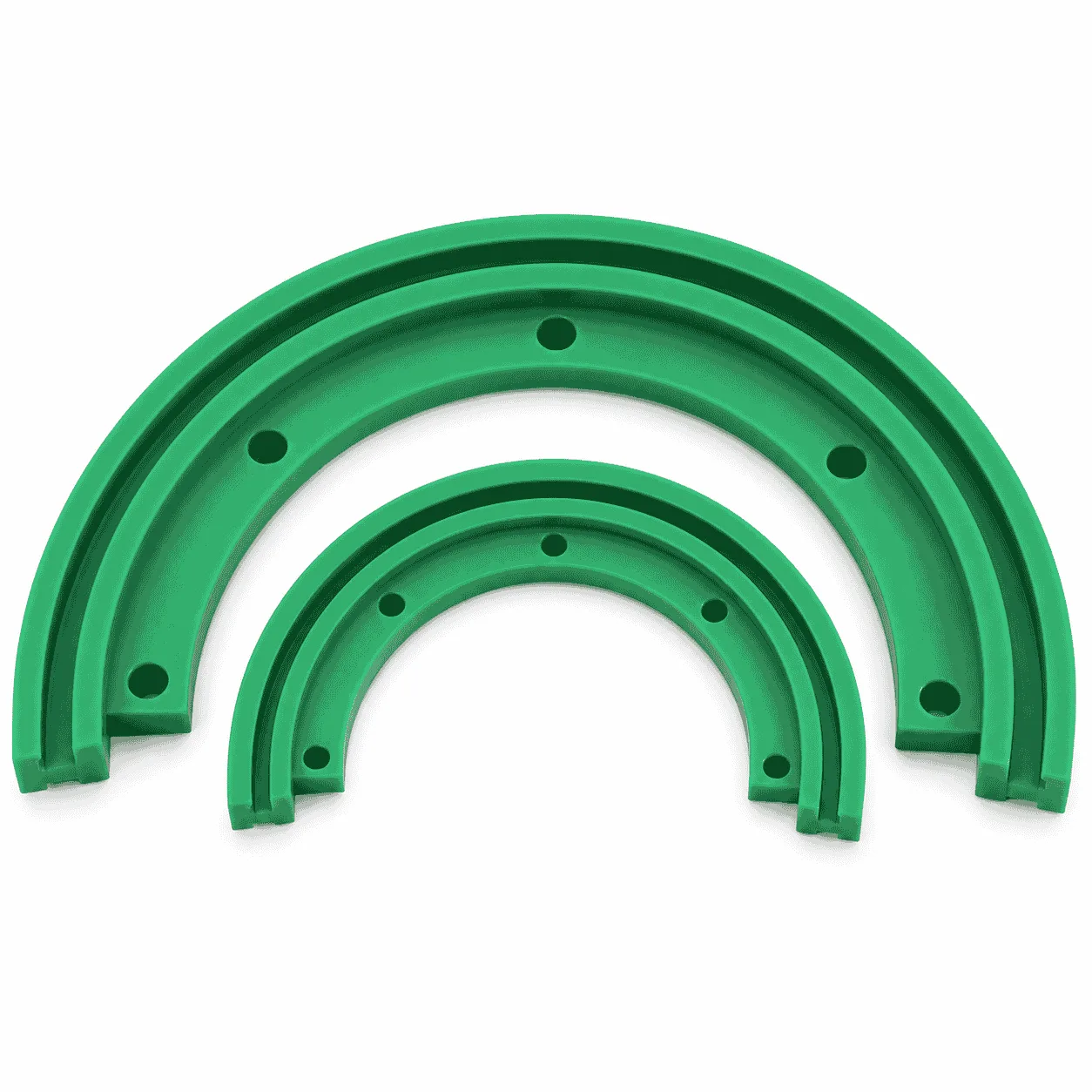
Curved Chain Guide Rail is a low-friction, wear-resistant UHMWPE guide used for conveyor turns, curved transitions and controlled roller-chain paths. Available profiles include CKG, K, Double-K, L, Recessed, Three-Rib, Raised, CT, T, Double-Row T and Triple-Row T types. Radius, angle, grooves, mounting holes, slots and metal supports can be produced according to chain specifications and installation drawings.
Curved Chain Guide Rail is a wear-resistant engineering plastic component designed to support, position and guide roller chains through straight sections, horizontal turns, curved transitions and special conveyor paths. The guide creates a controlled running surface for the chain, helping reduce lateral movement, vibration, operating noise and direct contact between the steel chain and the metal machine frame.
This product is commonly manufactured from ultra-high-molecular-weight polyethylene, also known as UHMWPE, PE1000 or UPE. The material combines low surface friction, excellent abrasion resistance, high impact toughness, low moisture absorption and useful resistance to many industrial chemicals.
These properties make an UHMWPE Curved Chain Guide Rail suitable for continuously operating chain conveyors, packaging machinery, material-handling equipment, automated production lines and mechanical transmission systems.
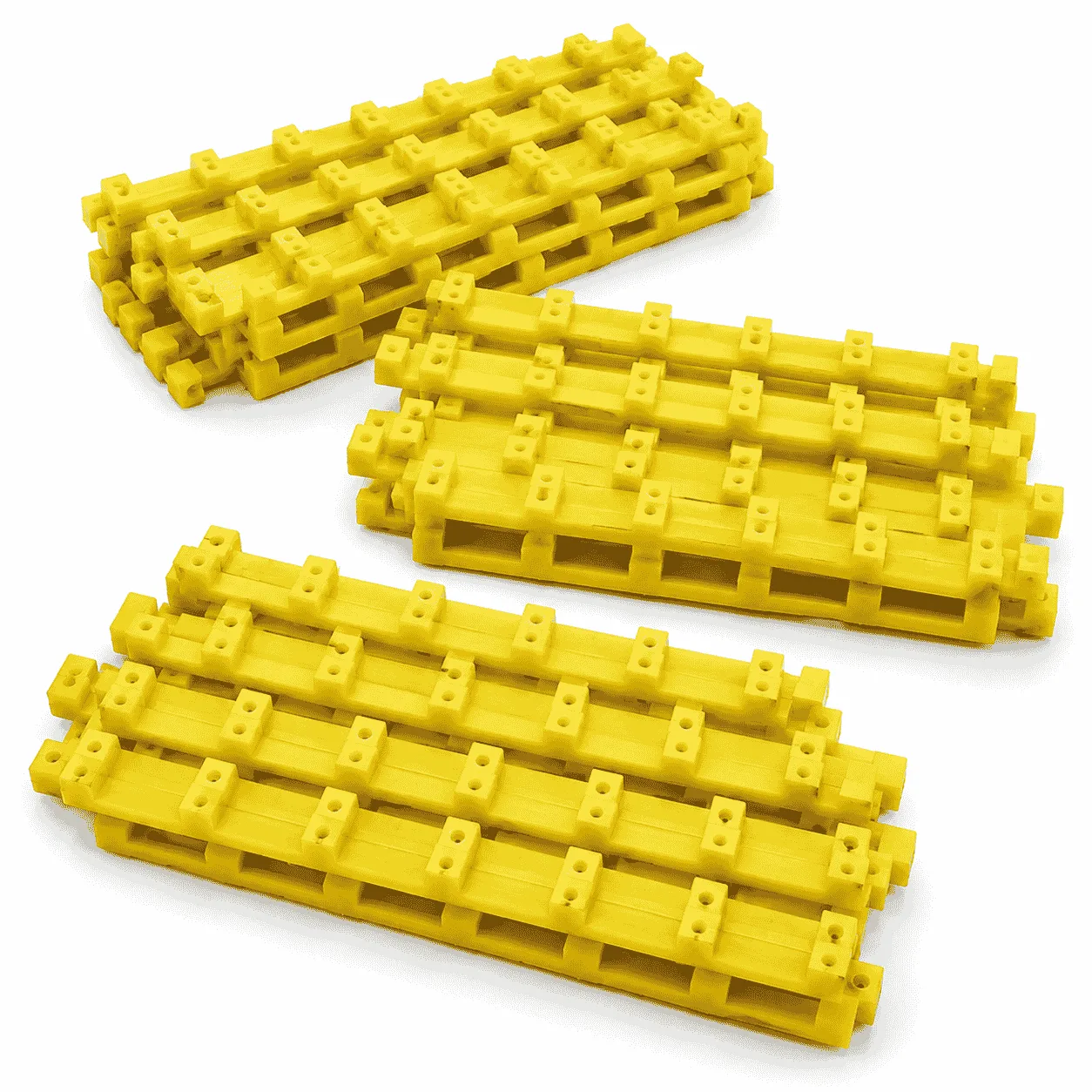
The reference image mainly shows available cross-sectional profiles and straight sample sections. A finished curved guide must be produced according to the required turning radius, turning angle, chain dimensions and installation drawing.
Depending on the selected profile and radius, curved sections may be CNC machined from UHMWPE sheet or block, divided into accurately matched segments, or assembled with a supporting metal structure.
Customers can view the available raw material range on our
UHMWPE Sheet
page. Curved grooves, mounting holes, slots, steps and special-shaped profiles can be produced through our
CNC Plastic Machining
service. Additional equipment applications are available on our
Conveyor Systems
page.
For general information about the material, refer to the
Wikipedia explanation of ultra-high-molecular-weight polyethylene.
Information about roller-chain construction and operation is available in the
Wikipedia explanation of roller chain.
The supplied product image shows 12 manufacturable product examples. Because the image includes two K-type displays, it represents 12 product displays rather than 12 completely independent universal profile standards.
The model names identify the general cross-sectional structure. They do not represent fixed international dimensions. Different manufacturers may use similar model names for profiles with different widths, heights and groove dimensions.
Final production of a Curved Chain Guide Rail must therefore be based on a confirmed cross-sectional drawing, chain specification, equipment dimensions or physical sample.
| Display No. | Profile Type | Reference Structure | Typical Selection Consideration |
|---|---|---|---|
| 1 | CKG Type | UHMWPE insert assembled inside a C-shaped metal support channel | Suitable for supported installations requiring a replaceable plastic running surface |
| 2 | K Type | Solid rectangular profile with an enclosed or partially enclosed chain groove | Suitable for direct mounting and applications requiring a rigid guide body |
| 3 | Double-K Type | Combined profile containing two parallel K-shaped guide positions | Suitable for two parallel chains or paired conveyor paths |
| 4 | L Type | Raised side-wall profile with an L-shaped supporting section | Suitable for side guidance, chain positioning and edge-support structures |
| 5 | Recessed Type | Solid guide with a recessed center running channel | Suitable for keeping the chain centered while allowing open access from above |
| 6 | K Type Variant | Alternative K-type profile with parallel chain-guide examples | Profile dimensions must be confirmed according to the required chain model |
| 7 | Three-Rib Type | Wide profile with a center running groove and raised supporting ribs | Suitable for wider roller chains requiring increased lateral support |
| 8 | Raised Type | Narrow raised running surface supporting the chain from below | Suitable for compact structures where the chain rollers run over a central raised section |
| 9 | CT Type | UHMWPE guide insert assembled with a C-shaped metal backing rail | Suitable for modular frames and guide sections requiring convenient replacement |
| 10 | T Type | Wide flat profile with a central raised T-shaped guide surface | Suitable for standard single-row chain support and open conveyor layouts |
| 11 | Double-Row T Type | Wide guide profile containing two parallel chain-running positions | Suitable for duplex conveying arrangements or two synchronized chains |
| 12 | Triple-Row T Type | Wide guide profile containing three parallel chain-running positions | Suitable for multi-row chain systems requiring common supporting alignment |
Available reference options include CKG Type, K Type, Double-K Type, L Type, Recessed Type, Three-Rib Type, Raised Type, CT Type, T Type, Double-Row T Type and Triple-Row T Type, together with an additional K-type display variant.
Curved Chain Guide Rail can be produced for straight chain paths, horizontal conveyor turns, vertical transitions and combined straight-to-curved sections. The manufacturing method depends on the required cross-section, turning radius, total length and mounting arrangement.
A straight plastic profile should not be forced into a small radius without confirming the material thickness and cross-sectional structure. Excessive forced bending may deform the running groove, reduce chain clearance or create continuous stress around the mounting points.
The following parameters should be confirmed before manufacturing a curved guide section:
The chain centerline radius is particularly important. Selecting the guide by measuring only the inner or outer edge may cause the actual chain path to differ from the sprocket or conveyor centerline.
The guide profile can be evaluated for single-row, double-row and multi-row roller chains. However, the chain model alone is not sufficient to determine the finished guide groove.
The following chain information should be supplied:
Roller chains require correct tension, sprocket alignment and suitable lubrication. The low-friction UHMWPE surface reduces guide-contact resistance, but it does not replace lubrication required between the chain pins, bushings and rollers.
Curved Chain Guide Rail is commonly used in machinery where a roller chain must follow a controlled straight or curved path.
Typical applications include:
Green is a common identification color for conveyor components, but the color alone does not indicate food-contact compliance, anti-static performance, flame retardancy or another special material property. These requirements must be confirmed using the appropriate material grade and supporting documentation.
When a roller chain enters a conveyor turn without suitable support, it may move laterally, vibrate, rub against the equipment frame or fail to follow the required centerline. The load placed on the guide normally increases at a curved section because the chain generates lateral force while changing direction.
A correctly designed Curved Chain Guide Rail provides continuous support around the turn. The running groove maintains the chain position, distributes contact over a controlled surface and reduces direct impact on the supporting frame.
The guide can help address the following operating problems:
The guide cannot compensate for incorrectly positioned sprockets, excessive chain tension, an unsuitable chain design or serious installation errors. The complete transmission and conveyor structure must be checked as one system.
The guide may be produced from compression-moulded UHMWPE sheet, thick plate, block or preformed straight profiles.
Available processing operations include:
Customers can provide 2D drawings, 3D models, chain samples, existing guide samples or equipment installation measurements. When producing replacement parts from a worn sample, the running groove should be checked carefully because its width and depth may already differ from the original dimensions.
UHMWPE has a higher thermal expansion rate than steel. Long straight guides and curved sections should therefore include suitable installation clearance, particularly when the operating temperature changes significantly.
Mounting holes or elongated adjustment slots may be designed to permit controlled dimensional movement. Fixing every mounting point rigidly without considering thermal expansion can cause the guide to bow, twist or place excessive stress on the fasteners.
The appropriate clearance depends on the guide length, temperature range, mounting structure and profile geometry. Final values should be confirmed according to the actual application rather than applying one universal allowance to every product.
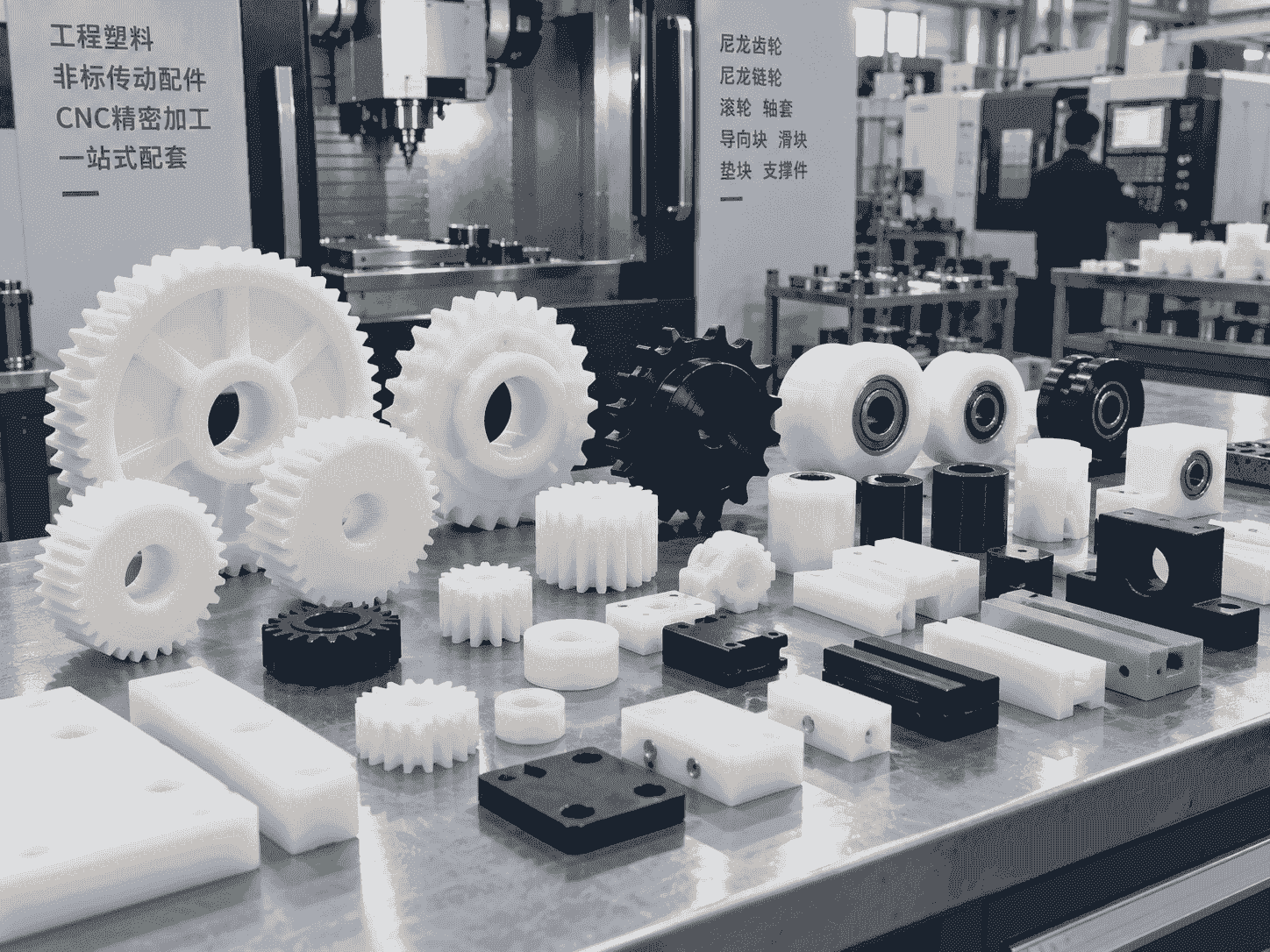
We have experience machining UHMWPE chain guides, curved guide rails, wear strips, sliding profiles, chain-support blocks and other special-shaped engineering plastic components.
Our factory is equipped with cutting machines, CNC machining centers, milling equipment, drilling equipment and dimensional inspection tools. We can process individual replacement components, small batches and continuous production orders.
Before production, we can review the chain model, guide profile, turning radius, chain clearance, mounting position and support structure according to the customer’s operating conditions. This helps reduce problems such as incorrect groove width, unsuitable radius, poor section alignment, chain jamming and mounting-hole errors.
During production, important dimensions including the profile cross-section, running groove, radius, turning angle, hole position, fitting surface and overall length are inspected. Finished components are deburred, cleaned and packaged according to their structure to support consistent batch quality and scheduled delivery.
It is used to support and position roller chains through conveyor turns, curved transitions and other controlled chain paths in packaging, material-handling and industrial machinery.
UHMWPE or PE1000 is commonly used because it provides low friction, excellent wear resistance, good impact strength and low moisture absorption.
Many displayed profiles can be evaluated for curved production, but feasibility depends on the profile cross-section, material thickness, turning radius and machining method. A dimensional drawing is required before production can be confirmed.
Reference options include CKG, K, Double-K, L, Recessed, Three-Rib, Raised, CT, T, Double-Row T and Triple-Row T types. The reference image also shows two K-type examples.
Yes. Depending on the design, the UHMWPE running profile can be assembled with stainless-steel, galvanized-steel or another specified support structure.
Yes. Drilling, counterboring, elongated slots, steps, grooves and special end structures can be produced according to the installation drawing.
No. UHMWPE reduces friction between the chain and guide surface, but the chain pins, bushings and rollers may still require lubrication according to the chain manufacturer’s instructions.
No. Green is primarily a product-identification color. Food-contact applications require a confirmed food-grade material and corresponding compliance documentation.
Check drawings for full specifications and confirm materials according to service conditions to prevent product defects.
Inspect all key processing steps and fully verify dimensions, holes, grooves and fitting surfaces.
Deburr, chamfer and clean products for easy installation. Ensure uniform quality among batch products.
Choose appropriate packaging solutions based on product features to protect goods from collision, deformation and mixing during transit.
Unlike metal parts, engineering plastic components still require strict control over dimensions, holes, edges, surface, materials and assembly performance for equipment use.

Engineering plastic parts suit friction, guide, support, buffer, anti-corrosion and insulation areas. We supply UHMWPE, POM, PA, PP/PE components for conveyor, food, mining, machinery, chemical and cable systems, with custom OEM service available.
Stay updated with our latest industry insights, company updates and featured articles.

Engineering plastics are increasingly used in industrial machinery, automated production lines, conveyor systems, packaging equipment, and food-processing machines. Materials such as nylon, UHMWPE, POM, and

Both are lightweight, corrosion-resistant, wear-resistant, and suitable for CNC machining. However, they perform very differently

Wear is a common cause of failure in conveyor systems, packaging machinery, automated equipment, mining

CNC machining is widely used to produce plastic prototypes, low-volume parts, replacement components, jigs, fixtures,

Both are lightweight, corrosion-resistant, wear-resistant, and suitable for CNC machining. However, they perform very differently

Wear is a common cause of failure in conveyor systems, packaging machinery, automated equipment, mining

CNC machining is widely used to produce plastic prototypes, low-volume parts, replacement components, jigs, fixtures,

Need UHMWPE sheets & custom plastic machined/OEM parts?Send specs & material needs, free quote within 24h.