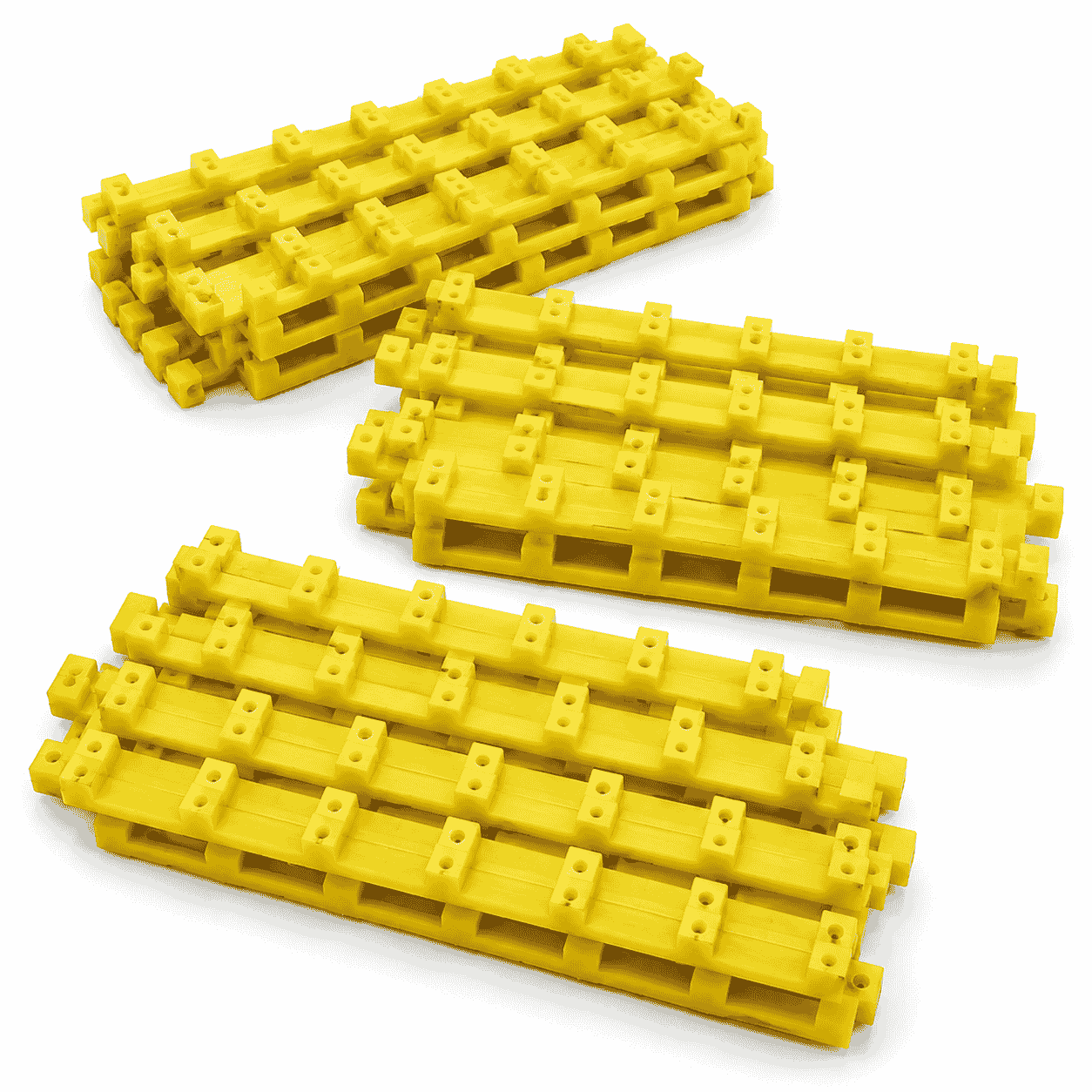


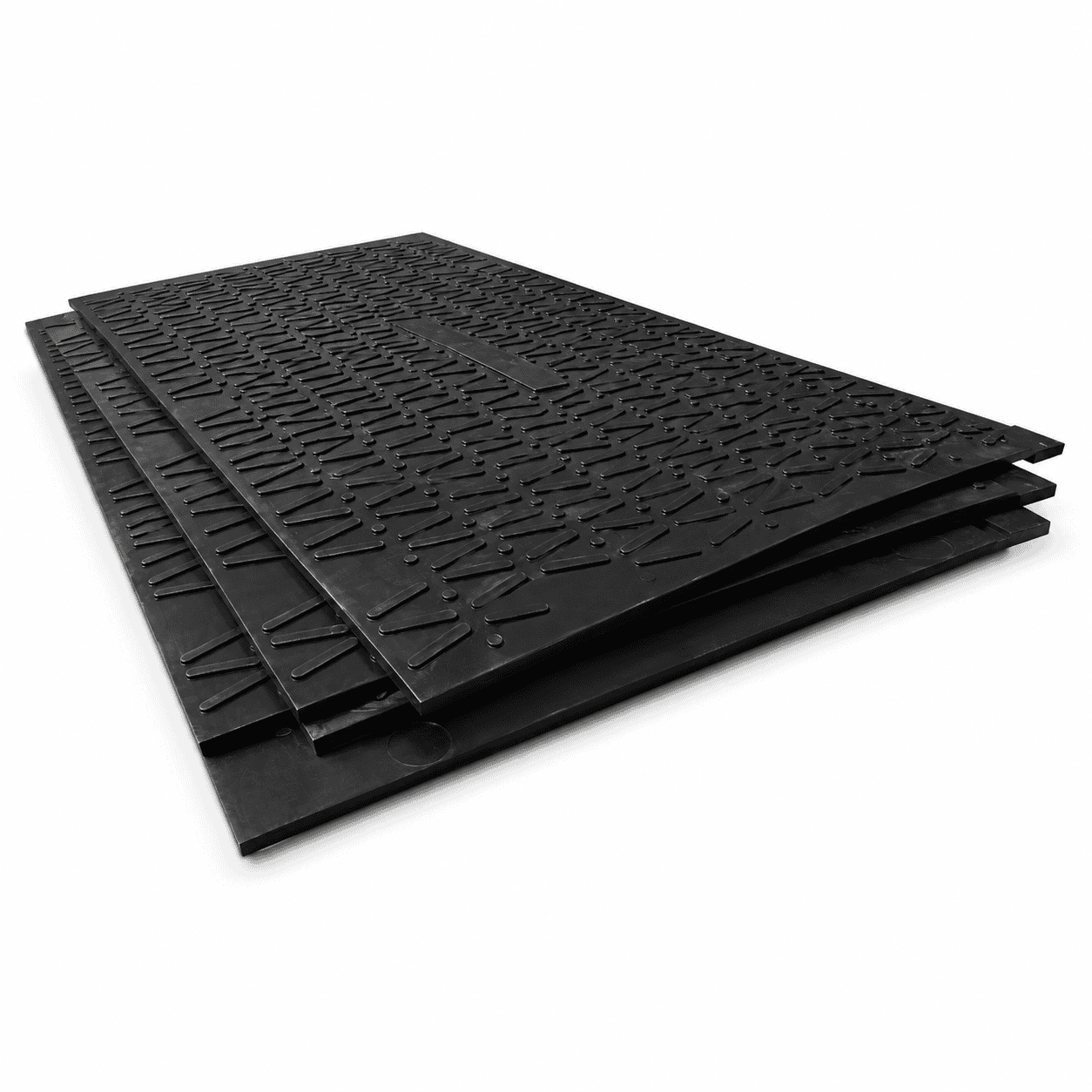
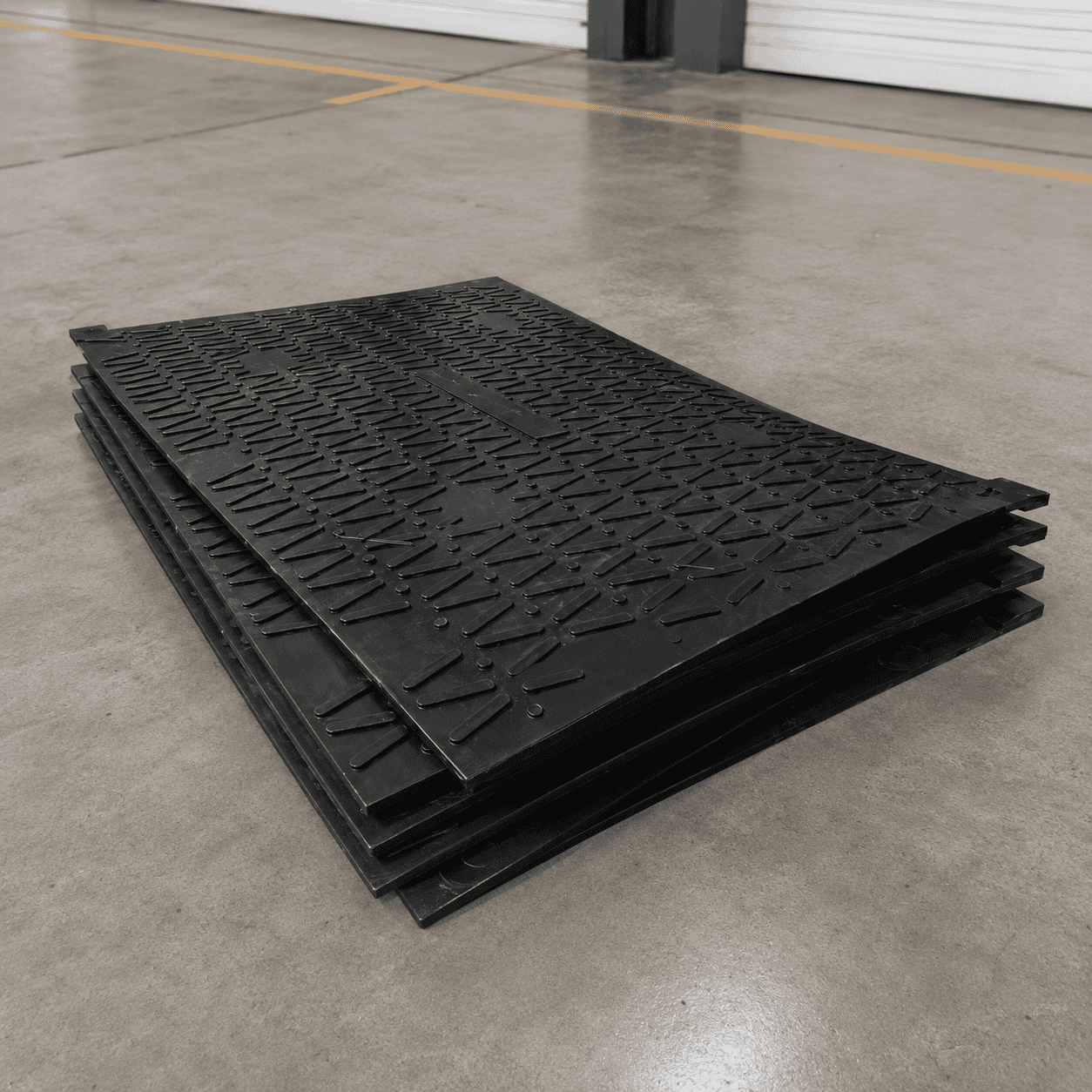
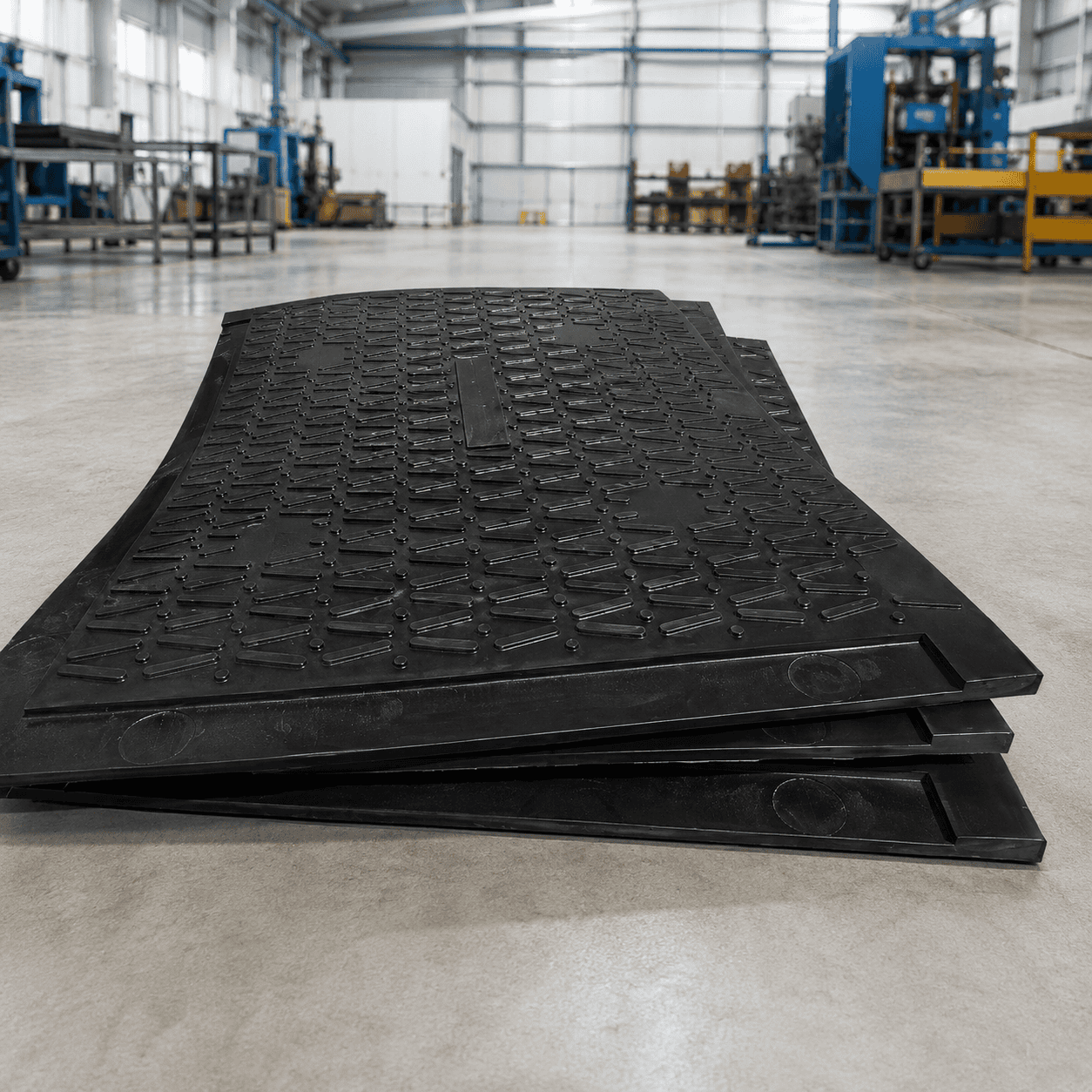
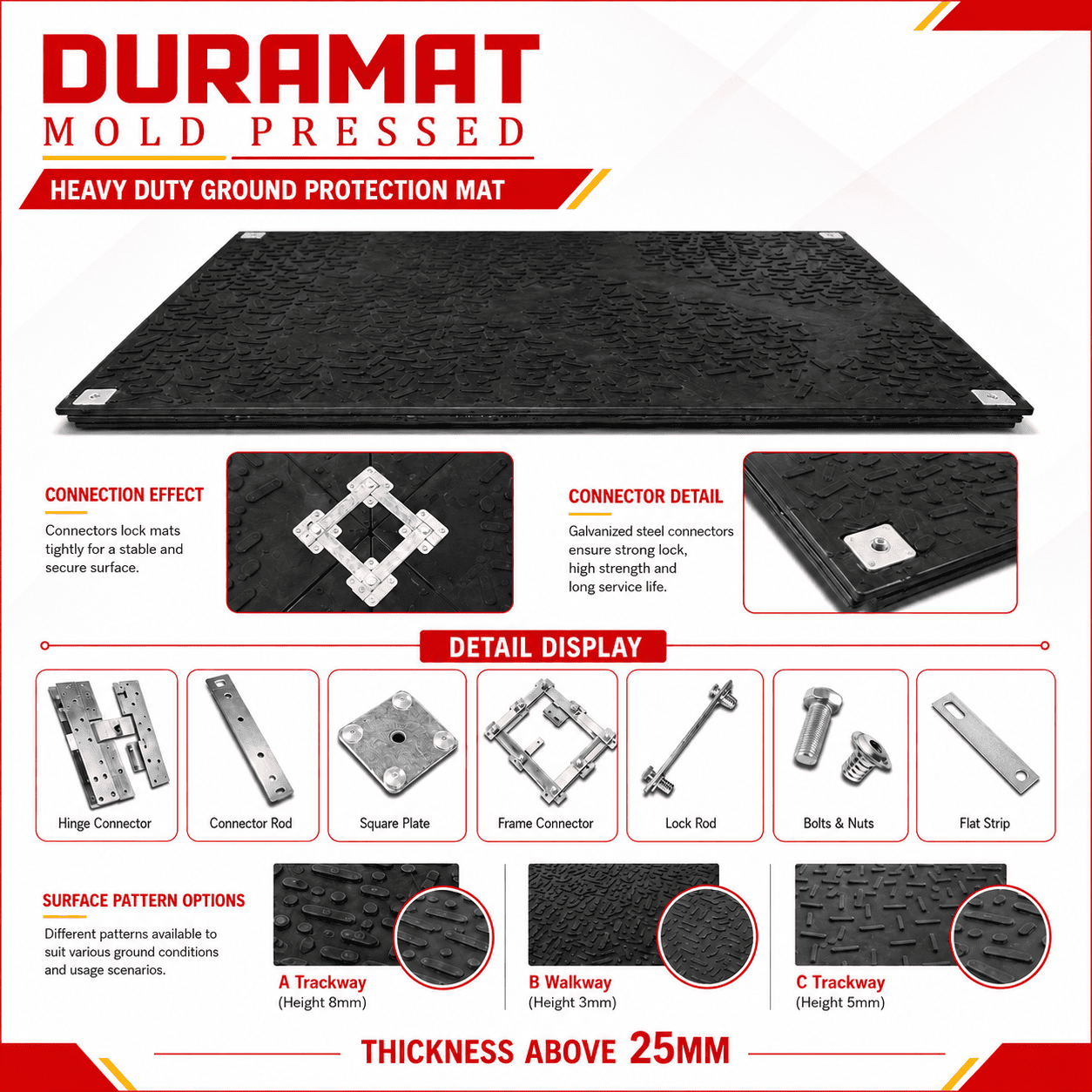
Heavy Duty Polyethylene Road Mats are large-format temporary access panels designed for heavy vehicle routes, equipment movement, working areas, and ground protection across mud, soft soil, grass, sand, and other difficult outdoor surfaces.
The main XP05 model measures approximately 4000 × 2000 × 38 mm, weighs around 312 kg, provides approximately 8 m² of nominal coverage, and has a listed stated load capacity of approximately 150 tonnes under suitable ground and installation conditions.
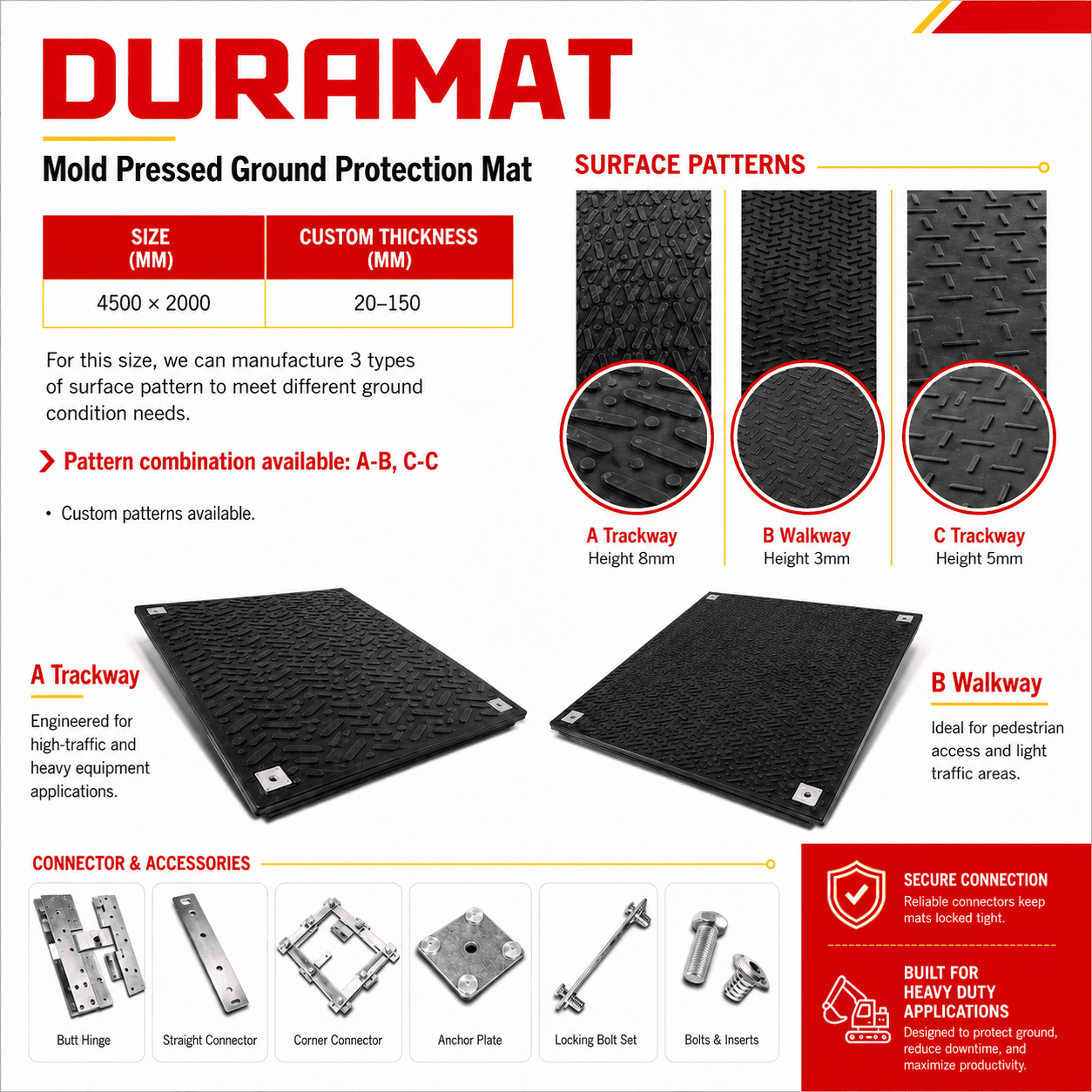
The product family is available with Type A 8 mm trackway, Type B 3 mm walkway, and Type C 5 mm trackway surface patterns for different vehicle and access requirements.
Heavy Duty Polyethylene Road Mats are large-format temporary access panels designed to create vehicle routes, equipment access lanes, protected working surfaces, and removable road systems across mud, soft soil, wet ground, grass, sand, gravel, and other difficult outdoor surfaces.
The main product featured on this page measures approximately 4000 × 2000 × 38 mm. Each panel weighs around 312 kg, provides approximately 8 m² of nominal surface coverage, and has a stated load capacity of approximately 150 tonnes under suitable ground, support, connection, and operating conditions.
The large one-piece panel structure reduces the number of individual units required to create a temporary access route. A single 4 m × 2 m panel covers a substantial section of ground while maintaining a modular format that can be installed, removed, transported, stored, and reused.
Heavy Duty Polyethylene Road Mats are suitable for heavy vehicle access, mobile equipment movement, industrial transport routes, utility operations, power projects, energy access, remote outdoor operations, temporary working areas, and other applications where permanent paving is unnecessary or impractical.
The complete product range also includes several alternative panel sizes from approximately 3000 × 2500 × 25 mm to 6000 × 2000 × 40 mm, with listed stated load classes from approximately 120 tonnes to 180 tonnes.
The XP05 model is the main specification used for this product page because its dimensions directly match the 4 m × 2 m temporary road mat format.
| Item | Specification |
|---|---|
| Model | XP05 |
| Panel Size | 4000 × 2000 mm |
| Thickness | 38 mm |
| Approx. Weight | 312 kg |
| Nominal Coverage | Approx. 8 m² |
| Stated Load Capacity | 150 tonnes |
| Material | Polyethylene-Based Engineering Plastic |
| Structure | Large One-Piece Panel |
| Surface Options | Trackway and Walkway Patterns |
| Typical Application | Heavy Vehicle and Equipment Access |
The 4000 × 2000 mm dimensions provide approximately 8 m² of nominal coverage per panel. Ten panels can therefore provide approximately 80 m² of nominal panel area before allowance for connection layout, route geometry, turning areas, and installation requirements.
The approximately 312 kg panel weight means suitable lifting and handling equipment should be considered during installation and removal.
The listed 150-ton stated load capacity should not be treated as a universal guarantee for every vehicle, every route, or every type of ground.
Actual operating performance depends on factors including:
A distributed vehicle load operating on firm ground creates a very different condition from a concentrated wheel load on deeply saturated or unsupported soil.
The complete product family includes five listed specifications. These models provide different combinations of panel length, width, thickness, weight, surface coverage, and stated load capacity.
| Model | Panel Size | Thickness | Approx. Weight | Stated Load Capacity |
|---|---|---|---|---|
| XP01 | 3000 × 2500 mm | 38 mm | 293 kg | 150 tonnes |
| XP02 | 4500 × 2000 mm | 38 mm | 351 kg | 150 tonnes |
| XP03 | 6000 × 2000 mm | 40 mm | 492 kg | 180 tonnes |
| XP04 | 3000 × 2500 mm | 25 mm | 195 kg | 120 tonnes |
| XP05 | 4000 × 2000 mm | 38 mm | 312 kg | 150 tonnes |
The XP01 model measures approximately 3000 × 2500 × 38 mm. It provides approximately 7.5 m² of nominal surface coverage, weighs around 293 kg, and has a listed stated load capacity of approximately 150 tonnes.
The XP02 model measures approximately 4500 × 2000 × 38 mm. It covers approximately 9 m², weighs around 351 kg, and has a stated load class of approximately 150 tonnes.
The largest and highest-rated listed model is XP03. It measures approximately 6000 × 2000 × 40 mm, weighs around 492 kg, provides approximately 12 m² of nominal coverage, and has a listed stated load capacity of approximately 180 tonnes.
The XP04 specification measures approximately 3000 × 2500 × 25 mm. It weighs approximately 195 kg and has a stated load class of approximately 120 tonnes.
The XP05 model measures approximately 4000 × 2000 × 38 mm. With approximately 8 m² of nominal coverage, a unit weight of approximately 312 kg, and a listed 150-ton load class, it is the main reference model for this product page.
Heavy Duty Polyethylene Road Mats use a large one-piece polyethylene-based panel structure instead of conventional assembled timber access surfaces.
The one-piece design creates a continuous surface across each individual panel and reduces the number of separate units required for a long temporary road.
A large panel format can provide practical advantages including:
The final operating performance depends on material formulation, panel thickness, production quality, surface pattern, ground support, traffic type, connection arrangement, and installation method.
The product should therefore be selected as part of a complete temporary access system rather than by panel dimensions alone.
One of the important features of Heavy Duty Polyethylene Road Mats is the availability of different surface structures.
The reference product information shows three principal pattern options:
These surface patterns use different raised heights and are designed for different traffic requirements.
Type A is a heavy-duty trackway surface with an approximate raised height of 8 mm.
The deeper pattern is designed for demanding vehicle access routes where greater tyre or track interaction is preferred.
Typical applications may include:
The 8 mm surface provides the most pronounced raised structure among the three listed pattern options.
Type B is identified as a walkway surface with an approximate raised height of 3 mm.
The lower-profile pattern can be used where a less aggressive surface is preferred.
Possible applications include:
The 3 mm raised structure provides a lower-profile surface than the two trackway options.
Type C is another vehicle-oriented trackway pattern with an approximate raised height of 5 mm.
This surface provides a middle option between the 3 mm walkway structure and the 8 mm heavy trackway pattern.
Typical uses may include:
The final surface pattern should be selected according to vehicle type, expected traffic, ground condition, route slope, weather, and traction requirements.
The reference product information also shows different pattern combinations for the panel surfaces.
Available combinations include:
An A-B combination can provide different surface characteristics on opposite sides of the panel.
For example, one side may use a more aggressive 8 mm trackway pattern while the other side uses a lower-profile 3 mm walkway surface.
A C-C configuration uses the 5 mm trackway structure on both sides.
This dual-surface concept can make Heavy Duty Polyethylene Road Mats more flexible for projects with different traffic and installation requirements.
Alternative pattern arrangements may also be available according to production capability and project requirements.
The raised surface structure of Heavy Duty Polyethylene Road Mats is designed to provide greater interaction with tyres or tracks than a completely smooth plastic panel.
The traction surface can be particularly useful on routes affected by:
The raised pattern provides a more practical temporary vehicle surface than a completely smooth panel.
Actual traction performance still depends on:
Mud, oil, stones, and other excessive contamination should be removed when necessary because heavy surface contamination can reduce traction.
Heavy Duty Polyethylene Road Mats can be used for a broad range of demanding temporary access and ground protection applications.
Typical applications include:
The 4000 × 2000 mm format is especially useful where smaller lightweight ground protection mats do not provide enough coverage for the intended vehicles or access route.
For another temporary access option, view our HDPE Temporary Road Mats for modular vehicle routes and difficult outdoor ground conditions.
Repeated heavy vehicle traffic can quickly damage weak or saturated ground.
Tyres and tracks can create deep ruts, while continued movement can make the route increasingly unstable.
Heavy Duty Polyethylene Road Mats create a temporary physical surface between vehicles and the original ground.
The panels may be installed over:
The large 8 m² nominal panel area helps cover substantial sections of the route with each individual unit.
Extremely weak, deeply saturated, or unsupported ground may still require additional preparation before panel installation.
Depending on actual conditions, ground preparation may include:
The large panel dimensions and 38 mm thickness make the XP05 model suitable for more demanding access applications than thin lightweight protection sheets.
Depending on ground support and installation conditions, the panels may be used for:
The listed 150-ton stated load capacity should always be evaluated together with the complete temporary road system.
A vehicle using wide tyres or tracks creates a different pressure distribution from a concentrated axle load using narrow tyres.
The main XP05 Heavy Duty Polyethylene Road Mats model has a listed stated load capacity of approximately 150 tonnes under suitable conditions.
This figure should not be interpreted as a universal guarantee that every 150-ton vehicle can operate on every type of ground.
Actual performance depends on:
For concentrated equipment loads, stabilizer legs, support feet, or outriggers, separate load assessment may be required.
A small concentrated support point can create substantially higher local pressure than a vehicle load distributed through multiple large tyres or tracks.
The complete product family includes several listed load classes.
The highest listed model therefore provides a stated load class of approximately 180 tonnes under suitable ground, support, connection, and operating conditions.
The highest-rated model is not automatically the best choice for every project. Panel dimensions, transportation, lifting, installation, route geometry, ground support, and actual traffic should all be considered.
Heavy Duty Polyethylene Road Mats are manufactured from durable polyethylene-based engineering plastic suitable for repeated temporary access applications.
Practical material characteristics include:
Compared with conventional steel road plates, polyethylene-based panels do not rust during normal outdoor use.
Compared with untreated timber mats, the plastic material does not rot, splinter, or absorb moisture in the same way.
These characteristics are useful for panels that may be repeatedly installed, loaded, removed, cleaned, transported, stored, and used again.
For general information about the base material, read more about polyethylene and its material properties.
The large panel format allows Heavy Duty Polyethylene Road Mats to be used for more than single vehicle routes.
Multiple panels can also create wider protected areas for:
The total protected surface can be expanded according to the actual layout.
A single 4 m × 2 m panel provides approximately 8 m² of nominal coverage. Twenty panels can therefore provide approximately 160 m² of nominal panel area before allowance for connections and route geometry.
One of the main practical advantages of Heavy Duty Polyethylene Road Mats is their reusable design.
After a temporary road or working area is no longer required, the panels can be:
Before reuse, the following areas should be inspected:
Correct lifting, transportation, stacking, and storage procedures can help maintain the practical service life of the panels.
Selecting the correct Heavy Duty Polyethylene Road Mats requires consideration of the complete operating environment.
Important selection factors include:
The XP05 4000 × 2000 × 38 mm model is suitable where a true 4 m × 2 m panel format is preferred.
For larger route coverage and higher listed load requirements, the XP03 6000 × 2000 × 40 mm model provides approximately 12 m² of nominal coverage and a listed 180-ton load class.
For a lighter configuration, the XP04 3000 × 2500 × 25 mm model weighs approximately 195 kg and has a listed load class of approximately 120 tonnes.
The final model should be selected according to the actual route, traffic, ground, lifting, transportation, and operating requirements.
Before installing Heavy Duty Polyethylene Road Mats, the proposed route should be inspected carefully.
Deep holes, unsupported voids, sharp objects, severe level differences, and standing water should be addressed before installation.
Panels should be positioned with suitable and consistent support along the main traffic route.
The selected surface pattern should match the intended traffic type.
Turning zones, braking areas, concentrated loads, and heavily used sections may require additional planning because these conditions create different forces from straight-line traffic.
Heavy Duty Polyethylene Road Mats provide a large-format temporary access solution for heavy vehicles, mobile equipment, industrial operations, utility access, energy projects, remote routes, and difficult outdoor surfaces.
The main XP05 model measures approximately 4000 × 2000 × 38 mm, weighs around 312 kg, and provides approximately 8 m² of nominal coverage.
Its listed stated load capacity is approximately 150 tonnes under suitable ground, support, connection, and operating conditions.
The complete product range includes sizes from approximately 3000 × 2500 × 25 mm to 6000 × 2000 × 40 mm, with listed load classes from approximately 120 tonnes to 180 tonnes.
With large one-piece polyethylene construction, multiple trackway and walkway surface options, raised patterns from 3 mm to 8 mm, reusable design, low water absorption, and corrosion resistance, these mats are suitable for temporary roads, heavy equipment routes, working compounds, and demanding ground protection applications.
The final model, surface pattern, route layout, load requirement, connection arrangement, and ground preparation should always be selected according to the actual operating conditions.
Check drawings for full specifications and confirm materials according to service conditions to prevent product defects.
Inspect all key processing steps and fully verify dimensions, holes, grooves and fitting surfaces.
Deburr, chamfer and clean products for easy installation. Ensure uniform quality among batch products.
Choose appropriate packaging solutions based on product features to protect goods from collision, deformation and mixing during transit.
Unlike metal parts, engineering plastic components still require strict control over dimensions, holes, edges, surface, materials and assembly performance for equipment use.
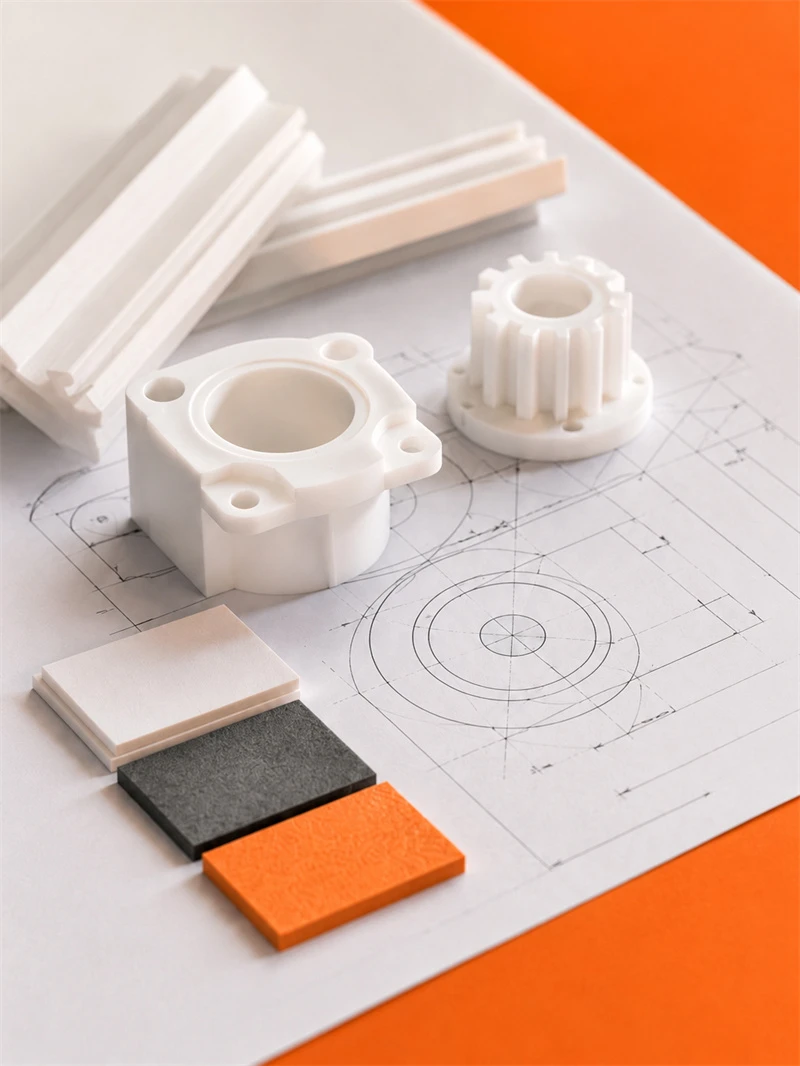
Engineering plastic parts suit friction, guide, support, buffer, anti-corrosion and insulation areas. We supply UHMWPE, POM, PA, PP/PE components for conveyor, food, mining, machinery, chemical and cable systems, with custom OEM service available.
Stay updated with our latest industry insights, company updates and featured articles.
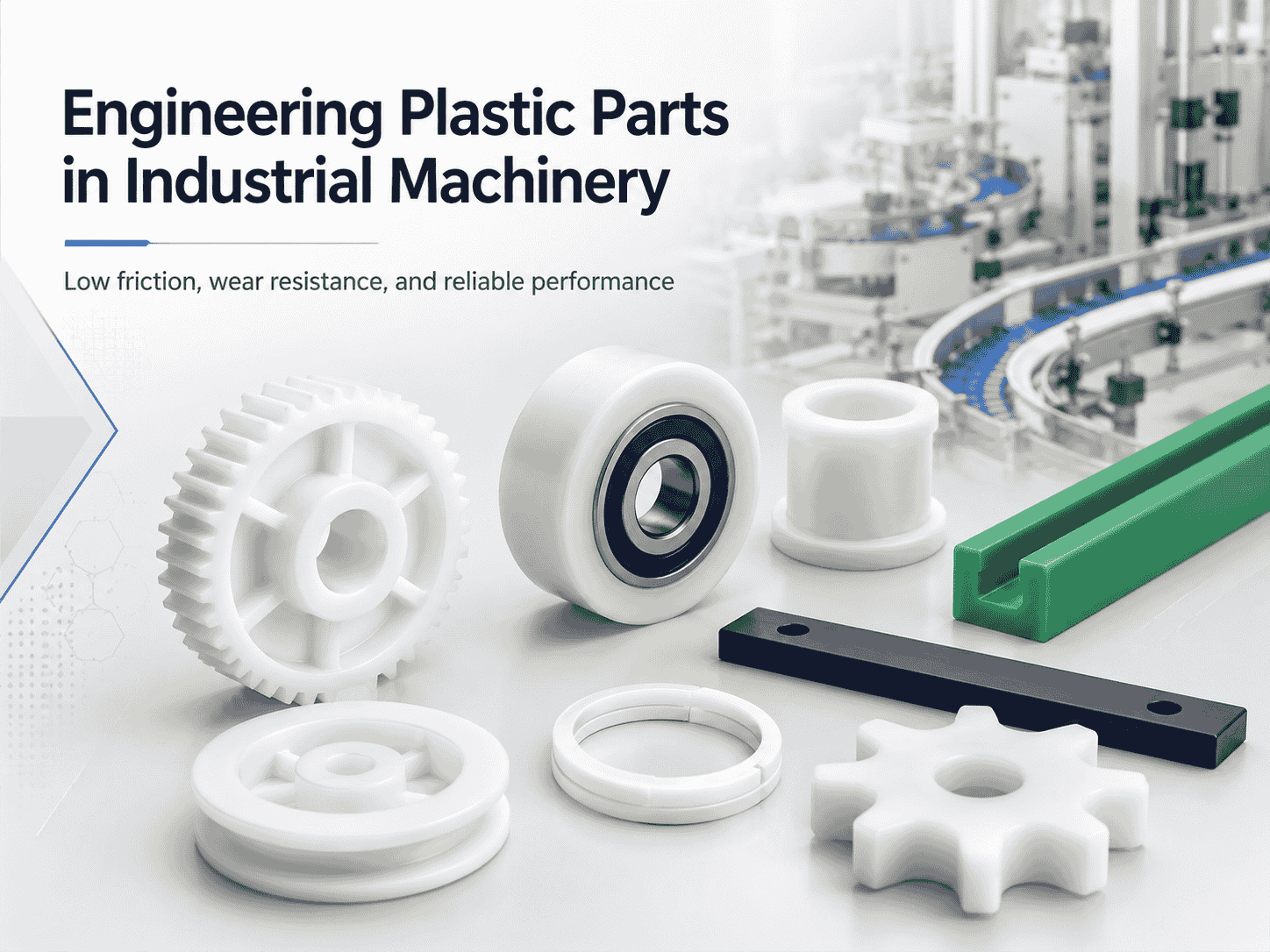
Engineering plastics are increasingly used in industrial machinery, automated production lines, conveyor systems, packaging equipment, and food-processing machines. Materials such as nylon, UHMWPE, POM, and
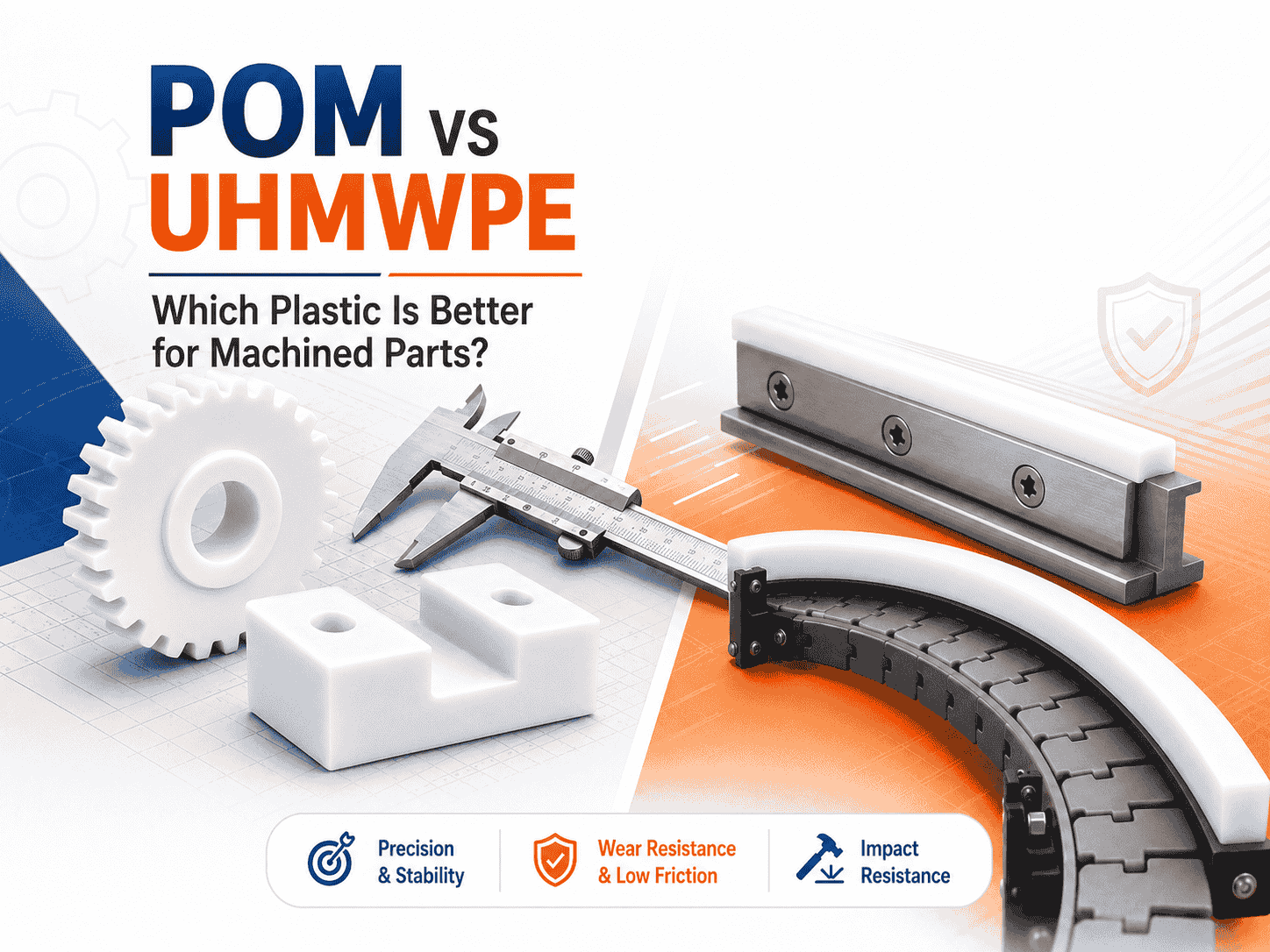
Both are lightweight, corrosion-resistant, wear-resistant, and suitable for CNC machining. However, they perform very differently
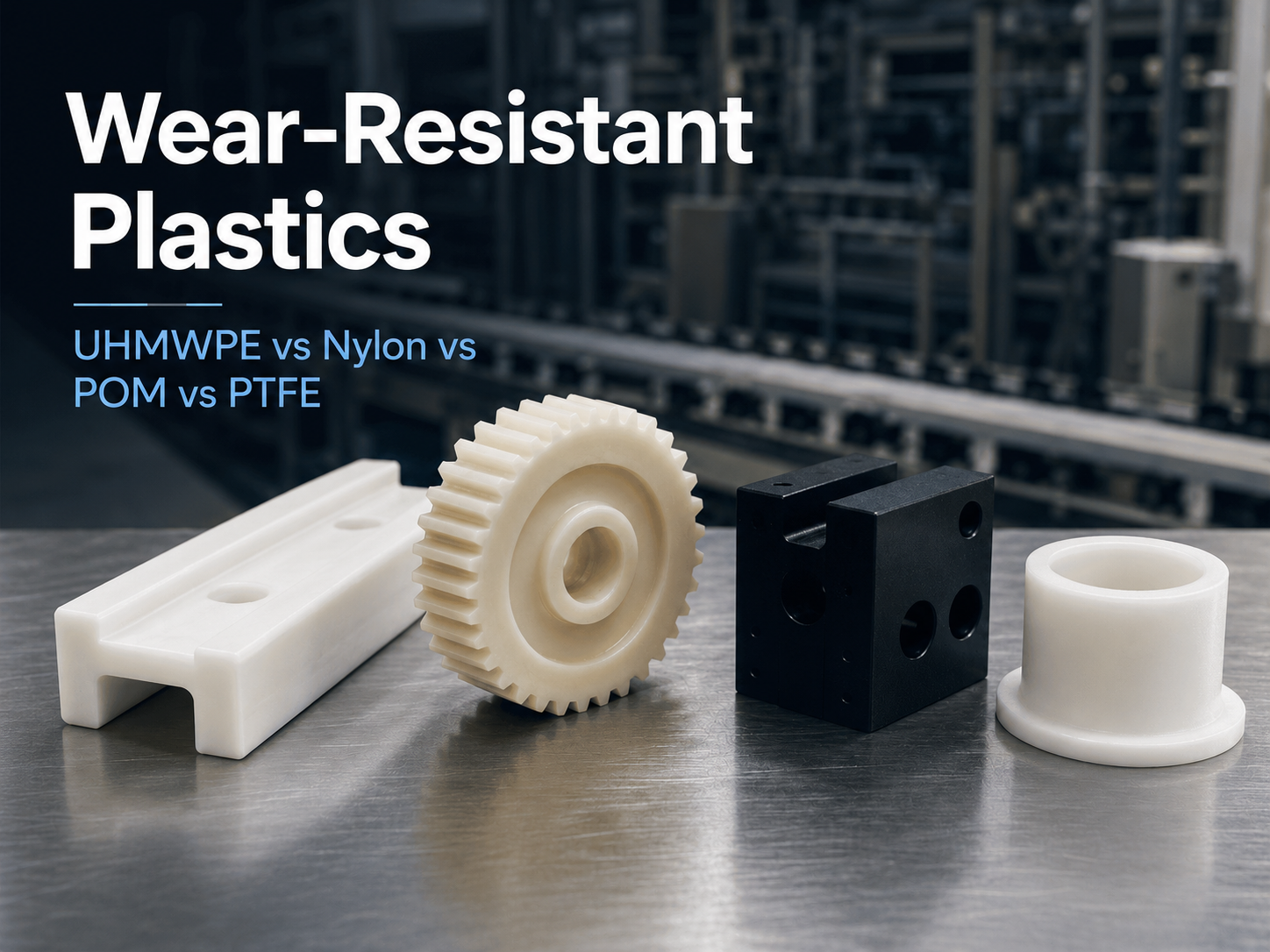
Wear is a common cause of failure in conveyor systems, packaging machinery, automated equipment, mining
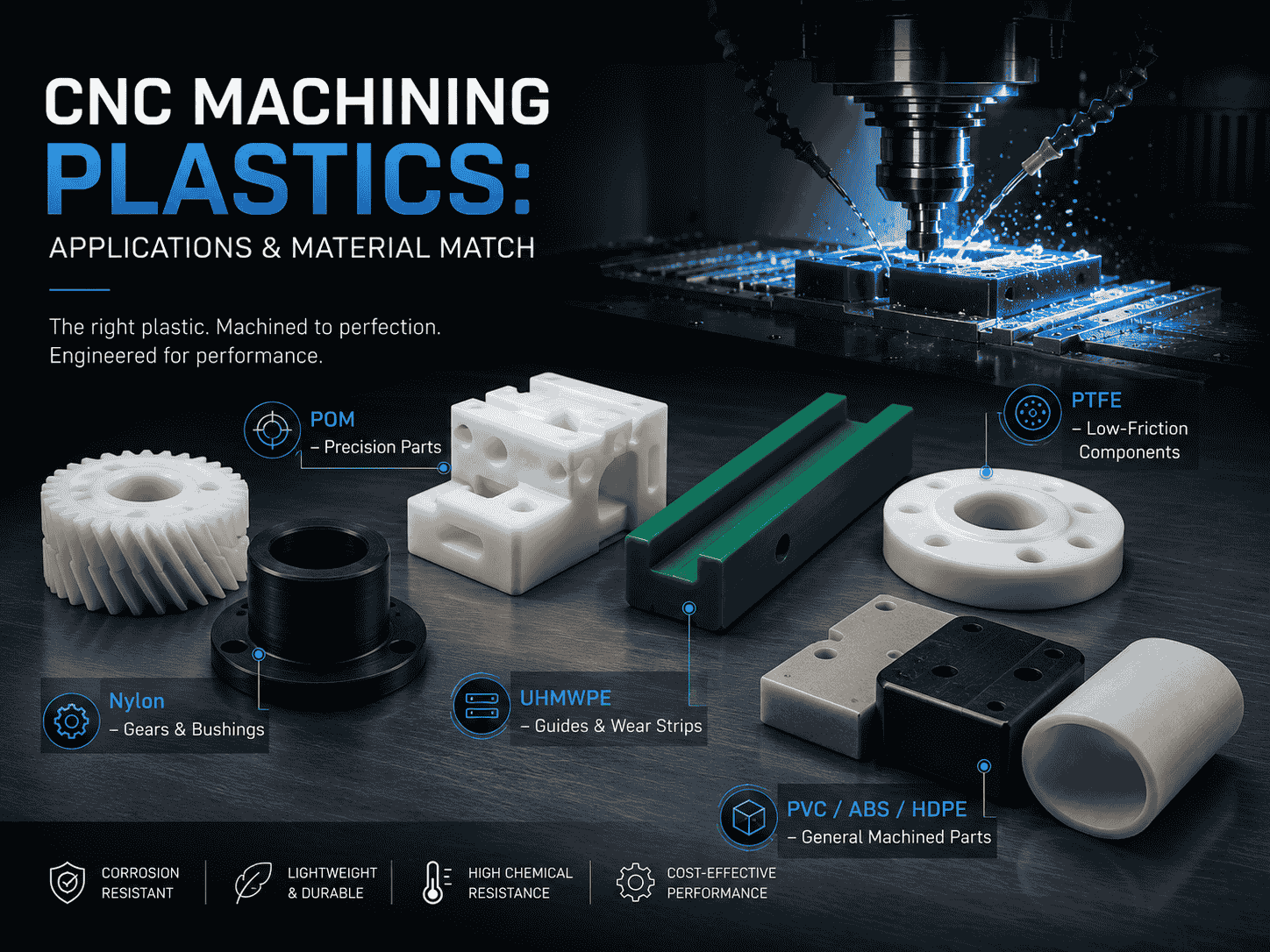
CNC machining is widely used to produce plastic prototypes, low-volume parts, replacement components, jigs, fixtures,
Both are lightweight, corrosion-resistant, wear-resistant, and suitable for CNC machining. However, they perform very differently
Wear is a common cause of failure in conveyor systems, packaging machinery, automated equipment, mining
CNC machining is widely used to produce plastic prototypes, low-volume parts, replacement components, jigs, fixtures,
Need UHMWPE sheets & custom plastic machined/OEM parts?Send specs & material needs, free quote within 24h.